

Overview:
- GLWA is constructing a 42-foot pump station in Jefferson CHalmers serving 250,000-plus regional customers.
- The neighborhood of 6,000 is 95% Black with a 47% poverty rate.
- Many residents learned about the project years after GLWA began buying properties in 2020, and the site requires zoning changes that waive minimum acreage requirements.
Planet Detroit’s Voices column includes opinion pieces from our community of partners and readers. These pieces express the voices of the authors and not necessarily those of the publication.
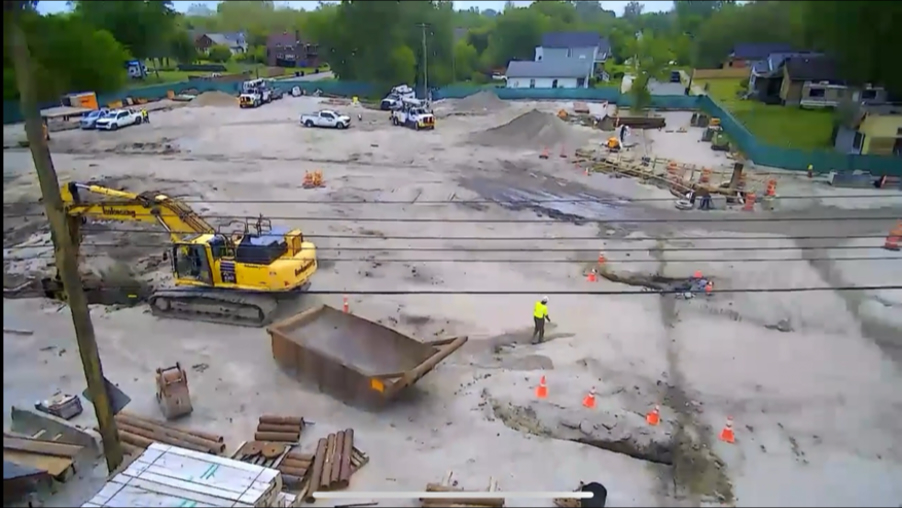
The Great Lakes Water Authority is building a 42-foot-tall sanitary pump station in Jefferson Chalmers, a residential neighborhood on Detroit’s east side. The building — taller than any home in the neighborhood — will sit in the middle of the street on a site assembled from residential parcels and vacated street right-of-way, on a block surrounded by homes.
On May 7, the Detroit City Council held a public hearing on the rezoning required for the project. It’s the last local-level approval needed, and it’s unclear whether it will be approved. Residents are hoping the council will stand with them and reject the project.
GLWA began acquiring property in August 2020, purchasing 22 parcels on Conner, Navahoe, and Algonquin over the next two years, including lots bought for as little as $3,548. Many residents say they only learned about the project years later, after site preparation and construction had already begun.
GLWA itself has acknowledged the gap: “We understand that our outreach should have started earlier and been more comprehensive,” the agency’s chief public affairs officer told Planet Detroit.
GLWA says the site is dictated by the underground infrastructure: two 16-foot relief sewers that run beneath Freud Street and must be intercepted near the existing pump station one block west. It seems numerous alternatives were dismissed.
For residents, the practical effect is that a 42-foot utility building serving more than a quarter-million people across the region is being built in a neighborhood of roughly 6,000 — one that has already absorbed the worst consequences of that system.
The site sits in the poorest and most predominantly Black section of the neighborhood. Census data for the surrounding tract is 95% Black, with 47% living in poverty. This is a community that was subjected to redlining and later to urban renewal, during which hundreds of nearby homes were taken by eminent domain and demolished. A 1993 neighborhood plan, reaffirmed in 2019, called for stabilizing housing, not industrial development.
The pump station doesn’t fit the neighborhood’s zoning. The site is zoned R2, a two-family residential district that doesn’t allow major utilities. To make the project work, the City Planning Commission recommended rezoning to a Planned Development district, a flexible classification that typically requires a minimum of 2 acres. This site falls short of that threshold; CPC waived the minimum.
The zoning ordinance classifies the pump station as a “public, civic, and institutional use,” but the building’s 42-foot height is twice as tall as most surrounding buildings and unlike anything else in this low-density residential area. Its operational footprint is similarly massive compared to the small residential lots that surround it.
The process has drawn legal scrutiny. Before the City Council voted to vacate a portion of Freud Street and adjacent alleys in July 2024, the Great Lakes Environmental Law Center wrote to the council arguing that the Department of Public Works moved the petition forward without evidence that two-thirds approval from adjacent landowners had been obtained, as required by city ordinance.
More reporting
Jefferson Chalmers residents say they were left out of GLWA’s $138M pump station project
The Great Lakes Water Authority says new pump station will improve stormwater management and prevent flooding, but residents contend the project was pushed through with little public input.
Keep reading


‘I’m still not on board’: Can GLWA’s new pump station design win over Jefferson Chalmers?
The Great Lakes Water Authority’s proposal for a five-story pump station in Detroit’s Jefferson Chalmers neighborhood, designed to blend with nearby structures, faces opposition from residents calling for better community engagement and information sharing.
Keep reading
GLELC also noted that property owners in the original A.M. Campau Subdivision plat may hold private rights to Freud Street that have not been resolved. City Council approved the vacation over those objections.
The Michigan Department of Environment, Great Lakes, and Energy issued a Finding of No Significant Impact — for a 42-foot utility facility being placed in a residential neighborhood in a community already bearing a disproportionate environmental burden.
None of this is new. As scholar Jon Cramer has written, the region’s water infrastructure has historically been used to produce and reinforce its racial divide. Detroit has long subsidized regional water infrastructure at its own expense.
As Wayne State Law Professor Peter Hammer has observed, the city subsidized the growth of the suburbs while subsidizing its own decline. Because Detroit operates a combined sewer system that carries stormwater and sewage in the same pipes, the city is charged more by GLWA than many suburban communities with separate systems.
The result: Detroiters make up roughly a quarter of GLWA’s sewerage customers but cover 40% of the regional sewerage budget. A statewide rate study found that a typical Detroit household pays about 30% more for water and sewer than a household in Troy using the same amount of water, despite being 50 miles closer to the source.
Jefferson Chalmers was hardest hit by GLWA’s system failures in June 2021, when basements flooded across the neighborhood. Longtime resident Dexter Gentry, now 71, has been dealing with sewage backups here since childhood.
The District 4 Community Advisory Council and nearly 400 residents have signed petitions opposing the GLWA project.
The water authority’s obligations should not end at the project’s fence line. If GLWA is going to build a regional facility in a community that has been harmed by the very infrastructure it builds, the authority must commit to an agreement that reverses the damage, not just with decorative brickwork and landscaping, but with direct and significant investment in housing, beautification, community facilities, local organizations, and environmental health in the neighborhood it is asking to carry this burden, commensurate with the negative impact of the project.
A multimillion-dollar investment in housing, beautification, community facilities, local organizations, and environmental health will cost GLWA consumers just pennies per month. Our community has developed such a proposal. We think we’re worth it.