

Overview:
- Academic stress is the top mental health concern among Detroit public school students, with teachers reporting daily symptoms of anxiety, fatigue and emotional overwhelm during the college application process
- Students increasingly turn to AI tools to write college essays when feeling stressed or overwhelmed, despite potential negative consequences for their applications and academic integrity
- The rise of Advanced Placement and IB courses allows students to earn GPAs above 4.0, but the competitive environment and heavy workload contribute to perfectionism and burnout among high-achieving students
by Brianna Jimenez
Emma Lee, a high school senior at Salem High School in Plymouth, was so stressed one day that she started crying at the thought of beginning her math homework.
The stress of balancing school, activities and home life reached its height during the college application process, and she felt the impact on her mental health.
“It’s kind of hard to balance school, extracurriculars, a social life and sleep,” Lee said.
Brizait Gonzalez-Rivera, a recent Cass Technical High School graduate attending George Washington University this fall, also said the college application process consumed her daily life.
“It was like a nonstop cycle: You would go to school, talk about it with your friends, go to math, start talking about it, go to English, start talking about it. Every day, it was either a workshop essay, scholarships or SAT,” Gonzalez-Rivera said.
Their stories aren’t unique for high school students, and their experience reflects a statewide trend.
OK2SAY, a Michigan safety program where students can confidentially report threatening behavior, shared in its 2025 annual report that it received the highest number of tips (1,816) from students dealing with anxiety, stress and depression.
Academic stress was also the top mental health concern identified by Detroit public school students, according to a 2021 University of Michigan Youth Policy Lab report, which surveyed 11,000 students before the pandemic.
The mental health challenges high school students face only intensify as they go through the college application process, and educators say students make academic decisions that could ultimately harm their mental health.
Looking from the outside
Dorothea Williams-Arnold, an English teacher at Cass Technical High School, said she notices mental health symptoms daily from students dealing with the college admissions process.
“Students complain all the time and are very stressed out, uncertain about their future because they have all this pressure on them, and they’re trying to maintain all these grades,” Williams-Arnold said.
She highlighted that students are noticeably more quiet and keep to themselves when they’re stressed.
“The signs that I see (from students) are poor performance, being emotional, being overwhelmed and tired,” Williams-Arnold said.
Charles Starkman, a psychologist and assistant director of Counseling and Psychological Services at the University of Michigan, said he often treats students who face symptoms of academic burnout, including harsh self-criticism, perfectionism, headaches, stomach issues and fatigue, which are often seen in school environments.
“Someone who’s really hard on themselves reports a lot of physical symptoms of stress, so they constantly have headaches, stomach issues, constant fatigue and are more likely to get sick,” Starkman said.
For Lee, she’s experienced fatigue due to long nights completing schoolwork.
“During my sophomore year, I would eat alone in an orchestra practice room (and) catch up on sleep because I would stay up pretty late to do school work,” Lee said.
Chat, help me with my college essay
When students are stressed, it can be difficult for them to find their voice for college application essays.
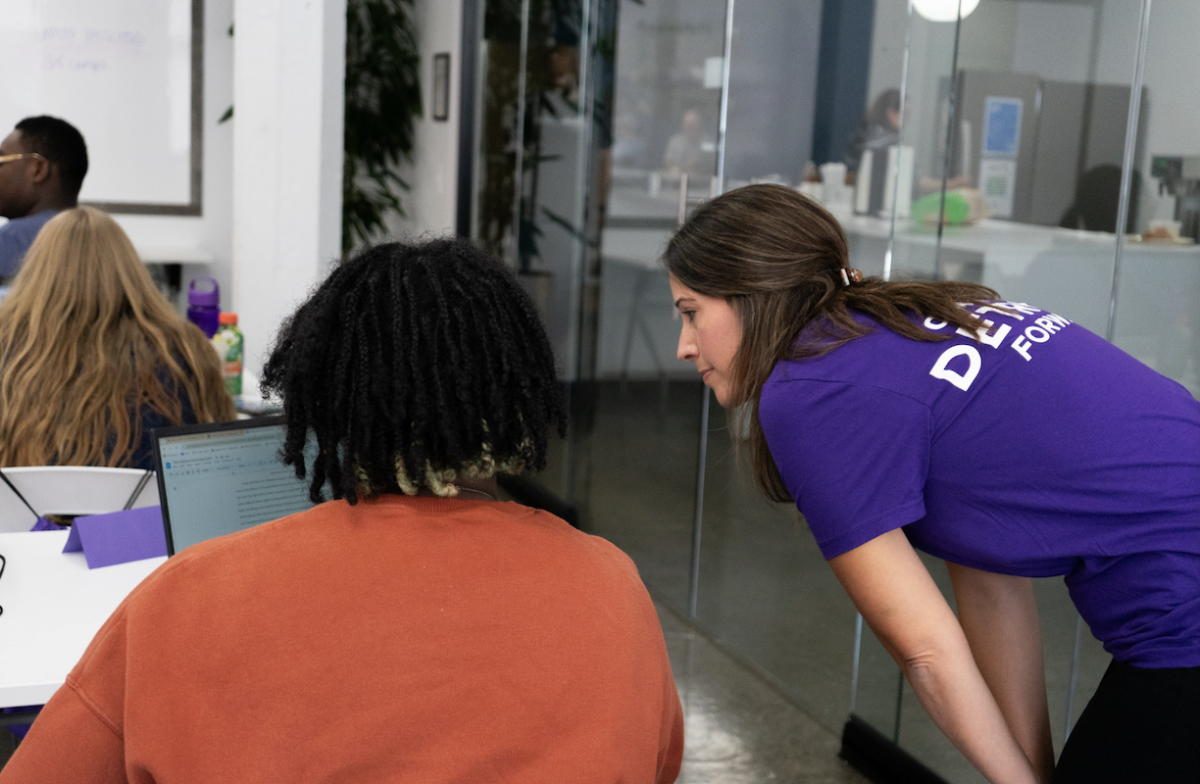
Danielle Alexander, a writing coach who leads Coaching Detroit Forward college essay workshops and has a Ph.D. in literacy, culture and language, said she’s seen more students turn to artificial intelligence as a tool. She said students use AI when feeling overwhelmed with deadlines, they’re juggling multiple things or have a lack of confidence.
“Using AI is stealing someone’s work in a way, even if you try to make it your own … and I think it just goes back to that lack of confidence or feeling rushed,” Alexander said.
While AI is a tool students use when feeling stuck, it can have negative consequences, Alexander said.
“If everyone produces the same type of essay, that’s going to make it harder for (college admissions officers) to choose, and you’re not standing out,” Alexander said.
Williams-Arnold also highlighted the uprising use of AI in her classroom and how the shortcut can hurt students in the long run. It ultimately causes “a false sense of accomplishment,” Williams-Arnold said.
Beyond the 4.0
Seeing a peer earn a GPA higher than a 4.0 is becoming less unusual, with higher-level courses making it possible to earn a 5.0. But this GPA boost could also cause unintentional harm to mental health.
In 2026, the University of Michigan received a record number of 115,125 undergraduate applications. The university also saw a 29% application spike over the past five years, according to University of Michigan’s Record.
As the application pool increases, students are pushing themselves to the limits academically to stand out, causing students to unconsciously pit themselves against each other.
In Gonzalez-Rivera’s IB English course, the environment went from inviting her junior year to “super competitive” her senior year. “Everyone grew apart and was only working on what they wanted to,” Gonzalez-Rivera said.
Both IB and Advanced Placement courses have the ability to raise a student’s GPA.
“I’ve gotten more used to seeing people with above 4.0, and normally the people that have above 4.0 are also the kids that are taking really hard classes like Advanced Placement,” Lee said.
An AP course can boost a high school student’s weighted GPA up by one point, according to College Vine. Williams-Arnold said this often makes students enroll only for the GPA boost, rather than the educational experience.
“One of the reasons why I stopped teaching AP is because a lot of students wanted that extra point more than they wanted class and work,” Williams-Arnold said.
In 2025, a record 65,898 Michigan public school students took an AP exam, up 4.5% from 2024, according to Michigan’s Department of Education.
While there may be GPA advantages, the heavy workload in these courses only increases the chances of high-achieving students experiencing burnout symptoms.
“High-achieving students especially undergo a lot of perfectionism, which goes hand in hand with burnout,” Starkman said.
As Detroit high school students race to perfect their college admissions application before fall deadlines, the dash often comes with a costly mental health decline. A process meant to excite students about their future causes the opposite: stress and fatigue.
“I worked so hard toward my goal that I completed it, but I don’t think it’s worth being so hard on yourself to the point that you’re sick because it’s just a bad cycle that you’re placing your body in,” Gonzalez-Rivera said.

This piece is part of the Detroit Journalism Summer Camp, run by The Detroit Writing Room in partnership with Planet Detroit.

Brianna Jimenez is a rising junior at Cass Technical High School. You can find her listening to music, spending time with her two dogs, or painting during her free time. She is driven to understand people’s stories and experiences, making journalism camp a great fit for her!