

Overview:
- A study in Eco-Tourism and Sustainable Development estimates the Great Lakes Way could bring $3.75 billion to $5 billion a year in economic benefits through connected trail tourism.
- The project includes 160 miles of greenways and 156 miles of water trails, with about 65% of trail miles usable, and it links 45 communities, mainly in Southeast Michigan.
- Detroit Greenways Coalition's Todd Scott says the trails must be designed well and that water trails still need more camping and bathrooms.
by Olivia O’Neill
Capital News Service
LANSING — Greenways and trails have become more popular in promoting community connectivity and ecotourism, but the network should be expanded in Michigan and the Great Lakes region, said a recent study.
Trails primarily in Southeast Michigan currently connect 45 communities, and the Great Lakes Way project is pushing to increase the number of usable greenways and sustain funding for such efforts.
The study examined the Great Lakes Way, which connects people to natural resources and expands ecotourism with trails. It estimated potential economic benefits of $3.75 billion to $5 billion annually by fostering connected trail tourism and expanding ecotourism in the region.
It appeared in the journal Eco-Tourism and Sustainable Development.
Involved in the project are the Great Lakes Institute for Environmental Research in Windsor, Ontario, and the PEA Group headquartered in Auburn Hills. PEA Group is a collective of engineers, surveyors and landscape architects who work to revitalize communities in Michigan, bordering states and Ontario.
As of now, there are 160 miles of greenways and 156 miles of “blueways”— watertrails — in the project. Around 65% of trail miles are usable, said John Hartig, a coauthor of the study and science-policy advisor for the International Association of Great Lakes Research and Great Lakes Institute for Environmental Research.
The original question, Hartig said, was “What if they were to connect a region with an interconnected set of greenways from Port Huron to Toledo, Ohio? It was a tall order, but that is the Great Lakes Way.”
It is “the trail of trails,” he said.
Hartig said the project grew from a two-decade-long greenways initiative but communities could not reach their funding goals and projects fell through. After these concerns were addressed by the Community Foundation for Southeast Michigan, $25 million was raised to help match greenways grants.
The Detroit Greenways Coalition has been an active member of the project’s advisory committee, said Todd Scott, its executive director.
“Our biggest concern is that it wouldn’t be designed to the best,” Scott said. “It would be easy for communities to take the easier route and do something that’s not really appropriate for a facility like this, like having bikes on sidewalks.”
According to the project’s 2021-24 progress report, initiatives involved St. Clair County’s Bridge to Bay Trail, the Downriver Linked Greenways, the Huron Waterloo Pathway Initiative, the Detroit Riverfront Conservancy and its Detroit Riverwalk, the Upper Peninsula’s Iron Belle Trail, Detroit’s Joe Louis Greenway and Monroe County’s Cornerstone Trail, among others.
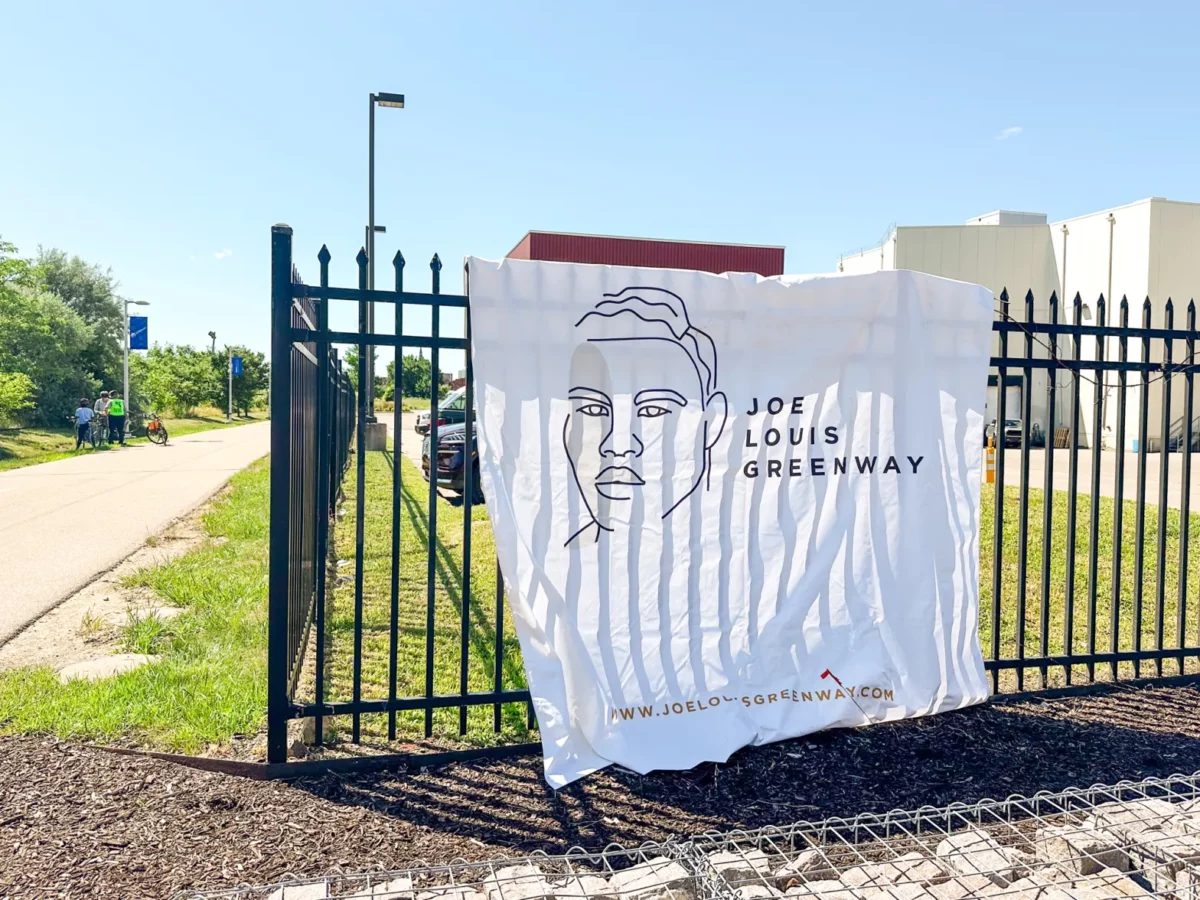
For example, there is trail work being done on the Joe Louis Greenway, which connects Dearborn, Hamtramck and Highland Park and links them to larger trail systems that crisscross the state, according to the city of Detroit website.
Hartig said the project’s planned water trails have all been completed, including the Detroit Heritage River Water Trail and the River Raisin Water Trail.
However, Scott said he doesn’t consider the water trails to be 100% completed.
“It needs to be done right,” Scott said. “Some things still still need more work before we would consider them to be done. For example, it would be great to have more camping facilities and bathrooms along the route.”
According to Michigan Trails Magazine, the almost 5-mile Detroit Riverwalk between Gabriel Richard Park and Ralph Wilson Park west of downtown, was named “Best Riverwalk in America” by USA Today for multiple years.
The Gordie Howe International Bridge, uniting Canada and the United States through a multimodal byway — a scenic or historic “byway” road for tourism, safety and economic development — opened last summer.
“It has been unbelievably great how that turned out, and the amount of usage is insane,” Scott said. “It is double the expectations of what the Windsor Detroit Bridge Authority thought it would be, and it has caused tremendous economic activity on both sides of the river.”
While many projects aren’t fully complete, communities are already seeing benefits of their connectivity.
Hartig said the bridge, as a toll-free trail for pedestrians and cyclists, “is an opportunity to expand and foster cross-boundary trail tourism and travel. The bridge is a tourist attraction now.”
Organized by the Waterfront Regeneration Trust, the first Great Waterfront Trail Adventure in August was a multi‑day cycling tour from Windsor, across the Gordie Howe International Bridge for the first time.
“Canadians came over and visited, and what an amazing experience they had,” Hartig said. “It is bridge-building and trail-building – creating a bridge between cultures and communities of our two countries.”
Scott said, “It’s going to be interesting to see how cycle tourism grows and how Detroit businesses take advantage of that.”
“There’s a little humble bar near the base of the bridge, and I stopped in the week before the pathway opened and said, ‘How are you guys prepared for this pathway’ and the people who will come off it to the bar? And when the bridge opened, they ran out of food.”
At the same time, Scott said some communities are uninterested and don’t see participation as a priority and that has been a concern.
Hartig said the eight Great Lakes states have been exploring a trail to mirror Canada’s Great Lakes Waterfront Trail that would be built over time on the foundation of existing, planned and complete trails.
“It started small, in metropolitan Detroit,” Hartig said. “But, right now the big thing is the other states in the Great Lakes started noticing what we are doing, and they said, ‘Why can’t we extend the Great Lakes Way further?’”
Hartig said buying into the project because the trails make communities attractive places to live, work and play, and be sustainable.
Hartig said the Great Lakes Way adds value for urban and rural communities.
“We brought Canadian cyclists into Detroit for a day. They learned about Detroit, got coffee and soon enough will be staying overnight in hotels and Airbnbs,” he said.
Olivia O’Neill reports for Capital News Service, a program of the Michigan State University School of Journalism. Capital News Service
