


Overview:
- Environmental advocates in Southeast Michigan are celebrating a federal appeals court ruling that could bring stronger pollution controls to a region plagued by high asthma rates.
- The court overturned the EPA's 2023 decision, citing Michigan's failure to enforce regulations on industrial facilities emitting volatile organic compounds that contribute to ozone pollution.

A federal appeals court has overturned the U.S. Environmental Protection Agency’s 2023 decision that declared the Detroit area in compliance with national ozone air quality standards.
It’s a ruling that environmental advocates say could lead to stronger pollution controls in a region burdened by some of Michigan’s highest asthma rates.
The U.S. Court of Appeals for the Sixth Circuit ruled Dec. 5 that the EPA violated the Clean Air Act when it redesignated the seven-county Southeast Michigan area from “nonattainment” to “attainment” for the 2015 ozone national ambient air quality standards. The decision returns the region to nonattainment status.
At issue: whether Michigan met all the pollution control requirements mandated by the Clean Air Act before the EPA could approve the redesignation. The court found that the Michigan Department of Environment, Great Lakes, and Energy failed to adopt regulations requiring certain industrial facilities to implement “reasonably available control technology” (RACT) for sources that emit volatile organic compounds, a key precursor to ground-level ozone.
“Excusing non-compliance with the statute’s deadlines would render toothless the requirement that a state continue complying with the [Clean Air Act] even if it already submitted a redesignation request,” Judge Helene White wrote in the opinion.
‘Clean Air Act deadlines are meant to have teeth’
The Sierra Club brought the challenge. Elena Saxonhouse is a senior attorney for the Sierra Club’s Environmental Law Program.
“It was good to see the Court acknowledging that Clean Air Act deadlines are meant to have teeth and that an EPA interpretation that undermines an explicit deadline cannot stand,” Saxonhouse told Planet Detroit.
“The upshot is that Michigan will need to complete additional Clean Air Act requirements for the area, including issuing rules limiting pollution from certain sources of the type of pollution that leads to ozone.”
Those pollutants include nitrogen oxides and volatile organic compounds, or VOCs.
The ruling means EGLE must now operate under nonattainment requirements and must adopt RACT rules before pursuing another redesignation request — a process Nick Leonard, a Great Lakes Environmental Law Center attorney who argued the case, estimated could take one to two years.
The ruling vindicates concerns advocates raised during the original redesignation process, he said.
“They should see some additional commitments from EGLE to take regulatory action to lower ozone pollution, including facilities on the east side,” the attorney said of what residents can expect. “I would hope sometime in the next several months to a year.”
Saxonhouse said EGLE issued RACT rules for VOC sources several years earlier, then suspended enforcement of those rules for the Detroit area the same day the nonattainment designation was lifted.
“You can see they cover a variety of sources, like auto-painting operations, asphalt mixers, certain processes at refineries,” she said.
EGLE spokesperson Josef Greenberg Stephens told Planet Detroit that EGLE is reviewing the decision, noting that EGLE was not a party to the case and cannot speak in detail about the legal outcome.
How wildfire smoke plays into ozone decisions
The East 7 Mile air quality monitor on Detroit’s east side has recorded ozone levels above the federal health-based standard of 70 parts per billion for the last decade. The monitor sits in a community with asthma hospitalization rates among the highest in Michigan.
The court upheld the EPA’s decision to exclude air quality data for June 24 and 25, 2022, attributing those ozone spikes to Canadian wildfire smoke rather than local pollution.
Environmental advocates challenged that determination as well, arguing it set a troubling precedent for future exceptional events claims. The exclusion paved the way for the attainment designation.
“We were encouraged that the court supported the use of exceptional events demonstrations and acknowledged the sound science behind EGLE’s determination that the Detroit area met the health-based ozone standard,” Greenberg Stephens said.
Saxonhouse said the wildfire smoke decision may not be a predictor of future decisions to exclude wildfire smoke data.
“We pointed to a lot of information in the record that directly contradicted the finding that it was wildfire smoke that caused high ozone readings on those two days,” she said. “It is unfortunate the court discounted that. However, the court’s decision on this was very fact-specific, so it doesn’t necessarily signal that shoddy analysis will be upheld in the future.”
As Planet Detroit reported in October, EGLE is seeking EPA approval to exclude four additional days of ozone data from 2023, also citing wildfire smoke. That request remains pending.
“We expect to get in touch with EPA and EGLE directly to discuss next steps, but I would hope to see EPA revising its internal and public information to reflect that this area is back in nonattainment, and clarifying an appropriate deadline for attainment,” Saxonhouse said.
“As for Michigan, it remains to be seen whether they will take this as a signal to take serious action to reduce ozone levels in the area, or keep trying to avoid taking regulatory action.”
An EPA spokesperson said the agency “is reviewing the decision” and did not respond to questions about whether it plans to appeal.
This story was updated Friday, Dec. 12, at 8:15 a.m. to include statements from EGLE.
More reporting on ozone in Detroit
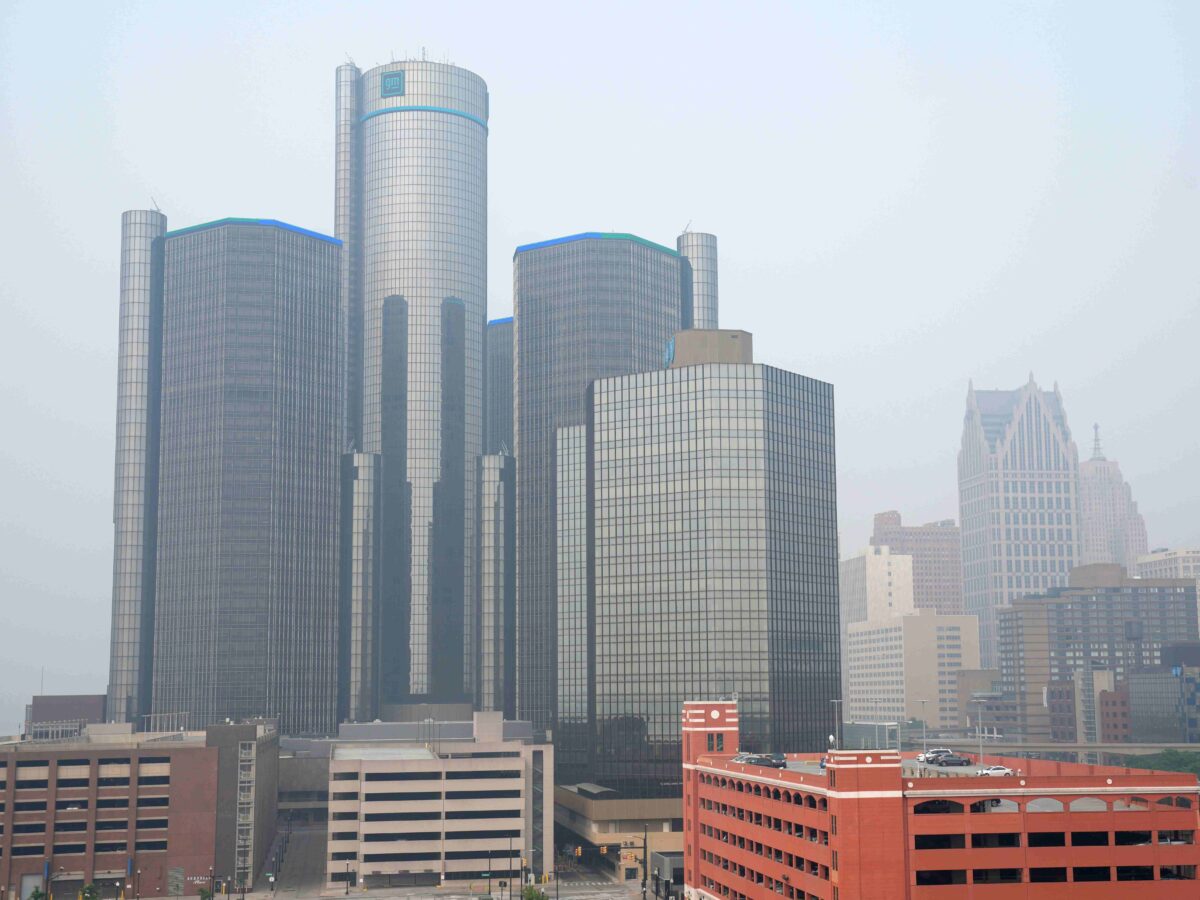
State regulators want EPA to ignore wildfire-smoke ozone spikes in Detroit
In a bid to maintain air quality compliance, Michigan’s environmental agency seeks to exclude four days of ozone data, attributing the spikes to Canadian wildfire smoke rather than local pollution.


Michigan fails to follow its own ozone pollution rules: Sierra Club
The Sierra Club threatens legal action against Michigan’s environmental regulators, accusing the state of neglecting its duty to curb ozone pollution in southeast Michigan, where communities, particularly on Detroit’s east side, face heightened asthma risks due to persistent air quality issues.


Healthcare professionals challenge EPA on Detroit ozone pollution
Advocates aim to reverse ozone pollution decision that discounted data from wildfire smoke days.
Metro Detroit’s worst ozone year in a decade sparks Sierra Club lawsuit against EPA
At issue is how much of the ozone problem is due to wildfire smoke.