

Overview:
- Ford's strategic pivot away from electric vehicles, marked by a $20 billion write-down, signals a new focus on grid storage solutions.
- The automaker plans to transform its Kentucky facility to manufacture lithium iron phosphate cells, packaging them into 20-foot containers with a minimum capacity of 5 megawatt-hours.
- This initiative involves a $2 billion investment over the next two years, with a goal to deliver at least 20 gigawatt-hours annually by 2027. As EV sales stall amidst shifting federal policies, the U.S. energy storage sector is experiencing a significant surge.

By Julian Spector, Canary Media
This story originally appeared in Canary Media and is republished here with permission.
Ford, a century after it launched the modern automotive era, has given up on its early ambitions to charge into the electrified future.
The company announced that it will delete nearly $20 billion in book value to extricate itself from its EV investments, an eye-popping loss that amounts to one of the biggest corporate impairments ever.
The company, of course, views it differently: The move is a “decisive redeployment of capital,” it said on Monday, as it rolled out a string of related strategic changes alongside the write-down.
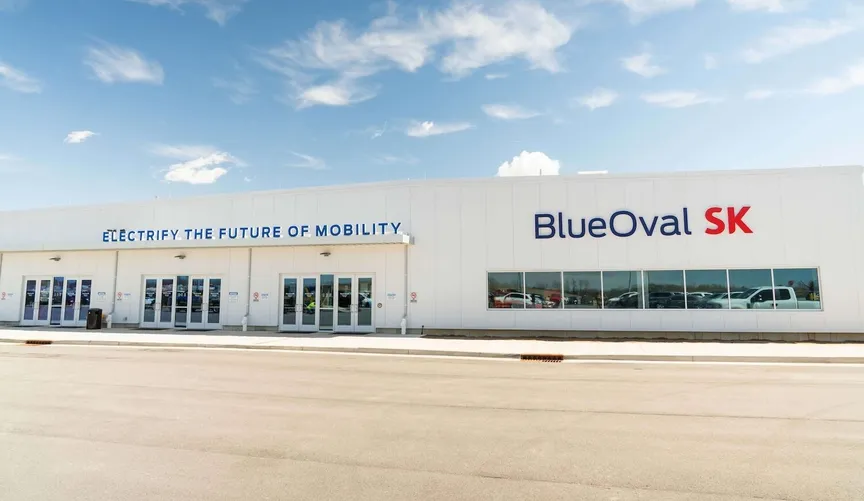
The pivot hits particularly hard in the southeastern Battery Belt, where Ford had invested in multibillion-dollar BlueOval SK plants to produce batteries and electric vehicles. The EV battery facility in Glendale, Kentucky, will lay off about 1,600 employees, and local outlet the Memphis Commercial Appeal reported that a Ford factory in Tennessee will hire around 1,000 fewer workers than previously planned, now that it is making gas trucks instead of electric ones.
As Ford retreats from EVs, though, it’s enthusiastically embracing battery-making — announcing plans to repurpose the Kentucky plant to fuel its entrance into the grid storage market. It expects to spend roughly $2 billion over the next two years to launch production of lithium iron phosphate cells and package them into 20-foot containers that hold at least 5 megawatt-hours of storage capacity, equivalent to a Tesla Megapack. The plan is to ship at least 20 gigawatt-hours annually by the end of 2027.
“This strategic initiative will leverage currently underutilized electric vehicle battery capacity to create a new, diversified and profitable revenue stream for Ford,” the company said in a statement. Ford also plans to make cells for home battery units at its factory in Marshall, Michigan.
Ford recently cut a deal with partner SK On, the South Korean battery maker, to dissolve their joint venture. Ford will keep the Kentucky battery plant while SK On takes the one at the sprawling BlueOval City complex near Memphis, Tennessee. That means batteries will still be made in that factory, just not exclusively for Ford products. A Ford subsidiary will hire more than 2,100 people to work at the Kentucky plant.
“They have built up battery manufacturing capacity, and now they need to do something with it,” said Pavel Molchanov, managing director for renewable energy and clean technology at financial services firm Raymond James. “While EV demand is languishing, U.S. energy storage deployments are skyrocketing.”
Ford’s sunny rhetoric about a “customer-driven shift” can’t hide the sheer enormity of the blow to its overall business.
As of Sept. 30, Ford’s accountants pegged its corporate value at more than $47 billion. Now Ford must lower that by $19.5 billion to reflect the dissolution of the joint venture agreement with SK On and the loss of planned EV models. The company will have to spend money to end production of the all-electric F-150 Lightning, switch to producing a gas-and-battery-powered extended-range model, and retool factories for new, non-EV production.
The move comes as EVs account for just about 10% of new vehicle sales in the U.S., far below the global figure of 25%. Though EV sales reach new records each year, the rate of growth has slowed, and there’s little reason to expect momentum to improve given recent federal policy changes.
“U.S. EV sales have never lived up to expectations,” said Molchanov. “That was true even while the tax credit was in place. Now, there’s no more tax credit, and EV sales have fallen off a proverbial cliff.”
The consumer EV tax credit ended in September as a result of the Republican budget law, taking away an incentive that helped lower or eliminate the premium for buying electric compared to a similar gas-powered model. Now, too, the average price of regular gasoline has dipped below $3 a gallon for the first time in four years, while residential electricity prices rose 13% over the first three-quarters of this year, much faster than inflation.
“In terms of commodity prices, this is the worst of both worlds for EVs,” Molchanov said.
Energy storage soars as U.S. EV market falters
Ford’s announcement says a lot about the changing fortunes of EVs and energy storage in the U.S. right now.
It used to be that EVs were on the exponential growth curve, and stationary storage offered a modest side hustle for any leftover batteries. Now, between American automakers’ apparent inability to make affordable models and the Trump administration’s slashing and burning of federal EV incentives, that market is heading for some doldrums.
Grid battery providers, by contrast, are seeing business surge. Revenue from Tesla’s energy division, home to the Powerwall home battery and Megapack for large-scale storage, grew 67% last year compared to 2023, and broke $10 billion for the first time, even as the company’s market-leading EV business lost revenue.
Overall, the U.S. will install a record amount of battery capacity on the grid this year. Though analysts predict some dropoff over the next couple of years as the industry adapts to new federal anti-China rules, the utility-scale outlook through 2030 has actually increased 15% since the first half of this year, according to industry group American Clean Power.
Demand from AI data centers plays a massive role in that: Hyperscalers are realizing that strategically placed batteries can unlock capacity at critical constrained hours, in some cases letting the companies build computing hubs years earlier than they could if they waited for conventional grid upgrades. Ford, not coincidentally, will target data centers with its new battery products.
The grid storage market has to date depended almost entirely on lithium iron phosphate cells made in China. But when President Donald Trump signed the One Big Beautiful Bill Act this summer, he preserved federal tax incentives for energy storage deployment while adding a new bureaucratic regime to make projects prove they don’t source parts from China in excess of newly set limits.
Starting in 2026, that will push storage developers to source U.S.-made batteries. There aren’t a lot of options today: LG, after making EV batteries in Michigan for years, began producing lithium iron phosphate cells there for grid use earlier this year. Tesla, Fluence, and others are following suit — in fact, the U.S. is on track for self-sufficiency in cell production for grid storage use by the end of 2026, according to the Energy Storage Coalition.
If project developers end up in a race to secure scarce domestic supply come 2027 or 2028, Ford could find eager buyers in spite of its short track record.
Still, that’s no guarantee of success. Other companies have been building grid storage products for years, working out kinks, packing more capabilities into a tighter footprint, and building relationships with savvy customers. Ford has a reputation for reliability in pickup trucks, not in grid batteries.
Put another way, Ford is copying Tesla’s strategy of leveraging EV prowess to sell grid storage, but doing so a decade later and without the EV prowess to lean on.
Editor’s note: A clarification was made on Dec. 23, 2025. This story has been updated to clarify BlueOval SK’s full name and to add new figures from Ford on employment at its Kentucky battery factory.

Rogers pushes electric vehicle disinformation in bid for Michigan Senate seat
Rogers and Slotkin focus on abortion, the economy and EVs in a Michigan Senate race light on environmental issues.

Revolutionary changes in transportation, from electric vehicles to ride sharing, could slow global warming – if they’re done right, IPCC says
By: Alan Jenn Around the world, revolutionary changes are under way in transportation. More electric vehicles are on the road, people are taking advantage of sharing mobility services such as Uber and Lyft, and the rise in telework during the COVID-19 pandemic has shifted the way people think about commuting. Transportation is a growing source…
