

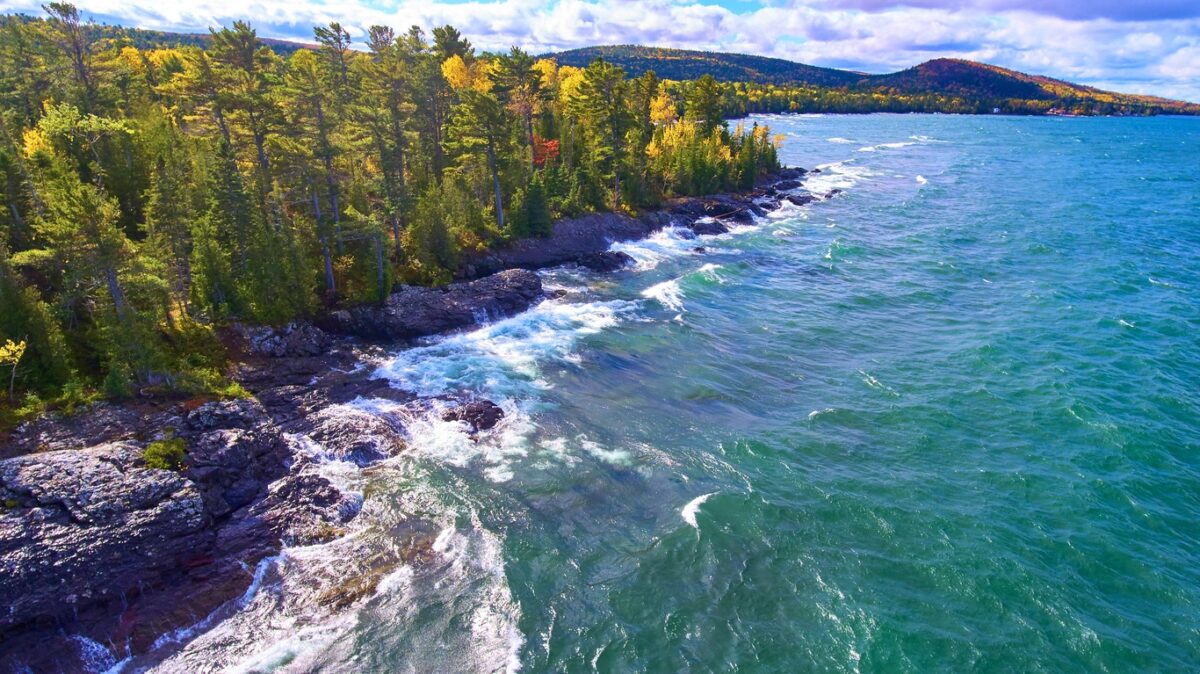

The National Wildlife Federation is working to protect the Great Northwoods — millions of acres of forests and waters across Michigan, Minnesota, and Wisconsin that provide vital wildlife habitat and connect nearby communities to nature.

We promote business practices that advance climate leadership, social justice, and the creation of a circular economy

In 1969, the Cuyahoga River caught on fire, and so did the Rouge River in Detroit. These fires, ignited by rivers contaminated with oil and other pollutants, led to the passage of the Clean Water Act in 1972.
The act aimed to restore and maintain the integrity of the nation’s waters and established a system that has regulated and significantly improved water quality for over 50 years.
Now, a bill called the PERMIT Act could roll back some of those protections. H.R. 3898 passed the U.S. House on December 11 and is being considered by the Senate Committee on Environment and Public Works, which held a hearing on permitting reform on January 28.
Detroiters rely on the area’s rich water resources—particularly for drinking water—that could be threatened if the Clean Water Act’s protections are weakened. Several environmental groups have raised concerns that, if the PERMIT Act becomes law, it would allow polluters to evade responsibility and undermine progress in cleaning up our waters.
The PERMIT Act “really strikes at the heart of the Clean Water Act by making it much easier for polluters to take advantage of weakened regulations and increase pollution in our water bodies,” said Liz Kirkwood, executive director of Flow Water Advocates.
This could affect waters on a larger scale—pollution from mines and agriculture far from Detroit could make its way into Lake Huron and the Detroit River, where Detroit’s drinking water comes from.
“Not only are all the Great Lakes connected, but all of the groundwater, all the rivers, all the inland lakes—these are all connected,” said Kristen Haitaian, policy director of Freshwater Future.
But this bill could also allow increased pollution at the local level from industrial polluters along the Detroit River and on or near other water bodies.
What the bill would do
The PERMIT Act would allow both the EPA and the Army Corps of Engineers “to have unfettered authority to exclude specific waterways from clean water protection,” Kirkwood said. With Michihan “being such a water-rich state, with over 3,200 miles of fresh coastline, 11,000 lakes, and many rivers and streams, that could put a lot in harm’s way.”
One key concern is that the bill would curtail states’ and tribes’ ability to protect their waters. The bill is “breaking the pact between the federal and the state governments,” Kirkwood said.
The bill also shields polluters from liability for discharges not disclosed in their permits, directs the EPA to consider treatment costs in setting water quality standards, changes the definition of “navigable waters” to exclude groundwater and certain features, and reduces permit requirements for pesticide discharge.
Many industries could have pollution restrictions relaxed. The proposed Copperwood Mine near Porcupine Mountains Wilderness State Park has raised concerns about toxic mining waste reaching Lake Superior.

“The extraction of yesterday will be returning to Michigan in the near future,” said Antonio Cosme, co-founder of Black to the Land Coalition. “As Detroiters, as the most populous section of this state, it’d be nice if we had an awareness about the copper mine attempts in the UP. There are all sorts of ways the future of the fresh water that we love is going to be impacted if we aren’t having a stake and seeing their issues as our issues.”
Under the PERMIT Act, the fossil fuel industry might have fewer restrictions, Haitaian said. The proliferation of concentrated animal feeding operations from factory farms is another risk. “We’re getting more and more harmful algal blooms in parts of the state that never had them before,” she added.
In Detroit, the bill might allow more pollution from “new industrial operations added into where there’s already overburdened communities, like in southwest Detroit,” Haitaian said.
Drinking water at risk
The PERMIT Act might mean more risk, less transparency, and higher treatment costs for tap water. If waters become more polluted and require more extensive treatment, those costs will be passed along to rate payers, Haitaian said.
“Water affordability is already a crisis for Detroiters. We know that there are about 60,000 households currently struggling to pay their water bills,” said Tiana Starks, director of communications for We the People of Detroit. “Adding any additional cost to Detroiters could put us over the edge.”
Water shutoffs in Detroit have caused significant problems. In a study with Henry Ford Hospital, We the People of Detroit found that “if you lived on a block where just one house was shut off from water, you were 1.5 times more likely to be subjected to a waterborne illness,” Starks said.
The organization has been working with Michigan Rep. Emily Dievendorf (D-Lansing) and other representatives on the Affordable Water Now legislative package, introduced in October. It protects water utility customers from shutoffs and requires water systems to be transparent about their policies.
The PERMIT Act’s potential effects on Detroit’s drinking water are unclear. But, Starks adds, “I think continuing to advocate for good policy at the state level can help us to combat things like this.”
Fishing, recreation, and cultural use
If water bodies in and around Detroit contain more contaminants, they could harm people who eat the fish they catch. For some Indigenous people across the state, fishing is a cultural practice protected by treaty rights.
The Michigan Department of Health and Human Services Eat Safe Fish Guidelines include fish that people should limit or avoid from specific Detroit-area water bodies. Fish caught there have contained PCBs and PFOS, linked to cancer and other health problems.
For many Detroiters, “water is a big part of our culture,” Starks said. She remembers fishing with her grandparents as a child and going to Hart Plaza with her family, with the Detroit River in the background.
Across Michigan, water bodies are tourism destinations. Recreation, fishing, and hunting on and near lakes and rivers support the economy and provide an important connection to the natural world.
If the PERMIT Act becomes law, “this is going to turn back time 50 years to a time when people didn’t even think about going into the lake or even touching the water,” Haitaian said. “Corporations are always going to do what’s cheapest and easiest, and if you don’t hold them to a certain standard, we’re going to go back to where we started.”
—
This story is part of Rooted Together: Connecting Detroit and Michigan’s Great Northwoods series, co-produced with the National Wildlife Federation’s Great Northwoods Initiative.