

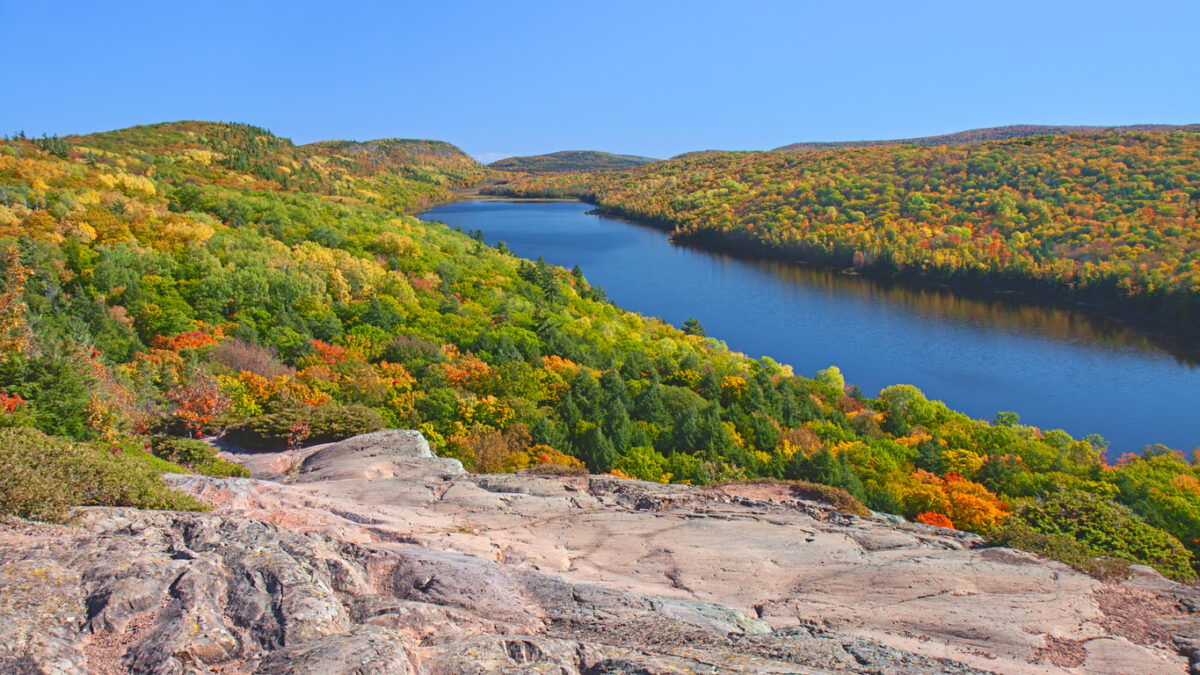

The National Wildlife Federation is working to protect the Great Northwoods — millions of acres of forests and waters across Michigan, Minnesota, and Wisconsin that provide vital wildlife habitat and connect nearby communities to nature.

We promote business practices that advance climate leadership, social justice, and the creation of a circular economy
The Great Northwoods is a vast expanse of land north of the 45th parallel, covering all of Michigan’s Upper Peninsula and part of the northern lower peninsula, plus northern parts of Wisconsin and Minnesota.
Some Detroiters have family traditions of going “up north” to fish, hunt, and recreate—but many don’t. Either way, these forests may seem remote and disconnected from Detroit.
They’re not. The Northwoods provide ecosystem services that directly benefit Detroit. The trees absorb carbon and pollution particles, improving air quality and helping mitigate climate change. The forests also help maintain a clean water supply by filtering out contaminants.
“If you have a forested area, you have good soils, and the forest kind of slows down the runoff of water and infiltrates it, so it recharges the water table,” said Inés Ibáñez, a professor at the University of Michigan School for Environment and Sustainability.
Rivers that flow through the Great Northwoods empty into the Great Lakes. Detroit’s drinking water comes from the Detroit River and Lake Huron.
“Being able to maintain these large forested areas really helps with the water supply to a much larger region,” Ibáñez said.
But the health of the Great Northwoods is threatened. The U.S. Department of Agriculture announced plans to roll back the Roadless Area Conservation Rule, which protects roadless areas across the country from road construction and timber harvesting, including 16,000 acres in Michigan. If these areas are opened for logging and mining, the forests may become more fragmented, harming the ecosystems and wildlife that depend on them.
Managing forests responsibly
The 16,000 roadless acres in Michigan are “a treasure and unique for Michigan,” said Marc Smith, Great Lakes policy director for National Wildlife Federation. These areas are “too wild to undermine them with any type of mining” or other extractive industry, he said.
Recreation and tourism in the Northwoods contribute to Michigan’s economy and quality of life, he added.
“When people think of the Northwoods, they imagine clean water, open spaces, and iconic wildlife like moose, wolves, loons,” Smith said. “But also, we need to think about the communities that rely upon those resources.”
NWF’s Great Northwoods Initiative aims to protect and restore the Northwoods ecosystem by preserving biodiversity and managing forests sustainably, while expanding access to outdoor recreation for historically excluded communities.
For people who go to the Great Northwoods, there’s often a sense of awe and inspiration. “I think everybody knows about the redwoods of California, but so few people know about the pines of Michigan or the beech or maple forests, said Antonio Cosme, co-founder of Black to the Land Coalition, a coalition of Black, brown, and Indigenous nature enthusiasts who engage people in meaningful outdoor experiences, including trips to the UP.
“You can experience those majestic, awe-inspiring natural places up here,” he said. Cosme is also the land stewardship manager at Rouge Park.
While public lands in the Great Northwoods are part of Michigan’s outdoor heritage, not all Michiganders have had the same access. Historically, low-income people and people of color have faced barriers and been underrepresented in outdoor recreation.
Detroit Outdoors works to break down those barriers, helping build connections between Detroiters and nature—both locally and in the Great Northwoods.
“We have the unique opportunity of being able to give them those experiences of the outdoors locally in Detroit, as a pathway to experiencing trips further away from the city,” said Isaac Piepszowski, program coordinator with Detroit Outdoors.
Merely going up north for vacation can establish a connection to nature, but Detroit Outdoors aims to make deeper connections. “It’s very much intentional experiences, with a lot of time for students to reflect,” Piepszowski said.
For the last few years, Detroit Outdoors has led a youth winter adventure in the UP, including ice climbing and time with people at Northern Michigan University.
Piepszowski recalled a student who sat alone on a frozen beach in Munising and returned in awe.
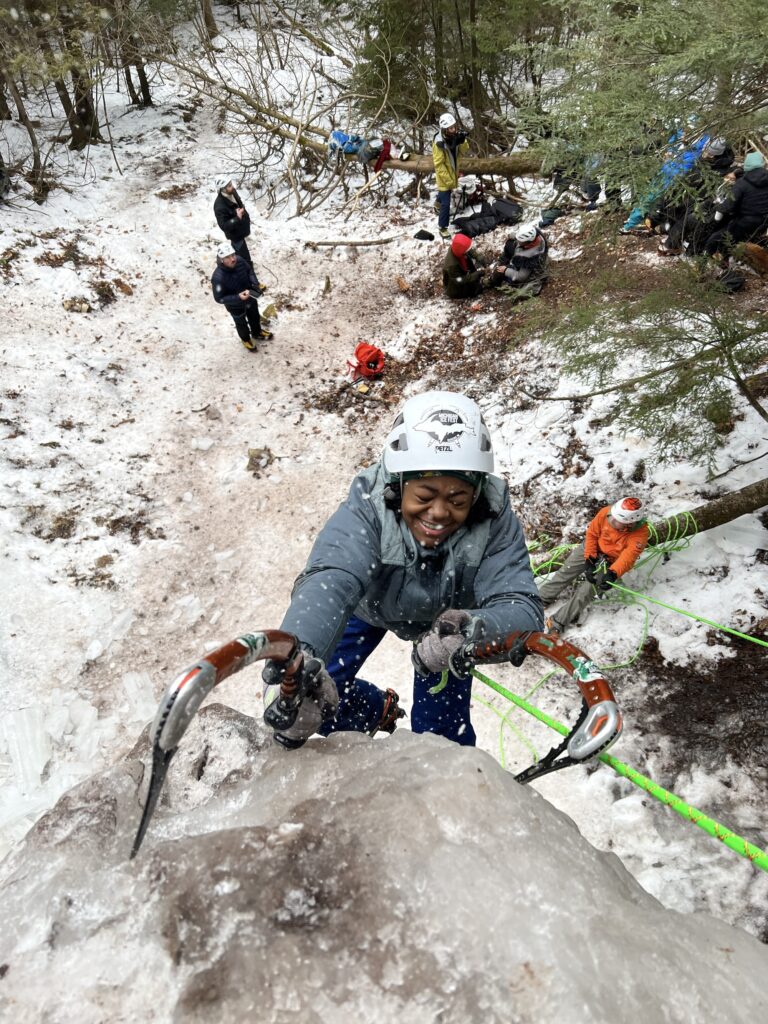
“He talked about really feeling free and able to breathe, unlike he has in a long time—and what that space has allowed for him to enter into.”
When students have experiences like this up north, they “come back with a new perspective on their local park or green spaces in the city,” Piepszowski said.
“We are going to these parks and spaces that are managed for everybody, and what we hope is one of the impressions they get is, ‘OK, this is a place where I can come back to, with my friends or my family,’ and some of them do,” said Garrett Dempsey, the lead Sierra Club staff with Detroit Outdoors.
Indigenous perspectives
Cosme has been building relationships with tribal communities in the UP for several years. Black to the Land has worked with tribal communities on traditional activities, including harvesting elm bark for elm bark lodges.
“I think it’s fundamental to be building relationships between Black and Indigenous communities,” said Cosme, who is of Indigenous descent, specifically Coahuiltecan (Mexican), and Boricua (Puerto Rican). “By spending time in the Great Northwoods, especially within Native communities, it’s an interesting way to build what I would call a decolonial solidarity.”
Both Black to the Land and Detroit Outdoors have taken groups to visit Jerry Jondreau, a member of the Keweenaw Bay Indian Community, at his farm, Dynamite Hill Farms.
Jondreau explained that his farm “is really all about returning to traditional foods, and not just the consumption of traditional foods, but the process and that relationship to place, and the reciprocity that comes from a maintained relationship—a relationship that’s not just extractive but that is reciprocal.
For visitors to the Great Northwoods, Jondreau asks that they be good guests.
“For the tribes, this is our home,” he said. This is where we can legally be Ojibwe people, because our treaty rights only extend through the ceded territory, and the entire State of Michigan has been ceded to the United States via treaty with the Anishinaabe people.”
From connection to protection
Those who live in the city may not make it to the Northwoods often, but they can still learn and practice stewardship at home through initiatives such as NWF’s community engagement programs, which offer participants opportunities to learn about urban habitat restoration and stormwater management.
“I think we’re—in very small ways—helping the state and all the natural resources be more appreciated, protected, and preserved, just by giving more people an interaction with them,” Piepszowski said.
Recently, a student who visited the Porcupine Mountains this summer emailed Piepszowski regarding a proposed copper mine near the area.
“She was absolutely furious about it,” he said. “I don’t know if she would have ever even known where the Porcupine Mountains were. But by spending just five days there, she now has ownership of that space.
She was like, ‘I’m calling the senators, I’m telling them that this place needs to be protected.'”
—
This story is part of Rooted Together: Connecting Detroit and Michigan’s Great Northwoods series, co-produced with the National Wildlife Federation’s Great Northwoods Initiative.