

Overview:
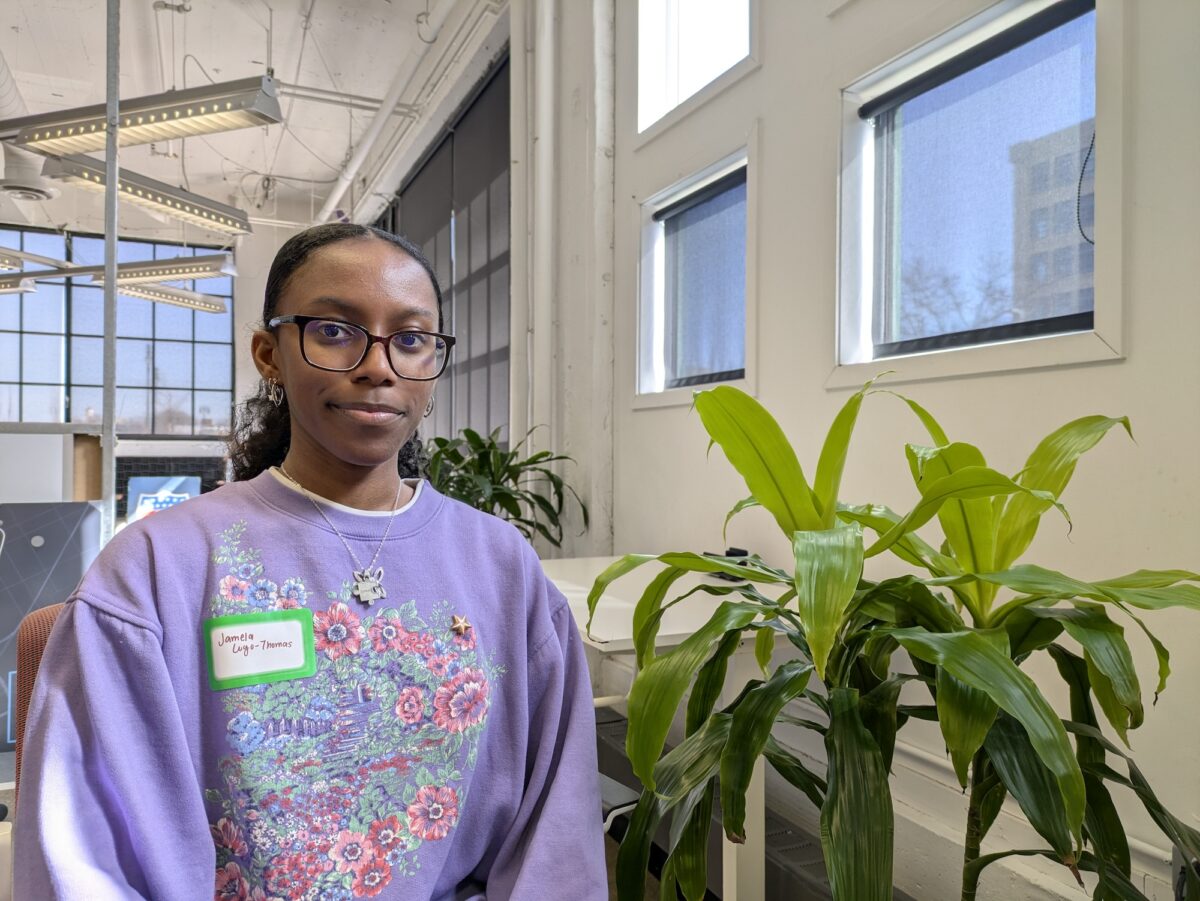
- At 16, Jamela Lugo-Thomas distributed water filters during Highland Park's lead contamination crisis while working at the city fire department
- The Highland Park resident experienced poor water quality at home, with 100-year-old lead pipes causing rust and discolored water

Planet Detroit’s neighborhood reporters are local residents who cover health, environment and climate issues in their neighborhoods. The Lab is made possible with the generous support of the Kresge Foundation.
When she was just 16, Jamela Lugo-Thomas found herself passing out water filters to her community. Routine testing had found elevated lead levels in the water of several Highland Park homes, prompting city leaders to encourage residents to use water filters.
Suddenly, Lugo-Thomas’ first summer job at the Highland Park Fire Department, which she thought would include basic office work like answering phones, turned into something else.
Being thrust into a position of providing important resources and information to community members was a big responsibility. It also gave her a close-up view of what happens when infrastructure fails and a basic human need like access to safe drinking water is threatened.
Lugo-Thomas and other advocates believe that safe drinking water isn’t just a need, it’s a right. And the United Nations agrees with them; in 2010, it recognized access to water and sanitation as a human right.
Quiet and unassuming, Lugo-Thomas is the kind of person who listens intently. Now 23 with a filmmaking degree from the College of Creative Studies in Detroit, she plans to make people stop and ask just how common these issues really are.

She’s participating in Planet Detroit’s Neighborhood Reporting Lab this spring, where she’ll get started by profiling Damon Garrett, the director of the Highland Park Water Department.
This interview has been edited for brevity and clarity.
Question: What was it like to work at the Highland Park fire department amid a water crisis?
Answer: I think of Highland Park, and I think it’s a little town, but it’s thousands of people. They were confused, and would ask, “What’s going on?” “Why is this happening?” Being able to explain the problem was very important.
It was action, action, action. At the time, it was stressful to have to re-explain the same thing to everyone. People would ask, “Why do I have to do this? Why do I have to come in?” It was a lot of responsibility and just a bit stressful for me at 16.
Q: What kind of water issues did you face in your own home?
A: We had had off-and-on problems with water quality because our pipes were made of lead and were over 100 years old. Rust was also a constant problem, and the water would frequently be a really dark yellow. Working at the fire department that summer was another time when [the water] was really bad, and they had to give everyone filters. It lasted a week or so; it wasn’t something that was going to go away in a few hours.
Being a kid in Highland Park, dealing with the lead issues, it just made me start to realize that this is a problem. As I was growing up, learning about what was happening in Flint made me want to understand what was going on better.
Health is so important, and I feel like our communities are often not at the top of the list when problems arise. So, that’s something that I’ve recently been trying to look into more deeply.
Q: How do you think that experience has inspired you in your documentary path?
A: It makes me think about how environmental issues affect different kinds of communities. When a community is so small and, like Highland Park, is extremely poor, it makes me realize that money has power. If the community had had more money, this problem may have been addressed sooner. But because we’re mostly old people, mostly retired, a mostly poor community, it wasn’t looked into like it could have been.
I think if we work together to document these issues, stories, and events, especially through film, we can get the message out to more people and help them understand.
Q: What is one thing you hope to achieve with your upcoming story for Planet Detroit’s Neighborhood Reporting Lab?
A: I hope that people will understand how big an issue this is. Also, look within their own community and ask, “Has this been a problem in the past? Have there ever been any water issues where I live? Or where my parents or grandparents live?”
Getting people to understand that even though we might have access to water, especially in the Great Lakes State, we don’t all have the same quality of water that people might think that we do.