


We promote business practices that advance climate leadership, social justice, and the creation of a circular economy
On a gray December morning at the Detroit/Wayne County Port Authority, the view across the river told one story about Michigan’s economic future: massive cargo terminals, a waterfront humming with diesel engines, and, on the horizon, the Windsor skyline. Inside, a different story was unfolding.
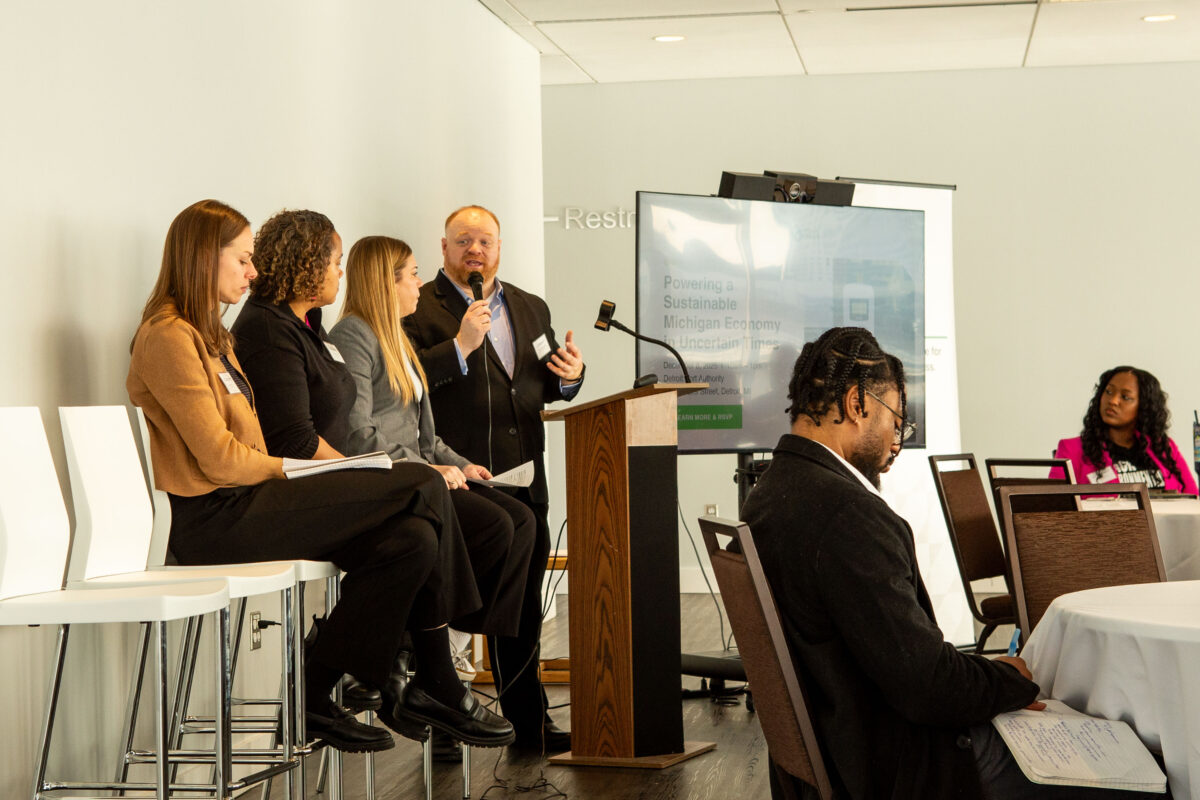
More than 100 community members, business leaders, labor representatives, and state officials gathered for the Michigan Sustainable Business Forum’s annual membership event, Powering a Sustainable Michigan Economy in Uncertain Times. The topic — how the rapid rollback of federal clean energy investments is reshaping Michigan’s economy and environment — was urgent. The numbers are stark.
In 2025, Michigan lost more than $1 billion in clean energy funding and more than 6,200 jobs, as canceled projects and federal program rollbacks rippled across the state. The losses span wind and solar development, EV manufacturing, weatherization programs, and the community grants that were, just months ago, transforming neighborhoods that had long borne the brunt of industrial pollution.
A billion-dollar hole
The scale of what’s been lost is still coming into focus. Synnia Williams, Business Representative for IBEW Local 58, described the human cost directly: the shutdown of an EV manufacturing plant cost 600 union jobs. The repeal of the federal tax credit for used EVs has further slowed adoption, eliminating the market signals that businesses had built plans around.
Vickie Lewis, President and CEO of VMX International, a Detroit-based recycling and sustainability company, has watched the ripple effects hit her own operations. Slower EV adoption has transformed the waste stream her company depends on, forcing a pivot toward consumer battery collection and hazardous battery management. VMX now operates the region’s only battery hazard center — an adaptation born of necessity.
| “As a waste company, we are pushing to do a better job. Zero Waste Detroit is working hard to do better things: making the recycling containers free, composting — we’re working on it.”— Vickie Lewis, President & CEO, VMX International |
For Madeline Walker-Miller, Founder and CEO of Nextiles — a company that creates building insulation from recycled textiles — the losses were more personal. Nextiles lost anticipated grant funding for insulation projects aimed at improving energy efficiency in underserved neighborhoods. The company pivoted to become a full-scale building material recycler, expanding into alternative markets including apparel and pet products. Walker-Miller put it plainly at the forum: “It was disappointing to lose access to funding, but we know the opportunity will come again.”
Communities that planned around federal promises
The economic losses are inseparable from the public health stakes. Mary-Jacqueline Muli, RN and founder of Climate Justice Nurse, reminded the room that Detroit’s asthma rates are not an abstraction. Pollution-driven respiratory illness costs the U.S. more than $80 billion annually in productivity losses. Clean energy programs that reduce emissions aren’t just environmental investments — they’re health infrastructure.
Tepfirah Rushdan, Director of the City of Detroit’s Office of Sustainability, described what the cuts mean at street level. The termination of Solar for All projects has delayed rooftop solar installations for residents in frontline neighborhoods who were ready to act.
| “Right now, many homes in Detroit are being built up, so it is the perfect time to install [sustainable building]… Some of these [homeowners who lost funding for home solar] had to delay their dream. A dream deferred.”— Tepfirah Rushdan, Director, Office of Sustainability, City of Detroit |
Rushdan was quick to add that Detroit has not stopped. The city continues to enforce fossil fuel ordinances, expand the Detroit Neighborhood Solar Initiative, and integrate sustainability into transit planning.
“This pendulum is constantly swinging,” she said. “This is the time to lay low, strategize, and continue thinking of a way forward.”
How Michigan keeps moving forward
If there was a throughline to the December convening, it was this: Michigan’s clean energy momentum does not depend entirely on federal policy. It depends on preparation, diversification, and the partnerships that keep projects alive when funding disappears.
Julie Field, Deputy Chief Climate Officer at EGLE, noted that the state has been pursuing legal action to protect certain federal resources and is actively working to identify alternative funding sources.
“We cannot rely on grants alone — how can the state support this system?” she asked. Field also pushed back on the framing that affordability and sustainability are in conflict. “As a state, we are learning how to better talk about how savings and sustainability are not mutually exclusive.”
At Port Detroit, the story is one of continued innovation under uncertainty. Mark Schupp, Executive Director of the Port, described early anxiety around the EPA Clean Ports grant — which ultimately remained intact — and the Port’s ongoing transition from diesel to zero-emission equipment.
Schupp was direct about the stakes: “When Henry Ford created the Port of Detroit, it was just about economics. The Port of Detroit remains an economic driver, but we must consider the health of the community. We can’t fall into the ‘either or’ of ‘either jobs or health.'”
Eric Lee, Director of Research and Technology Commercialization at NextEnergy, offered a longer view. He highlighted geologic hydrogen — an emerging, potentially zero-carbon energy source for heavy-duty transportation — as one example of the innovation Michigan is positioned to lead, if it stays ready. “When we look at the future… the idea that we can just do what we did before without recognizing that the world is different… at a certain point common sense says that we have to be careful with what we have.”
What communities and businesses can do
State Representative William Bruck, attending from the 30th District, drew the day’s themes together: “When I think of sustainability, I think of self-reliance. To be successful in the change, you have to diversify. Diversify your revenue streams and services. Sometimes we don’t have the federal government to depend on, so you have to be self-reliant.”
That spirit of self-reliance — combined with continued advocacy for the restoration of federal funding — was the forum’s closing message. Michigan was recently ranked the nation’s sixth-largest clean energy economy, with more than 127,000 clean energy jobs. That position didn’t happen by accident, and it won’t be maintained by waiting.
Daniel Schoonmaker, Executive Director of MiSBF, framed what’s at stake simply: Michigan is on the right side of history. The work ahead is making sure the state’s communities, workers, and businesses don’t bear the cost of political decisions that run counter to that future.
| “We are moving forward, whether there is funding or not.”— Devan Dodge-Frye, Sustainability Manager, City of Royal Oak |
This story was produced in partnership with Michigan Sustainable Business Forum, a Planet Champion sponsor of Planet Detroit.