

Overview:
• DTE Energy and its Zug Island subsidiary face a $100-million judgment over sulfur dioxide pollution.
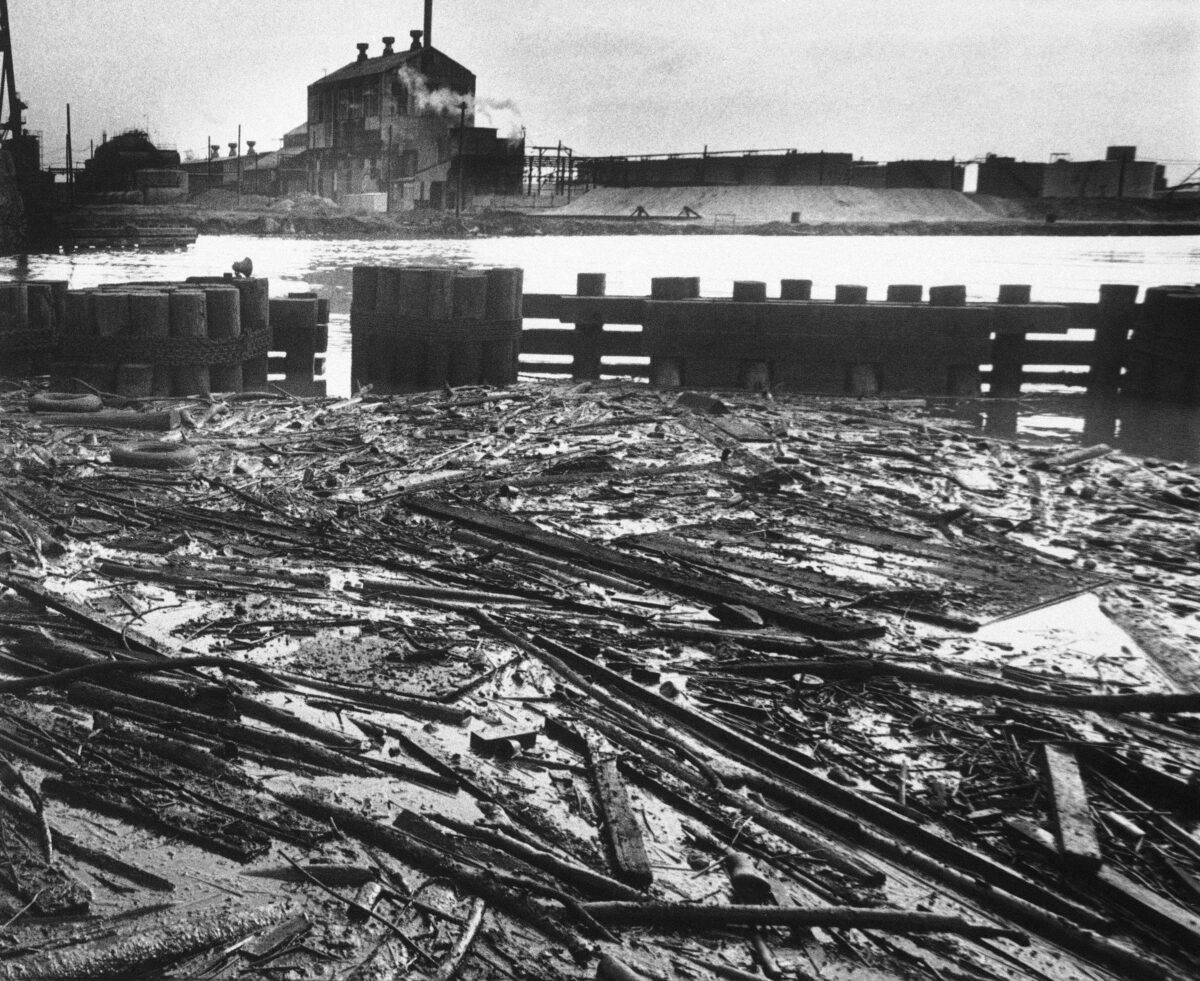
• The island, a symbol of industrialized Detroit, was once a marshy peninsula on the Rouge River that buzzed with wildlife and bubbled with sulfur springs.
• Heavy industrial activity on Zug Island pumped out pollution for decades at the expense of nearby residents' health before early environmental regulations took effect.

This story was produced with support of Internews’ Earth Journalism Network.
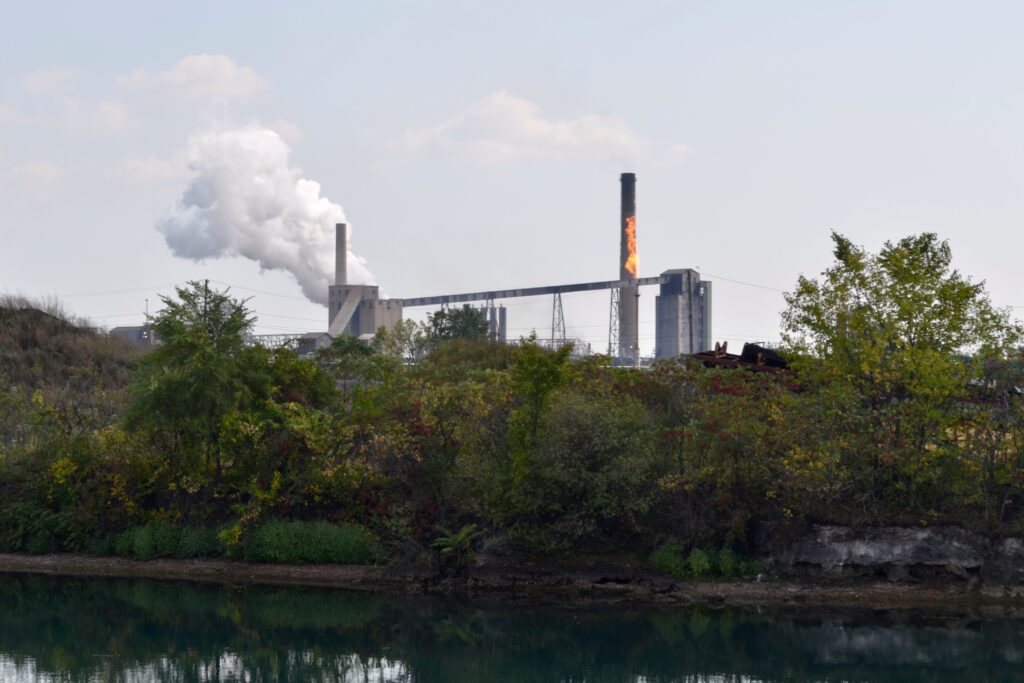
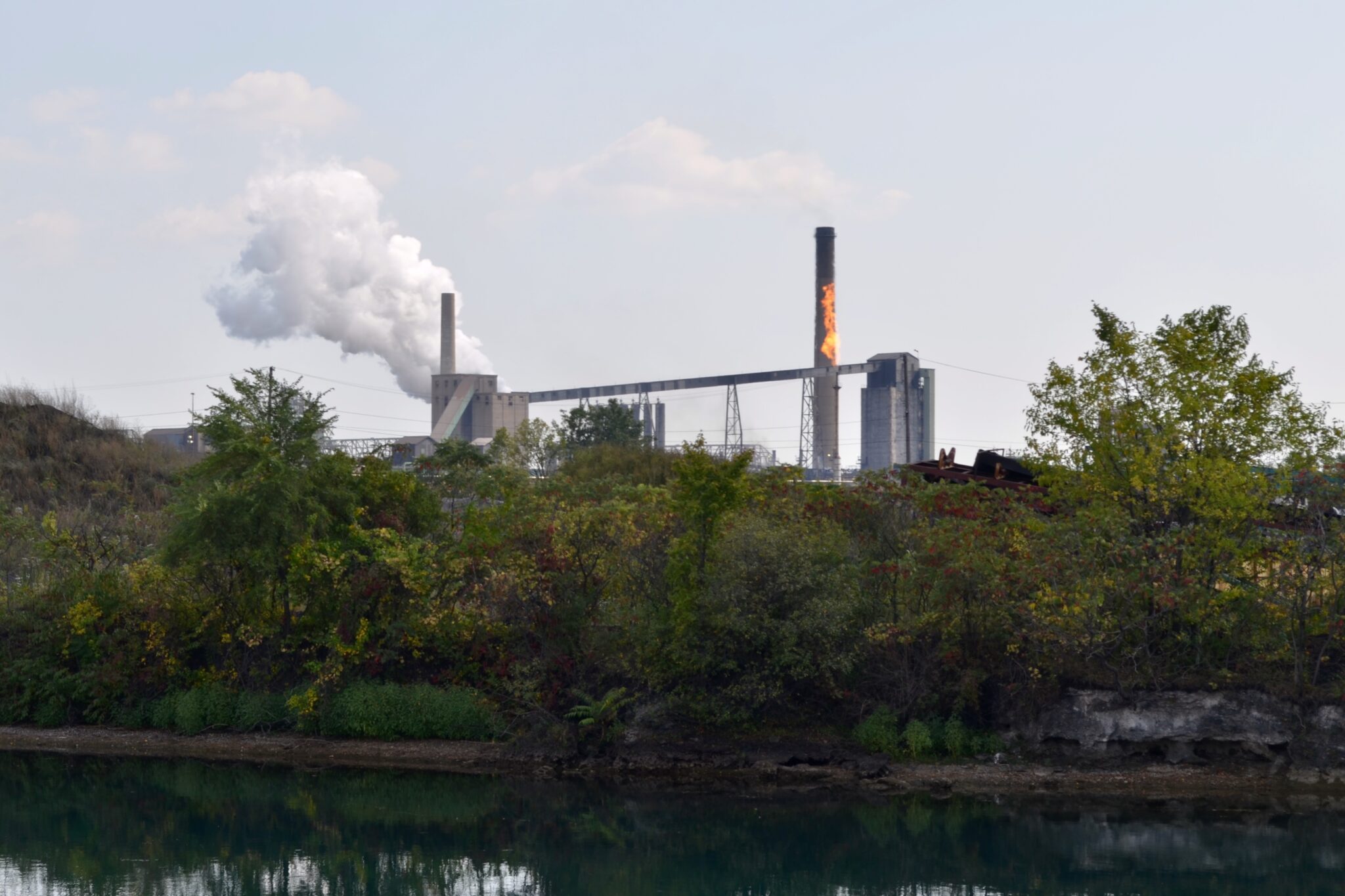
You can smell it before you can see it. Massive black blast furnaces and grey smokestacks, and a coke oven that shoots flames into the sky, heavily contribute to the surrounding area’s reputation as Michigan’s most polluted zip code.
Civic Action Toolbox
🗳️ Civic Action Toolbox
Why it matters
Who's making public decisions
Upcoming Meetings
Open Comment Periods
Contact Your Representatives
Civic Actions: What You Can Do
Organizations to Follow
What to watch for next
Did you take action? Let us know.
Civic resources compiled by Planet Detroit
The site: Zug Island. An industrial, coal-choked wasteland on the Detroit River shoreline. It’s situated near many polluters: an oil refinery, sewage treatment plant, and a soon-to-open international border crossing.
Detroit’s decisions over more than a century to concentrate industrial development in the city’s southwest corner created multiple hazardous neighbors for residents during an era with fewer environmental protections. The steel industry on Zug Island has pumped out pollution for more than a century.
As federal environmental oversight weakens, Detroit risks repeating the problems of its past, when skies were red-orange and industry was virtually unchecked.
How Zug Island became a symbol of industrial Detroit
Zug Island, owned by U.S. Steel, was once a marshy peninsula on the Rouge River that buzzed with wildlife and bubbled with sulfur springs.
Located in River Rouge and bordering Detroit, the island was once part of the former village of Delray.
Lifelong residents describe the industrialized island as a “big, giant, black monster.” That’s how Theresa Landrum — a 71-year resident of Detroit’s 48217 zip code, Sierra Club member, and environmental activist — characterized it in federal court testimony.
In 1859, Samuel Zug, an anti-slavery activist, founding member of the Republican Party, and bookkeeper, purchased the land at the confluence of the Detroit River and Rouge River with intentions of building an estate for his family, according to the historical society.
Stinky sulfur springs that bubbled up 1,200 barrels of mineral water per day proved unlivable, and in 1888 Zug allowed the River Rouge Improvement Co. to dig a canal, creating Zug Island, according to a contemporary Detroit Free Press report.
Early ideas for the island included a city garbage dump with a promise of the operations being “smokeless and odorless,” or improving the land into a “healthful resort similar in attractiveness to Belle Isle.”
Ultimately, the land was dedicated to industrial use in 1891, when the 325 acres were sold to two Detroiters with plans for a railroad trestle coal dock. By 1895, the president for Solvay Process Co., aptly named Mr. Rowland Hazard, bought Zug Island and employed 300 men who sunk 10 salt wells for soda ash and byproduct manufacturing, the Free Press reported.
The Rouge River area was described as “the busiest scene of industrial activity in Michigan” by the Detroit Free Press in 1895.
Shipping was Detroit’s largest industry by the mid-1800s as a result of iron ore mining in the Upper Peninsula, and the completion of the Sault Ste. Marie locks that brought iron and copper ore to Detroit directly by ship.
With its waterfront access, Zug Island was a key site for receiving ore from Lake Superior’s plentiful deposits.
Populations boomed across the United States in the 20th century, and large integrated steel mills came online in what were then the Steel Belt states to support the burgeoning demand for the alloy.
In 1864, the first Bessemer-type steel, produced with an inexpensive industrial process for the mass production of steel, was produced in the U.S. at Eureka Iron Works in Wyandotte, according to the Detroit Historical Society.
In 1901, a $1-million blast furnace was announced for the Detroit Iron and Steel Co. on Zug Island. The first iron ore cargo was unloaded onto Zug Island in 1903, and in 1904 the plant started to “eat into its 360,000 tons of ore.”
The M.A. Hanna Company of Cleveland bought the works in 1904 and built a second blast furnace in 1909. In late 1931, the plant expanded and was integrated into a larger steel mill as National Steel Corp., which added Great Lakes Steel Corp. as a subsidiary.
In 1948, Great Lakes Steel employed 13,000 men across its Ecorse and Zug Island facilities. By 1955, steel company officials said the blast furnace on Zug Island was the world’s largest. It measured 30 feet 3 inches in diameter, with a rated capacity of 50,000 tons of pig iron a month.
In 1948, the Detroit Free Press reported that the Solvay Process Co. discharged 30 million gallons of wastewater per day into the Rouge River, containing calcium chloride, unreacted brine, and calcium sulfate.
The waste from Great Lakes Steel was mainly human sewage, oil, and neutralized pickle liquor. “The huge furnaces, massive mills and giant presses operate in a one-time duck march work almost round the clock in these steel-hungry days,” the Detroit Free Press reported in 1948.
A year later, the Stream Control Commission, a state administrative body that controlled water pollution, created an industry report on pollution controls and ranked industries from 1 to 8. Zug Island scored a 6, meaning existing pollution controls were inadequate or incomplete.
Zug Island pollution, noise cross international border
Reports of Canada’s battle with Zug Island pollution date to at least 1949, when a “black column of smoke” rose from tar refuse that was being burned on Zug Island on days when the wind was blowing across the Detroit River toward Canada, according to the Windsor Star.
Over the years, Windsor residents complained of noxious odors from phenol gas, orange clouds of iron oxide, and a maddening noise.
A low-frequency noise has long been attributed to Zug Island. Planet Detroit found a 1959 report that termed the problem the “Windsor Whir.”
Colin Novak, a University of Windsor scientist and chief investigator of the Windsor Hum as part of a 2011 Canadian federal government inquiry, said the “Whir” was a continuous, high-amplitude sound, much higher than that of the more recent Windsor Hum, Novak said.
“My thought, especially since it wasn’t a continuing problem, is that the sounds that people were hearing back then was just increasing general industrial noise that was growing in intensity from increased industrial activity,” Novak said.
According to a Windsor city building commissioner in 1959, the possible source of the hum had something to do with “a pair of fans that vibrate against the smoke stacks, which react like tuning forks.”
Novak said he thinks residents started to notice the Windsor Hum, which he described as an “intermittent, very low amplitude” sound, around 2008. The disruption sparked the 2011 Canadian investigation, conspiracy theories, indie films, and a citizen-led hum tracker.
U.S. Steel suspended operations at the Zug Island plant in 2008 when the American economy was in a recession. A year later, manufacturing resumed, and the hum returned, Canadian magazine Maclean’s reported.
The low-frequency sound was most prominent between 2010 and 2012, after which it dropped off, Novak said.
The sound subsided when the steel mill closed in 2020.
Zug Island drives decades of air quality concerns
Heavy industrial activity on Zug Island pumped out pollution for decades at the expense of nearby residents’ health before early environmental regulations took effect.
Steel production produces particulate matter, greenhouse gases, and volatile organic compounds, according to the air quality monitoring company Kunak.
The Air Pollution Control Act of 1955 was the first federal legislation to declare the harms to public health from air pollution and to fund corresponding research.
In May 1963, the U.S. State Department in Washington began an inquiry into the effects of air pollution from Zug Island on Windsor. In September of that year, seven air sampling stations were set up along a 10-mile stretch of the Detroit River on the Canadian side.
Funding for control techniques came with the 1963 Clean Air Act, the first federal legislation that authorized research into air pollution control techniques as a U.S. Public Health Service program. The 1967 Air Quality Act added to federal government activities in this area.
In 1970, under President Richard Nixon, the federal government’s environmental responsibilities were consolidated into a new agency. The Environmental Protection Agency sets and enforces standards for air and water quality, and individual pollutants.
The Clean Air Act of 1970 authorized federal and state regulations to limit emissions from industrial and mobile sources, updating and expanding the existing 1963 act.
The law introduced four major regulatory programs affecting stationary sources: the National Ambient Air Quality Standards, State Implementation Plans, New Source Performance Standards, and National Emission Standards for Hazardous Air Pollutants.
Zug Island’s recent history
The coke oven battery operations on Zug Island include 85 coke ovens that are more than 19 feet high, a byproduct recovery plant, and a coke oven gas flare — a tall stack that occasionally shoots flames into the sky.
The coke battery transforms coal into metallurgical coke, a carbon-rich blast furnace fuel.
Coal is heated without air in an oven of more than 2,000 degrees Fahrenheit until most of its volatile matter is released, causing it to soften, liquefy, and re-solidify into hard, porous coke. This coke is then mixed with iron ore and limestone to create molten iron, which is further processed into steel.
National Steel Corp.’s Great Lakes division once owned and operated the battery, according to the Michigan Department of Environment, Great Lakes, and Energy (EGLE).
National Steel sold the battery to EES Coke in 1997 but continued to manage operations.
In 2003, U.S. Steel acquired National Steel’s iron and steel assets. In 2004, DTE Energy formed EES Coke Battery, LLC, to take over coke manufacturing, according to EGLE.
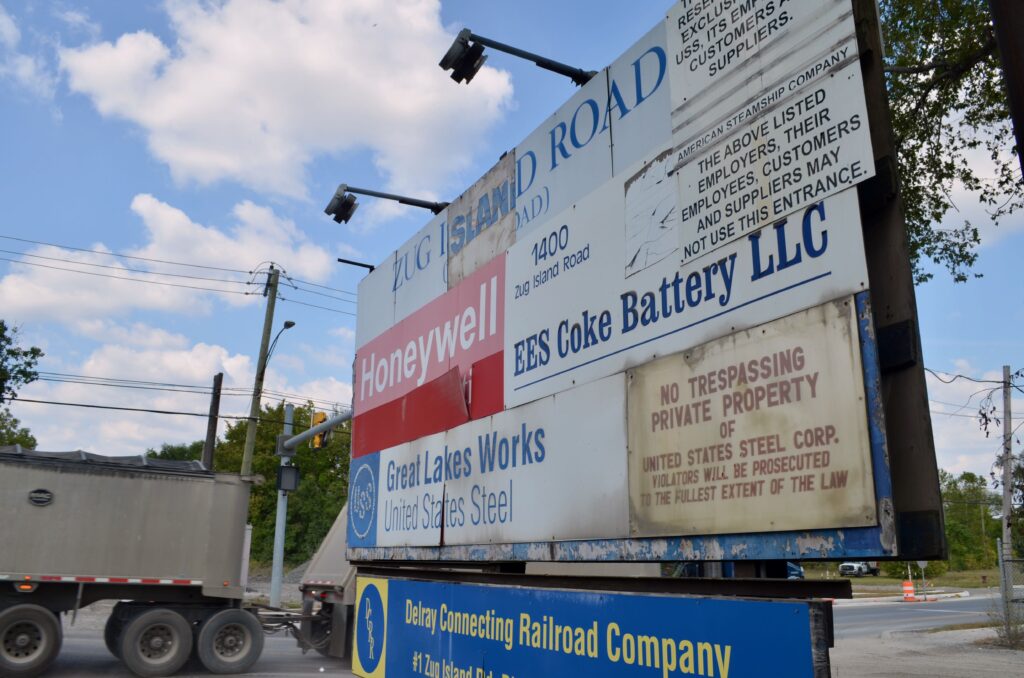
In 2019, U.S. Steel announced Great Lakes Works would permanently shut down and lay off as many as 1,500 workers. Steel production ended in April 2020, despite Trump’s statements that tariffs would strengthen the steel industry, NPR reported.
As of 2025, Great Lakes Works offers steel finishing facilities primarily serving the automotive industry. Iron and steelmaking on Zug Island are permanently idled, according to the company.
EES Coke Battery’s history of environmental violations
National Steel Corporation’s facilities, including the sites on Zug Island, were included in a consent agreement the company reached with the Michigan Department of Natural Resources in 1993 to control particulate matter and fugitive dust emissions and help bring part of Wayne County into attainment with PM-10 standards.
The consent agreement served as a facility-specific tool to meet National Ambient Air Quality Standards.
The consent order is still active, said Josef Stephens, public information officer for EGLE. The order is part of a State Implementation Plan for particulate matter and PM-10 and can only be terminated by the EPA in limited circumstances, Stephens said.
Regulatory documents show a pattern of excessive emissions from EES Coke Battery.
EES Coke Battery collected 62 state air quality violations from 2013 to 2026. The facility has taken compliance actions on the six most recent violations, and the remaining are inactive, according to EGLE.
The latest violation notice was issued by Michigan regulators to EES Coke Battery on March 5, 2026. The company failed to properly verify emissions of particulate matter and volatile organic compounds during September 2025 stack tests, which are required by EGLE every two years, according to the notice.
A stack test “measures the amount of a specific regulated pollutant … and is an important tool used to determine a facility’s compliance with emission limits,” according to the EPA.
EGLE found the tests did not follow the required methods and lacked sufficient valid samples of air contaminants.
EES Coke Battery has until March 26 to respond to the violation notice. The written response to EGLE should include the dates the violation occurred, what caused it and for how long, whether the violations are ongoing, and a summary of actions taken to correct the violation and prevent a recurrence, as specified in the notice.
A spokesperson for facility owner DTE Energy told Planet Detroit that EES Coke Battery is “committed to 100% compliance” with state and federal regulations in the interest of public health.
“Our operations have systems in place to enable this compliance, while we serve a critical function producing coke to fuel the steel industry and supporting more than 170 jobs in the community,” the spokesperson said.
The facility exceeded the hourly particulate matter limit and failed to monitor, maintain, and submit records on time, or at all, according to 18 violations issued by the state to EES Coke Battery in 2013.
From January to June 2024, the facility exceeded the visible emissions limit from the bypass and bleeder flares 15 times and reported 172 opacity exceedances from the flares.
Of the reported opacity exceedances, 171 took place on a single day, according to Jenifer Dixon, planning and policy coordinator at EGLE. The values are based on the facility’s self-reported data, she said.
From July to December 2024, EES Coke Battery exceeded visible emissions 17 times and reported five opacity exceedances.
EES Coke has taken compliance actions to resolve the two 2024 violations, state regulators said.
EPA lawsuit over Zug Island air pollution ends in $100 million judgment
A 1990 state permit issued when EES Coke Battery was rebuilt set a limit on the amount of coke oven gas burned at underfire, according to an EPA lawsuit against the facility.
The state permit included restrictions to “ensure that New Source Review was not triggered,” the EPA said.
The New Source Review program, part of the Clean Air Act, requires facilities to install pollution control equipment upon building or making a significant change that increases air emissions.
In 2014, EES Coke asked the state to remove the coke oven gas limit, which the state did in the air quality permit issued that year.
“In seeking the change, EES Coke predicted its future pollution levels and told the state that there would not be a significant emissions increase” of sulfur dioxide or particulate matter, the EPA lawsuit said.
The removal of the limit resulted in more than 1,000 tons of additional sulfur dioxide emissions in several different years, according to the EPA.
In 2020, the EPA issued an air quality violation notice to EES Coke Battery, and in 2022, it filed a Clean Air Act lawsuit against the facility over sulfur dioxide emissions.
On Feb. 17, a federal judge ordered DTE Energy and EES Coke Battery to pay a $100 million fine, comply with the Clean Air Act, and fund $20 million in community air-quality improvement projects.
The ruling against the utility and its EES Coke Battery subsidiary by U.S. District Judge Gershwin Drain followed a September bench trial of the EPA lawsuit.
DTE argued in the case that it is not responsible for EES Coke Battery and its Clean Air Act violations.
Earlier in the case, Drain said in an Aug. 25 ruling that the facility violated the Clean Air Act by making a major modification to its operations, by seeking and obtaining a permit from EGLE that would remove the limit on the amount of coke oven gas burned at underfire, instead of a minor modification as the permit allowed.
In addition to the $100,000,001 civil penalty to be paid to the government, Drain ordered DTE and EES Coke Battery to comply with the Clean Air Act by obtaining the necessary New Source Review permits and to form a community action quality committee and fund it with $20 million for community air quality improvement projects.
DTE plans to appeal Drain’s order, a spokesperson for the utility told Planet Detroit at the time of Drain’s order.
The defense lawyers representing EES Coke Battery and its owner, DTE Energy, said during the trial that the government’s proposal amounts to a shutdown order — one that EES Coke Battery cannot afford, physically accommodate, or complete on time.
Residents say it’s about time something is done to protect their health.
Twenty-six premature deaths, 3.8 nonfatal heart attacks, 8,000 acute respiratory symptom days, 14.5 new asthma cases, and additional Alzheimer’s cases are modeled to have occurred in 2019 due to sulfur dioxide and particulate matter pollution from the coke battery, an epidemiologist testified at the trial.
An air quality expert with 40 years of experience testified Sept. 17 that EES Coke Battery’s excess particulate matter emissions are “one of the largest sources I’ve ever seen,” with pollution that traveled as far as Maine, Missouri, and North Carolina.
Trump exempts Zug Island facility from new coke oven rules
In November, President Donald Trump’s administration granted EES Coke Battery on Zug Island, along with 10 similar facilities across the nation, a two-year exemption from compliance with the Biden-era Coke Oven Rule, which is designed to detect and limit hazardous air emissions.
Eleven facilities across the nation — including EES Coke Battery — are now exempt from coke-oven pollution requirements for 2 years.
The regulations include new requirements for fenceline monitoring of benzene; leaks from coke oven battery doors, lids, and offtakes; and pollution control standards. Without Trump’s exemption, EES Coke Battery would have had to meet new pollution-control standards for hazardous air pollutants by Jan. 5, 2026, under the EPA rule.
The president can exempt stationary sources from Clean Air Act compliance for up to two years if the president believes the necessary technology is unavailable and it is in the country’s national security interest.
Planet Detroit covered the story in depth.
The lived health burden around Zug Island
Detroit ranked sixth worst in the nation for year-round particle pollution in 2025, according to the American Lung Association.
Lifelong residents of neighborhoods near Zug Island testified in federal court in September that they’ve stopped undertaking outdoor activities due to the impact of air pollution on their health.
Dolores Leonard, a resident of zip code 48217 since 1957 and an early advocate for environmental justice, said she gets a tight feeling in her chest from being outside too long.
Leonard’s inability to be outside in her neighborhood, coupled with COVID-19 precautions, keeps her in her garage while her grandchildren play outdoors, she said.
“That’s not really a visit,” she said.
This story is part of a Planet Detroit series examining the public health impact of Zug Island industry on nearby communities.
ZUG ISLAND NEWS
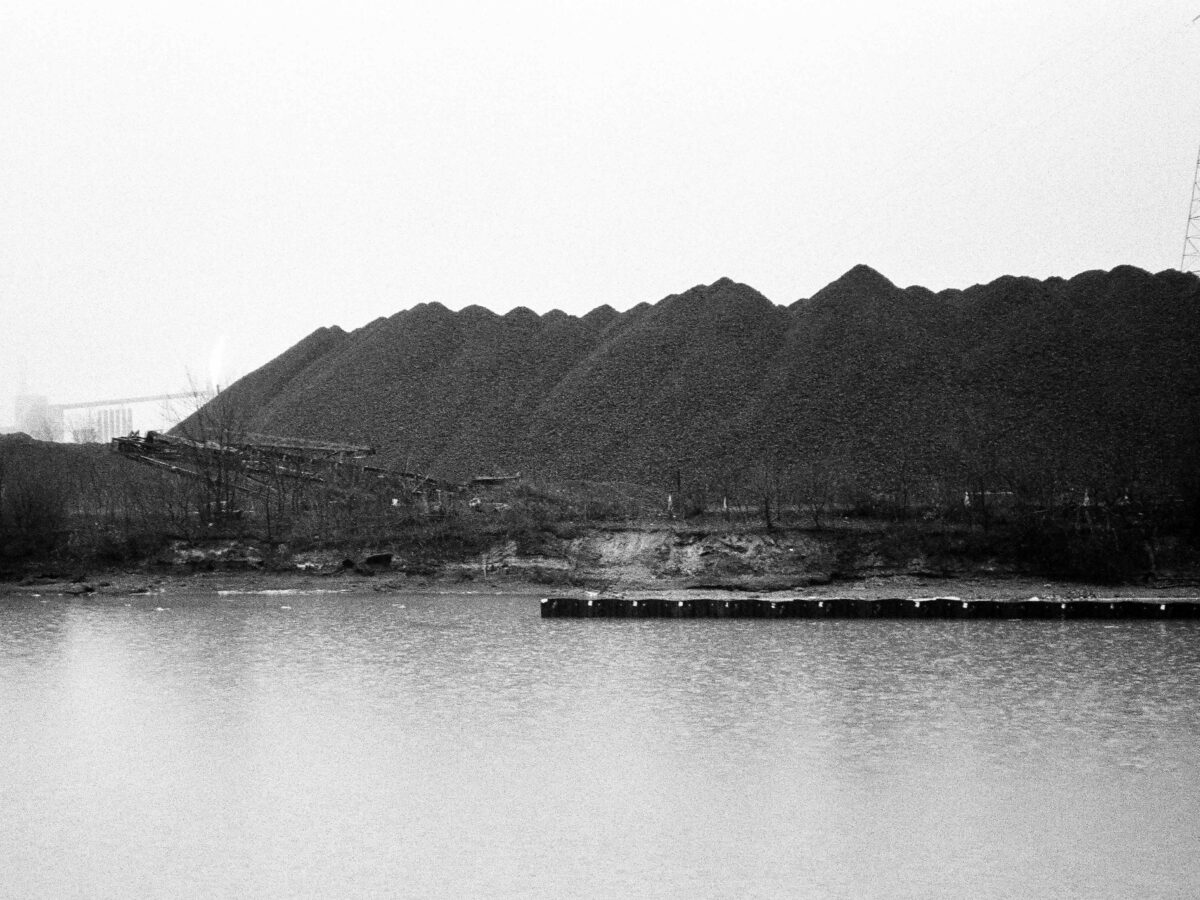
Court finalizes $100 million judgment against DTE Energy for Zug Island air pollution
This story was produced with support of Internews’ Earth Journalism Network.DTE Energy and three of its subsidiaries must pay $100 million for Clean Air Act violations at EES Coke Battery on Zug Island within 90 days, according to a final judgment entered in federal court Tuesday. The facility must come into compliance with the Clean…

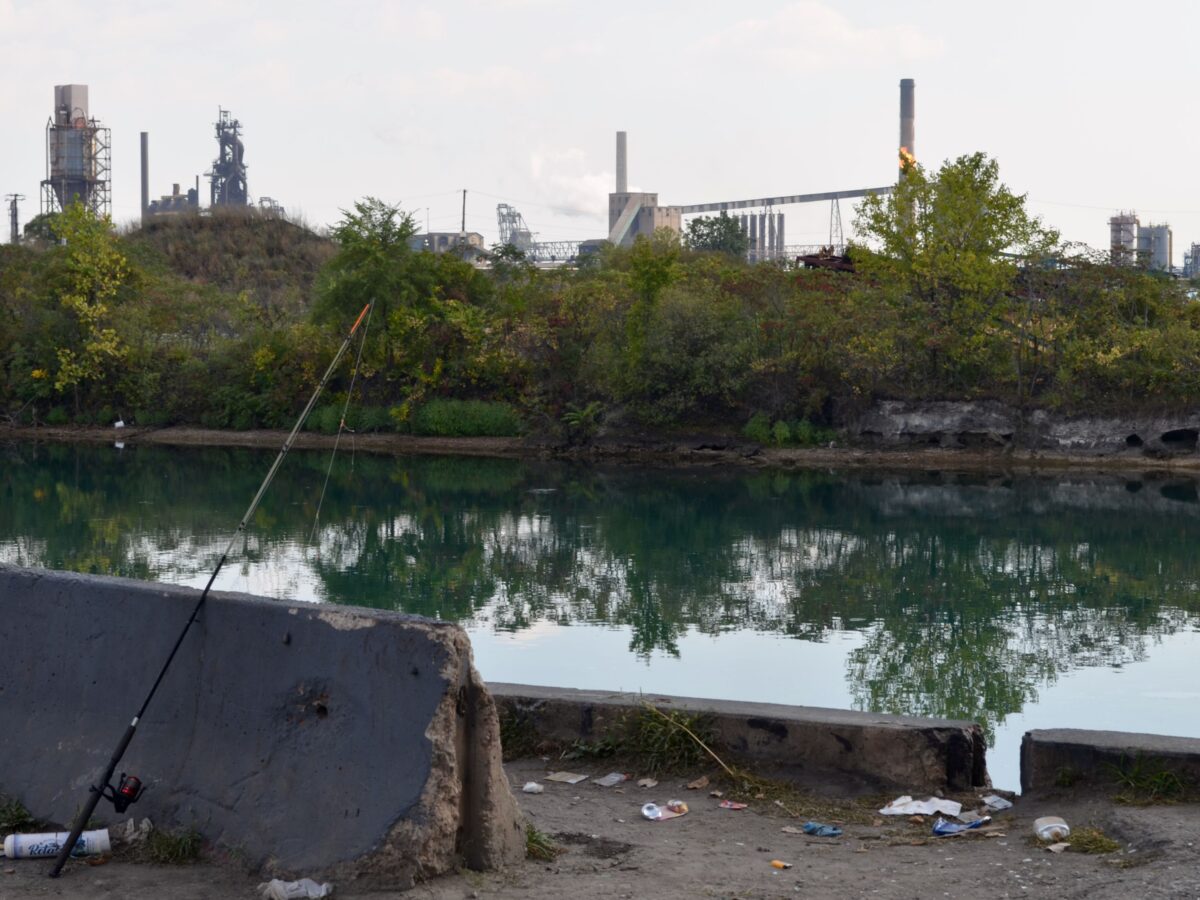
Judge fines DTE, its Zug Island facility $100 million for Clean Air Act violations
The EPA sought a $140 million civil penalty in the lawsuit, which DTE lawyers said amounts to a shutdown order on Zug Island.

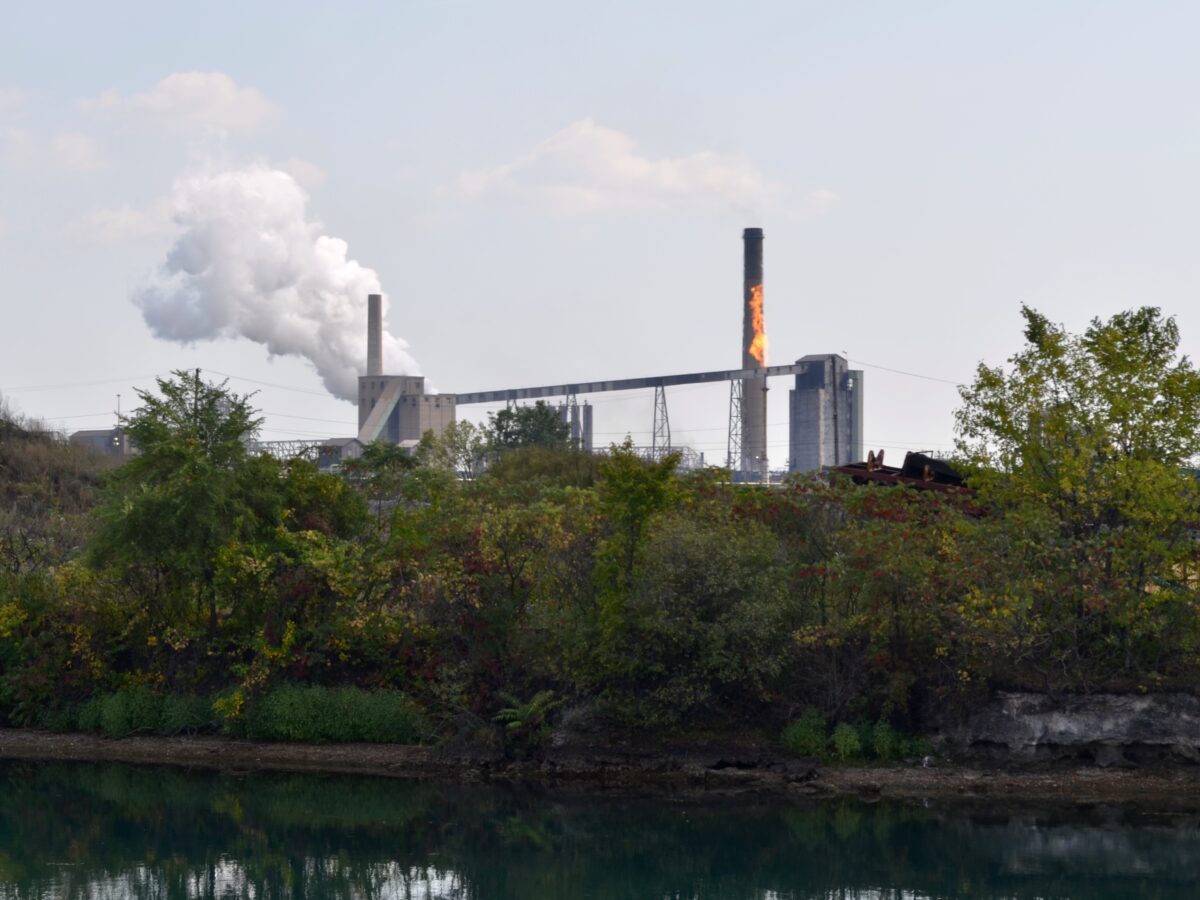
Trump exempts Zug Island’s EES Coke Battery from new pollution rules for 2 years
In May, Planet Detroit reported that EES Coke Battery was offered a two-year exemption by the Trump administration from deadlines to comply with air pollution standards.