

Overview:
- Rallies are planned in six Michigan cities this weekend to oppose data center projects that organizers say benefit from DTE and Consumers Energy's political donations.
- Data center opponents support legislation to repeal tax breaks for the facilities and enact a one-year moratorium on new projects.
- A ballot initiative to ban political donations from monopoly utilities has 81% support among Michigan voters, according to a recent poll.

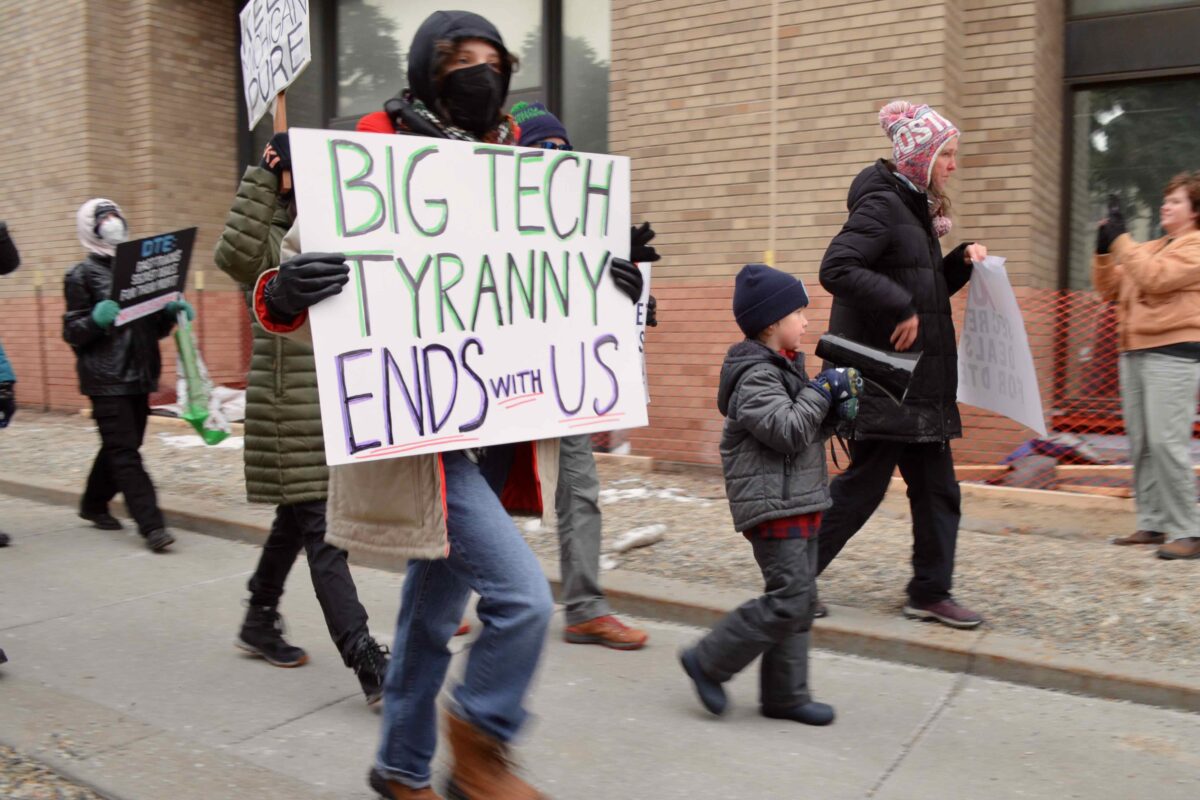
Rallies are planned in Detroit, Ann Arbor, and several other Michigan cities this weekend to push back on data center projects that organizers say are driven by DTE Energy and Consumers Energy’s political donations.
Several of those who spoke with Planet Detroit tied grassroots efforts to stop data centers to the Michiganders for Money Out of Politics (MMOP) ballot initiative, which would bar monopoly utilities from making political donations.
State Rep. James DeSana, a Monroe County Republican scheduled to speak at the Ann Arbor rally, said his constituents oppose data centers by a wide margin that crosses party lines. They’re concerned the projects will occupy agricultural land, use large amounts of electricity and water, and create noise and vibration, he said.
Civic Action Toolbox
🗳️ Civic Action Toolbox
Why it matters
Organizers and speakers at data center rallies planned across Michigan this weekend say opposition to the power- and water-hungry facilities crosses party lines.
Who's making public decisions
Upcoming Meetings
Contact Your Representatives
Civic Actions: What You Can Do
Organizations to Follow
What to watch for next
Augusta Township voters will decide on rezoning land for a $1-billion data center project in August, and the MMOP ballot initiative could appear on the November ballot if it gathers enough signatures. A data center moratorium and a repeal of tax breaks for the facilities are among the measures under consideration in the Michigan Legislature.
Are you taking action? Let us know.
Civic resources compiled by Planet Detroit
DeSana is among the lawmakers supporting the MMOP ballot initiative, arguing that political spending was behind the passage of Michigan’s data center tax breaks in 2024.
“The reason that these big, gigantic corporations are getting tax breaks is because money in politics got the bills passed,” he said, adding that ratepayers’ money is being used against them when utilities lobby for data centers.
Wendy Albers, an Augusta Township resident who is helping organize Saturday’s rally in Ann Arbor, said Michiganders will be hit twice by data centers, supporting wealthy companies with state tax breaks and paying bigger utility bills.
“I think politics are for the people and we should not have big corporations paying to influence our politicians,” she said.
DTE Energy spokesperson Ryan Lowry said the company “is committed to being a responsible corporate citizen and complies with all applicable laws regarding corporate donations and political contributions.”
DTE will include additional protections in its service agreements with new data center customers to ensure they cover the costs required to serve them, Lowry said.
Repeal of data center tax breaks, one-year moratorium introduced in Michigan Legislature
Albers supports legislation to repeal state tax breaks for large data centers and bills to institute a one-year moratorium on data centers in the state.
A moratorium could set up a better vetting process for proposed data centers and give municipalities a chance to update zoning ordinances to prepare for possible developments, Albers said.
She is also pushing for a local moratorium in Augusta Township, where a $1-billion data center has been proposed. Voters will decide on rezoning land for the project in August.
The projects have encountered intense opposition in many Michigan communities, with residents arguing data centers could increase their utility bills and undermine state climate goals.
The facilities’ power demands could trigger an “off ramp” provision in Michigan’s climate law, allowing fossil fuel generation to stay online if there’s a capacity shortage.
Data center developers and public officials have said the projects could bring thousands of temporary construction jobs and millions in local tax benefits.
DTE and Consumers executives have touted data centers as a major growth opportunity for the utilities during shareholder calls.
Data center rally times, locations
Rallies are planned for Friday and Saturday in:
- Houghton: 6-8 p.m. Friday, April 10 across the street from Veteran’s Memorial Park, Memorial Road.
- Detroit: 5-7 p.m. Saturday, April 11 Roosevelt Park, 2231 Michigan Ave.
- Ann Arbor: 11 a.m.-4 p.m. Saturday, April 11, University of Michigan Diag, 913 S. University Ave.
- Lansing, 11 a.m.-1 p.m. Saturday, April 11, 1300 Eureka St.
- Grand Rapids, 4-5 p.m. Saturday, April 11, Calder Plaza, 320 Ottawa Ave. NW.
- Traverse City, 10 a.m.-11 a.m. Saturday, April 11, Open Space Park, W. Grandview Parkway.
Michigan has bipartisan agreement that ‘money corrupts politics’: Voter advocate
If the MMOP ballot initiative gathers enough signatures, Michiganders will have a chance to vote on the measure in November. The proposed legislation would ban political donations from regulated monopolies, companies with government contracts over $250,000, or businesses seeking such contracts.
Christy McGillivray, executive director for the nonprofit Voters Not Politicians, said the statewide backlash to data centers illustrates how elected leaders in both parties are disconnected from their constituents, a disconnect she said is driven by money in politics.
“We have to have a feedback loop that actually holds politicians accountable for how their constituents feel,” she said. “When DTE can buy them off, that accountability loop is broken and that means our democracy is really on the rocks.”
McGillivray said she has had success obtaining signatures for the MMOP ballot initiative at largely Democratic events like the “No Kings” protests — as well as the Michigan Republican Party’s 2025 nominating convention.
“Everyone agrees that money corrupts politics,” she said.
A November poll by Democratic-affiliated Public Policy Polling found 81% of Michiganders somewhat or strongly support the MMOP ballot initiative.
Consumers spokesperson Brian Wheeler said the MMOP ballot initiative would eliminate the free speech rights of CMS Energy, Consumers’ parent company, and Consumers employees.
“This ballot petition disenfranchises over 900 state contractors, picking winners and losers in who can and cannot express their freedom of speech through transparent political activity,” Wheeler said.
Wheeler also defended the impact data centers would have on ratepayers, saying projects that create significant load growth will put downward pressure on rates and lower costs.
Douglas Jester, a consultant with 5 Lakes Energy, previously told Planet Detroit that data centers could increase residents’ utility bills if other users are required to pay for a portion of new generation needed to meet the facilities’ energy needs. Data centers could also drive up the wholesale cost of power, which could impact other customers, he said.
State House candidate looks to repeal tax exemptions, change zoning act
Chris Gilmer-Hill, who is running as a democratic socialist to represent the 8th District in the Michigan House of Representatives, said he wants to repeal the state’s data center tax exemptions and change Michigan’s Zoning Enabling Act to make it harder for data centers to locate in communities that don’t want them.
Last year, the Saline Township board voted to deny the rezoning of 575 acres needed for a $7-billion Oracle and OpenAI data center in September.
Landowners and project developer Related Digital sued the township days later, alleging its rezoning decision constituted exclusionary zoning barred by the Michigan Constitution. This occurs when “a community unreasonably excludes a legitimate land use,” the lawsuit said.
The township settled the lawsuit in October after township attorneys warned the suit could be amended to include monetary damages, allowing the 1.4-gigawatt project to move forward.
Gilmer-Hill, who is scheduled to appear at Saturday’s Detroit rally, said he’s heard from Detroit and Ferndale residents who are concerned data centers will increase their utility bills.
“Even the Republicans we talk to, they’re no longer saying, ‘oh, just put it in Detroit or just put it in the rural area,'” he said. “People don’t want these at all.”
DATA CENTER NEWS

Data center news: Ypsilanti Township escalates fight against U of M, Los Alamos project
Local battles over data center development in Michigan are escalating, from recall efforts to formal resolutions.


Wixom weighs data center ordinance: ‘We aren’t necessarily prepared’
Wixom’s draft data center ordinance creates a buffer between the facilities and residential areas.

University of Michigan buys possible data center site on Huron River, informs Ypsilanti Township supervisor via text
As a public university, U of M is exempt from local zoning requirements — meaning the project does not require township approval.