

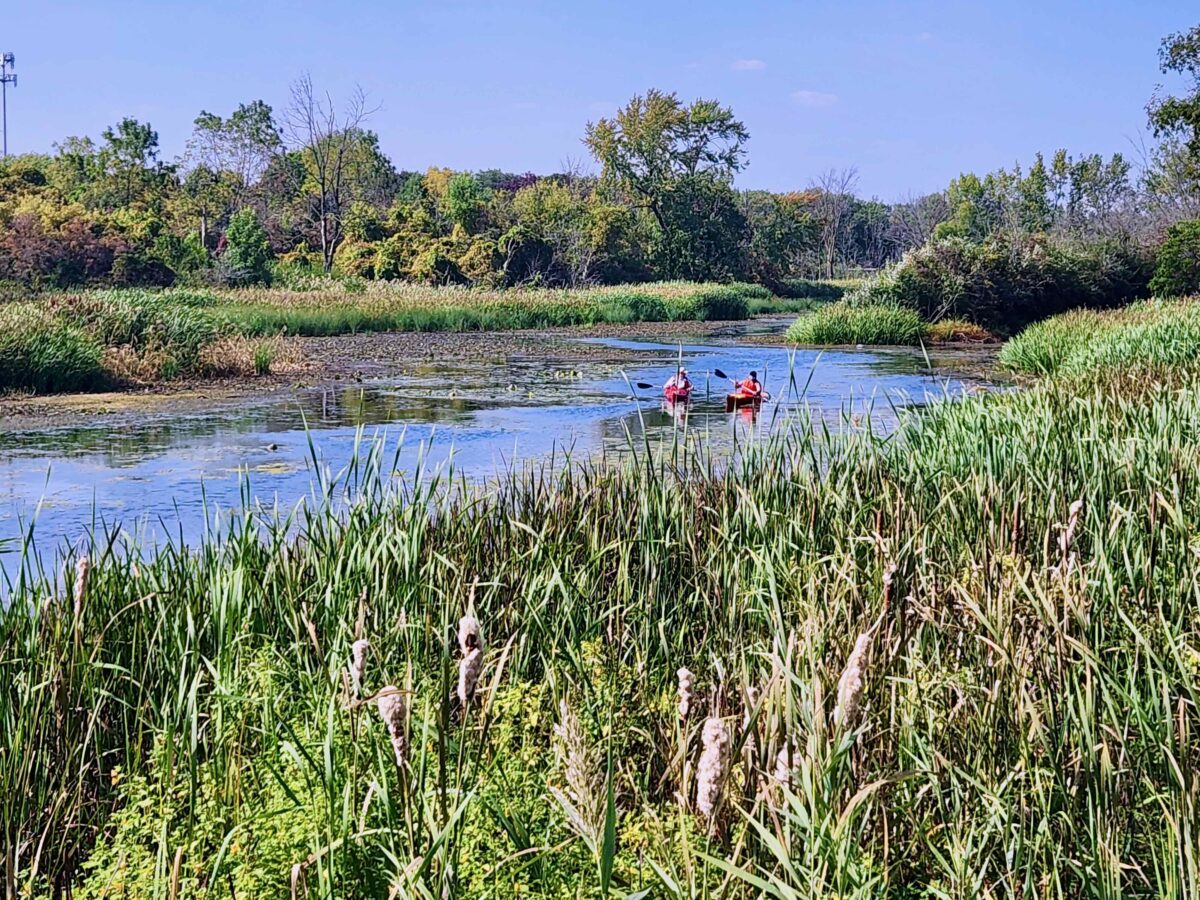
Overview:
- The Nottawaseppi tribe and five conservation partners planted wild rice at Humbug Marsh and Belle Isle in September 2025.
- Wild rice, Michigan's official state grain and a threatened species, once thrived in Detroit River wetlands before development and pollution eliminated major stands.
- The project serves as both ecological restoration and cultural tribute, honoring First Nations heritage while creating habitat for wildlife in the recovering Detroit River ecosystem.

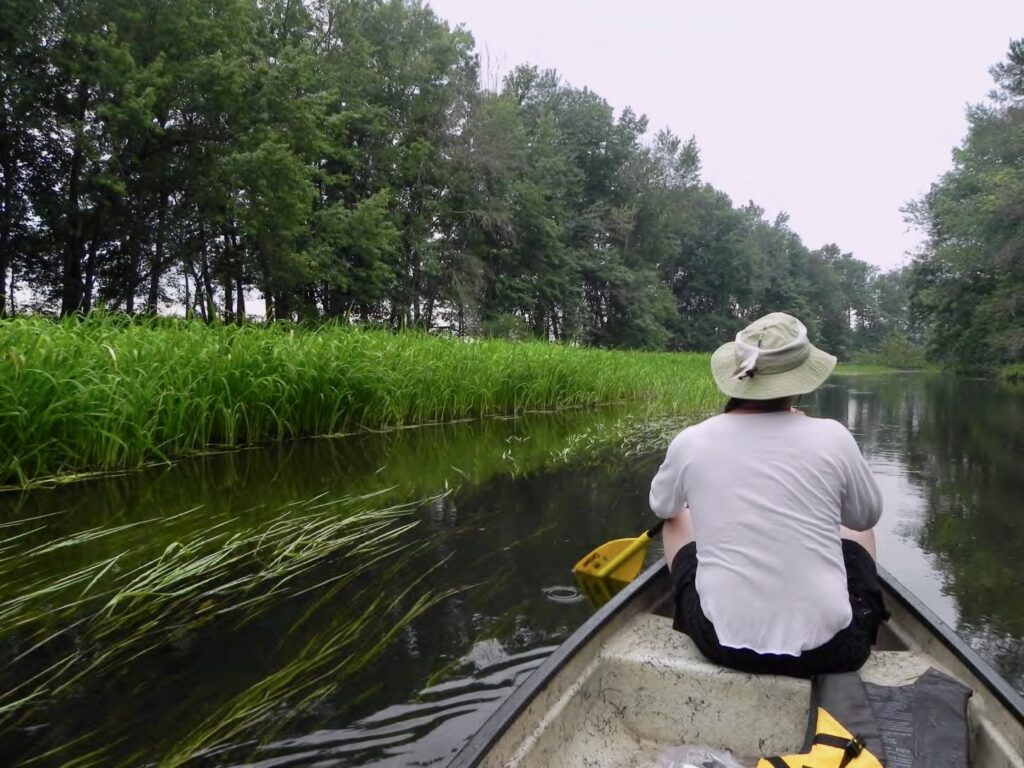
Tribal member Kevin Harris glides his canoe through the slow-moving waters of the Pine Creek, a quiet stream that winds south of Battle Creek, Michigan, near the town of Athens.
The only sounds on this quiet and peaceful day are the canoe paddle breaking the water surface with each rhythmic stroke, the soft swishing sound of the wild rice stalks hitting the side of the canoe, and the “conk-la-ree” song of nearby red-winged blackbirds.
It’s a perfect day to assess the fruits of the Nottawaseppi Huron Band of the Potawatomi’s efforts in restoring wild rice in the waters within and surrounding its 120-acre Pine Creek Indian Reservation.
Harris is proud of his tribe’s restoration efforts, but not satisfied, he told Planet Detroit.
He’s working with Metro Detroit conservation partners to restore wild rice in the Detroit River, the homeland of his ancestors. The tribe’s goal is to restore this sacred grain in its ancestral waters, raise awareness of tribal history and culture in a region that often overlooks it, and honor traditional ways.
The Nottawaseppi is a federally recognized tribal government with over 1,500 members. This tribe is an advocate for wild rice restoration throughout Michigan, including spearheading the effort to designate it as Michigan’s official state grain in 2023.
How wild rice planting sites were selected
Wild rice was once abundant in the Detroit River’s extensive coastal wetlands. First Nations have always regarded it as a divine gift from the Creator. Historical records show that wild rice was common near a Potawatomi village at the confluence of the Detroit and Rouge rivers, and in coastal wetlands along the mainland shoreline and surrounding islands.
As Detroit became settled and developed by Europeans, most of these wetlands were filled, and shorelines hardened to support commerce and industry. Water pollution took its toll. Eventually, the Detroit River lost all its major wild rice stands, and today it has been designated as a threatened species by the state of Michigan.
“Wild rice or Mno-men is a staple of our Neshnabek diet,” said Harris, cultural specialist of the Nottawaseppi. “It is one of the sacred gifts from the Creator we use in cultural ceremonies and traditions, and in strengthening our food sovereignty.”
In the summer of 2025, six conservation partners, including the Nottawaseppi, U.S. Fish and Wildlife Service, Michigan Department of Natural Resources, Belle Isle Conservancy, Grosse Ile Nature and Land Conservancy, and the State of the Strait — a U.S.-Canada forum fostering ecosystem-based management of the corridor — came together to scope out a wild rice demonstration project for the Detroit River under the guidance of the Nottawaseppi.
The group reviewed many potential sites. They include:
• The Detroit River International Wildlife Refuge’s Humbug Marsh, Gibraltar Wetlands Unit, and Sugar Island.
• Belle Isle’s Lake Okonoka, part of the island’s canal system.
• The creeks of Pointe Mouillee State Game Area, located at the mouths of the Detroit and Huron rivers.
• Grosse Ile’s Morse Preserve on Thorofare Canal.
• The Bruce Jones Preserve on the Trenton Channel.
All partners agreed this restoration effort would not be a rigorous research project, but an experimental approach of planting wild rice and seeing if it would establish.
From this list of potential sites, two were chosen for initial wild rice planting: the Monguagon Delta of Humbug Marsh and Belle Isle’s Lake Okonoka.
Monguagon Delta and Creek are named after Chief Moguago, who was a pivotal Nottawaseppi leader from 1839 to 1863. He resisted forced removal during the “Trail of Death,” helping his people return to Michigan and establish the Pine Creek Indian Reservation. This helped ensure their survival in their ancestral homeland.
Okonoka is widely believed to be an indigenous-inspired name.
How wild rice grows
The key factors in the wild rice site selection were shallow, slow-moving water, mucky or silty bottom substrates, and protection by the landowner or manager.
On Sept. 17, 2025, Harris and conservation partners planted wild rice harvested from Pine Creek Indian Reservation by canoe at Monguagon Delta and Lake Okonoka.
The 410-acre Humbug Marsh is Michigan’s only Ramsar Wetland of International Importance and the cornerstone of the Detroit River International Wildlife Refuge, owned and managed by the U.S. Fish and Wildlife Service.
“Both the restoration of wild rice and our partnership with First Nations are core commitments of the refuge,” said Dan Kennedy, refuge manager of the Detroit River International Wildlife Refuge.
“Wild rice carries deep cultural meaning for First Nations and also enriches the ecosystem, offering shelter, food, and resting habitat for a wide range of bird species.”
The 982-acre Belle Isle is owned by the city of Detroit and managed as a state park in a partnership with the Michigan Department of Natural Resources.
Wild rice’s last documented occurrence on Belle Isle was in 1892, said Greg Norwood, ecologist with the Michigan Department of Natural Resources.
“It has now been designated as a restoration target species in the island’s stewardship plan. Despite years of working with others to restore so many other species and habitats on the island, no one knew how to restore wild rice. We are honored to work with the Nottawaseppi to restore wild rice and learn from them,” Norwood said.
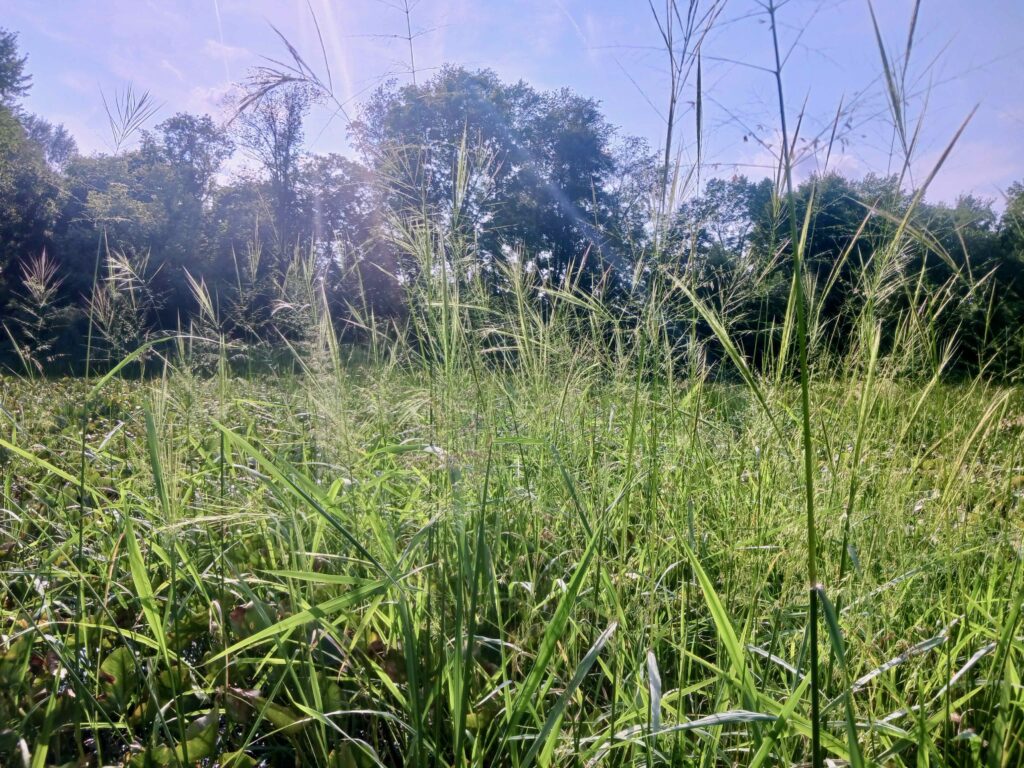
Wild rice typically germinates in early spring, soon after winter ice melts. In mid-May, clusters of short, underwater leaves begin to form. By about mid-June, these leaves will have grown to reach the water surface and can be seen floating on it.
During this floating-leaf stage, these plants are especially vulnerable, often suffering high mortality from being uprooted by wind and wave action or by drastic changes in water levels.
By late June, the aerial shoots will have broken the water’s surface and become emergent. Eventually, these emergent stems will reach a height of 2 to 8 feet above the water surface.
‘A living tribute to the First Nations’
Initially, there will be no harvesting of wild rice that emerges at either location. The goal is to protect this sacred plant and help it thrive in its historical waters.
“If successful, this Nottawaseppi-led restoration effort would be more than an ecological demonstration project – it would be a living tribute to the First Nations who first cared for these lands and waters,” said the wildlife refuge’s Kennedy.
It also provides a unique opportunity for natural resource managers and conservation leaders to learn from Indigenous knowledge, broaden perspectives, and strengthen partnerships to restore ecosystems.
This summer, these partners will monitor closely for the return of wild rice in Humbug Marsh and on Belle Isle. To broaden awareness and deepen support, Harris will share this restoration story at the State of the Strait Conference Sept. 17 at the Detroit Zoo, where the focus will be on rewilding – a conservation effort to restore nature until it can take care of itself.
Looking ahead, wild rice will be an indicator of healthy shorelines and wetlands in the next Detroit River ecosystem health assessment within 5 to 10 years.
The DNR’s Norwood said that to many, wild rice is more than an aquatic plant.
“It is a symbol of reverence for these waters and all life within them.”
It is also a barometer of ecological resilience and balance. Wild rice’s presence tells us that the water is clean, the shorelines are healthy, and the wetlands are flourishing.
Since wild rice depends on high water quality, clear and slow-moving waters, and protection from over-harvesting, its reestablishment would mark another milestone in the Detroit River’s ecological revival. And it would signify a renewal of relationships with the river, with each other, and with the wisdom and teachings of those who came before.
DETROIT RIVER COVERAGE

Community embraces Ralph Wilson Park, Detroit riverfront’s $80 million addition: ‘Come on down’
As the sun set on the Detroit River Friday, Rex Powell enjoyed it from a bench at the Ralph C. Wilson Jr. Centennial Park. It’s his third time visiting since the 22-acre park opened Oct. 25. Powell, who lives in Lincoln Park and is retired, said he’d make the 12-mile journey to the park on…

Stanton Yards development merges art, nature on Detroit River, envisions ‘thriving new community destination’
A waterfront extension of Detroit’s Little Village cultural development is planned as a 13-acre public gathering place.

Detroit River nonprofit targets wetlands loss with island habitat restoration
The Detroit River lost “probably 95%” of its coastal wetlands, “particularly on the Detroit side,” says riverkeeper Bob Burns.
