

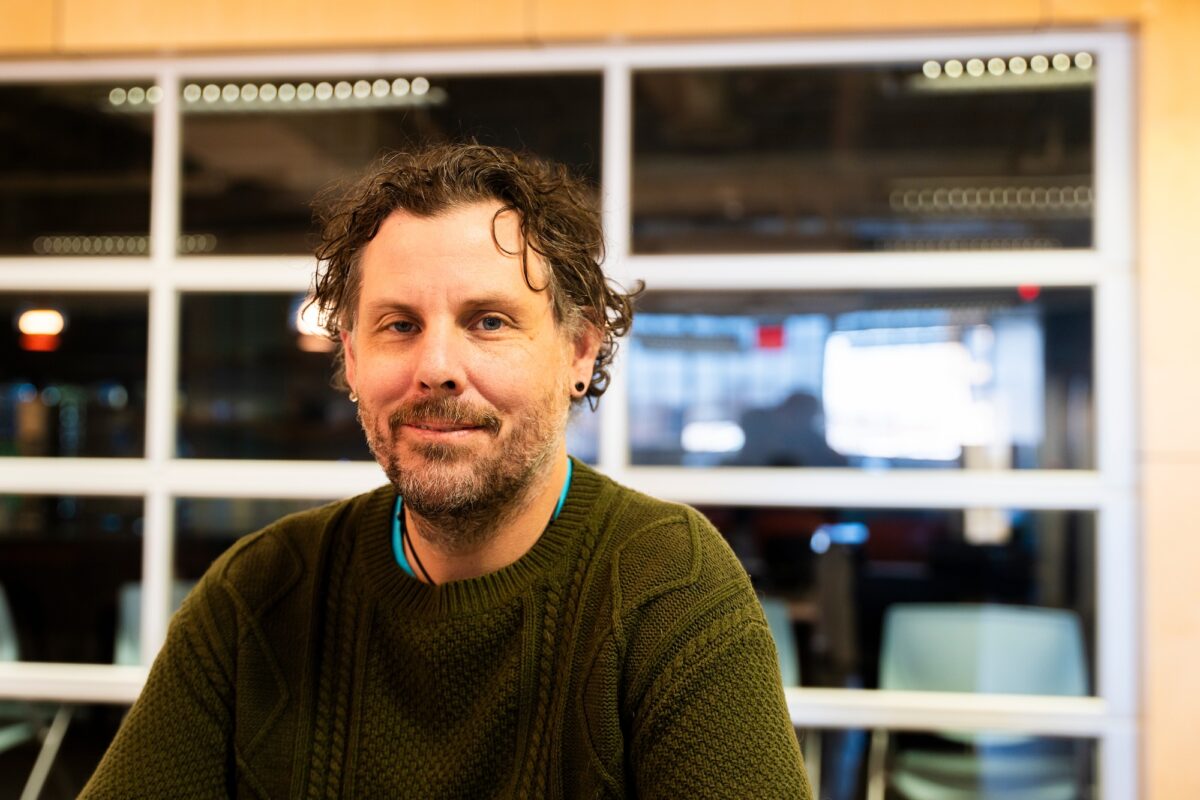
Overview:
- Brad Armstrong turned to nature as a child to cope with family instability and found it became central to his identity and career in environmental education
- After a decade in outdoor education, Armstrong grew frustrated with programs being cut and began exploring entrepreneurship, policy, and his own trauma through therapy and spiritual recentering
- Now in Detroit, Armstrong supports himself through landscaping while studying ecotherapy, documenting public meetings, and connecting his environmental background with community needs
Planet Detroit’s neighborhood reporters are local residents who cover health, environment and climate issues in their neighborhoods. The Lab is made possible with the generous support of the Kresge Foundation.
When asked to describe himself, Brad Armstrong does not start with a job title. He starts with where he grew up.
Armstrong was raised in Connecticut in what he describes as a broken and unhealthy household. His father struggled with alcoholism. His parents divorced when he was ten.
“The whole world collapsed,” he said. He remembers feeling depressed and unsure of who to trust. “I didn’t trust adults. I didn’t trust authority.”
Home did not always feel safe, but the outdoors did. As a kid, when he was bored or restless, he was told to go outside. That became more important than anyone realized at the time. Hiking, camping, skiing, just being outside gave him a sense of control. “Nature became the backbone of who I was,” he said. “When I was alone outdoors, I was in control.”
As he got older, Armstrong knew he did not want the same life he saw around him. He did not want to work in a factory like his father. Turning eighteen felt like freedom. He left Connecticut looking for something different, worked in restaurants for a while, got into the skiing world. Later, he studied recreation and environmental education. What started as something personal slowly became his career.
For more than ten years, Armstrong worked in environmental and outdoor education, partnering with schools and organizations to take students outside and connect them with nature. He believed being outdoors could change how kids saw the world and themselves.
But over time, he grew frustrated. Environmental programs were treated like extras. When budgets were cut, arts and outdoor education went first. Because his work sat outside the core school system, it depended on funding that was never stable. “Touching one kid isn’t enough for me,” he said. He wanted a bigger impact.
That frustration led him to think about how real change happens. He started noticing how business and policy shape what schools can and cannot do. If he wanted broader change, he might have to work beyond traditional education. His path shifted toward entrepreneurship and larger sustainability conversations.
His personal life was shifting too. He began looking more seriously at his own trauma and upbringing. He talks openly about difficult dynamics with both parents and the impact religion had on his early life. Instead of walking away from spirituality completely, he began rethinking it. He describes this as a period of spiritual recentering.
He started exploring healing practices, reflection, and therapy-based approaches focused on integration rather than survival. Nature, which had been an escape, became something deeper: a place for reflection and intentional grounding.
That recentering changed how he views community. He realized that isolation had shaped much of his life. Healing, he says, is not just individual. It requires connection with others.
Recently, that search brought him to Detroit. Armstrong is still new to the city and describes himself as figuring things out. He supports himself through landscaping and handyman work while studying ecotherapy and exploring future projects. He has also become involved in neighborhood reporting and documenting public meetings. “Information is opportunity,” he said. He believes that when communities have access to information, they have more power.
Armstrong sees Detroit as a place with layers of history and resilience. He is not claiming to have all the answers. He is trying to connect his background in environmental education and his personal healing journey with the needs of the city.
His life has involved a lot of movement. Leaving home at eighteen. Changing careers. Moving cities. But one thing has stayed consistent: his connection to nature and his search for something steady.
NEIGHBORHOOD REPORTING LAB STORIES

DTE Energy attacks $100 million fine for Zug Island pollution on appeal, says order for community funds ‘crossed a line’
DTE is appealing a February federal court ruling that found Southeast Michigan’s electric service provider responsible for Clean Air Act violations by EES Coke Battery and entered a $100-million judgment against DTE.



Michigan environmental news: Consumers rate hike, SNAP rolls shrink, Joe Louis Greenway funding
Consumers Energy customers will pay higher gas bills starting Nov. 1, Michigan food banks face surging demand as SNAP rolls shrink, and three wildfires burn across the Upper Peninsula.

Google data center secures Van Buren Township approval, with startup expected in late 2027
Van Buren Township’s planning commission approved Google’s data center site plan in a 5-1 vote Wednesday, despite concerns from nearby residents about construction noise, dust, and health impacts. The facility is expected to begin operations in late 2027.