

Overview:
- DAYUM, a youth-run Detroit organization founded in 2018, is advocating for a statewide climate justice curriculum in Michigan high schools that addresses systemic pollution rather than blaming individual behavior
- Strategic coordinator Julia Cuneo emphasizes supporting young people as organizers now rather than asking them to wait until adulthood to create change
- The organization is hosting a statewide youth summit May 16-17 to connect students with Michigan lawmakers and build collective organizing skills
Planet Detroit’s neighborhood reporters are local residents who cover health, environment and climate issues in their neighborhoods. The Lab is made possible with the generous support of the Kresge Foundation.
The lights in Julia Cuneo’s office shut off in the middle of the interview.
It happens every so often, she said, laughing, before continuing from DAYUM’s office in Detroit’s Love Building. Then she went back to describing the work of organizing young people around climate justice and book bans.
Activism, she said, is less glamorous than people imagine. “Most of it is meetings. I send a lot of emails, and I go to a lot of meetings.”
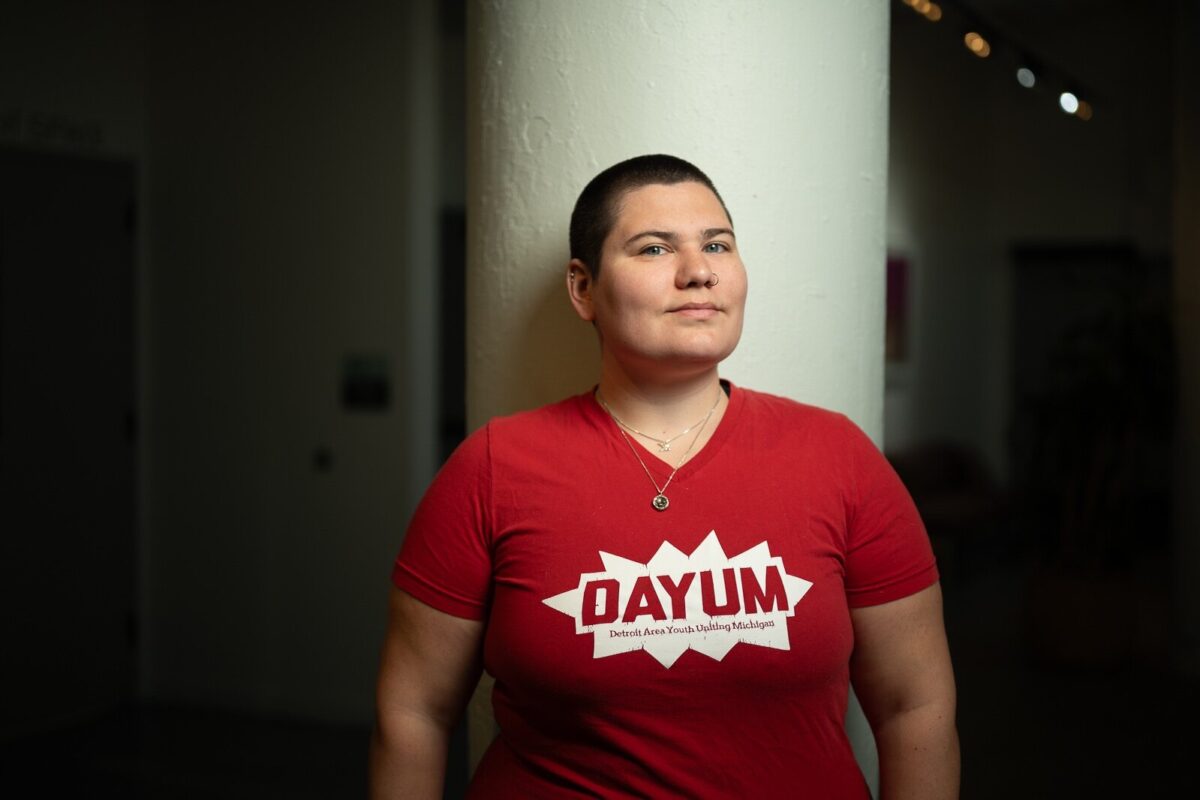
This plainspoken answer is representative of Cuneo’s style. Cuneo, who uses she and they pronouns, is the strategic coordinator of Detroit Area Youth United Michigan, or DAYUM.
She describes herself as “an adult ally” helping young people build campaigns and organize collectively.
The distinction between an “adult ally” and “leader” is central to both Cuneo and DAYUM’s structure. Founded in 2018, the organization is youth-run, with high school students helping direct strategy, recruitment, budgeting, and campaigns.
Cuneo said one of DAYUM’s founding ideas was that youth organizing should be about “actually changing the system, not about changing the young people that are part of the work.” That vision forms the group’s climate campaign, which grew out of students’ own fears about floods, blackouts, pollution, and the future.
“Young people are also on this planet today,” she said.
This approach, in part, is derived from Cuneo’s own experience. She went to her first protest in fourth grade, demonstrating against the Iraq War. At the time, she said, she got pushback from teachers and classmates and had very little support from adults who agreed with her.
“I knew how to be an activist and protest, but I didn’t know how to protect myself and do it collectively,” she said. Later, when she learned more about community organizing, she realized those were the skills she had been missing. “These tools would’ve been really helpful when I was in high school,” she said.
At DAYUM, those “tools” are created through campaigns inspired by young people’s living experience. The climate campaign was developed in part through discussions of mental health. A student told adult organizers that anxiety about climate change was a major source of stress, particularly from the extreme weather and outages.
“The connection that our young people made from climate to mental health was really unique to me,” she said.
In response, DAYUM and its partners began advocating for a statewide climate justice curriculum in Michigan high schools. The plan is to create a task force that would develop courses covering both the causes of climate change and ways students can act on it.
Cuneo said that much of environmental education still places the blame on individual behavior. The curriculum DAYUM hopes for is one that is direct about major polluters and public policies.
“They teach young people that, essentially, climate change is your fault,” she said, describing class lessons focused on turning off lights or lowering the heat. “And that’s just not the case.”
When the idea of a task force first came up, she said, it was made up of adults. “We really pushed that young people should be at the table when they design this curriculum,” she said.
In adult-run settings, young people are frequently talked down to or brushed aside.
“The phrase I heard all the time as a kid was like, ‘Good for you,’” she said. At DAYUM, the goal is to give them a place to gain confidence with each other before stepping into those broader conversations.
“They’re like, ‘I’m active now. I want to do something about this now’,” Cuneo said. By contrast, she said, “There’s a lot of adult orgs being like, we just have to wait a couple of years.” For the students she works with, waiting is not quite an option.
DAYUM’s climate campaign is not the group’s only focus. They also organize against book bans in Michigan, another issue that came from young people themselves.
Cuneo said she wants young people to leave with more than one campaign behind them.
“We really want them to start off strong,” she said, describing the hope that they will carry on organizing in college, work, and the rest of their lives.
At a personal level, Cuneo said the climate campaign includes improvements to parks, the Detroit River, and the Great Lakes, and a focus on creating more space for people to walk, gather, and be outside.
“I would love to see a Detroit where we prioritize access to nature,” she said.
Over the years, Cuneo’s role has continued to change. She plans to transition out of DAYUM over the next two years, while former youth members return as adult staff and learn to support the next group.
“I’m not used to being a solo individual,” she said. “I’m more part of the collective.”
In the meantime, Cuneo’s work continues. DAYUM is organizing a statewide youth summit on May 16 and 17, bringing together students and lawmakers from across Michigan.
The hope, she said, is that young people come to see that “the people making the laws are just people” and that they can change their communities, too.

NEIGHBORHOOD REPORTING LAB STORIES

DTE Energy attacks $100 million fine for Zug Island pollution on appeal, says order for community funds ‘crossed a line’
DTE is appealing a February federal court ruling that found Southeast Michigan’s electric service provider responsible for Clean Air Act violations by EES Coke Battery and entered a $100-million judgment against DTE.



Michigan environmental news: Consumers rate hike, SNAP rolls shrink, Joe Louis Greenway funding
Consumers Energy customers will pay higher gas bills starting Nov. 1, Michigan food banks face surging demand as SNAP rolls shrink, and three wildfires burn across the Upper Peninsula.

Google data center secures Van Buren Township approval, with startup expected in late 2027
Van Buren Township’s planning commission approved Google’s data center site plan in a 5-1 vote Wednesday, despite concerns from nearby residents about construction noise, dust, and health impacts. The facility is expected to begin operations in late 2027.

