

Overview:
- Community Aid For Empowerment estimates over 400 immigration arrests have been made in Pontiac since 2025, with most occurring in the heart of the city's Latino community on the north side.
- Advocates report frequent presence of Oakland County sheriff's deputies at immigration arrest scenes. The sheriff's office says it does not engage in federal immigration enforcement.
- Fear of arrest is keeping families home, affecting school and church attendance in the city.
This reporting was made possible in part with support from the Poynter Institute.
The degree to which immigration enforcement has intensified in Pontiac was made clear to Elida Reyes at church.
🗳️ Civic Action Toolbox
Why it matters
Intensified federal immigration enforcement is separating families, keeping children home from school, and creating an atmosphere of fear that affects daily life for Pontiac residents regardless of immigration status, advocates and city officials say.
Who's making public decisions
The Pontiac City Council and Oakland County Board of Commissioners passed resolutions opposing certain immigration enforcement activities.
Upcoming Meetings
Contact Your Representatives
Civic Actions: What You Can Do
What to watch for next
Further action by the Pontiac City Council or Oakland County Board of Commissioners regarding immigration enforcement in the city.
Are you taking action? Let us know.
Civic resources compiled by Planet Detroit
In the spring of 2025, she noticed the Latinos at her place of worship were leaving.
“I started asking, ‘where are they going? What’s happening?’ And people were being taken by ICE,” Reyes said, referring to U.S. Immigration and Customs Enforcement.
Reyes, 69, formed an immigrant advocacy group, Community Aid For Empowerment, or CAFE. Its volunteers document arrests, deliver food to affected families, and transport them to court appointments. The group has an ICE hotline, and holds Know Your Rights trainings.
More than 400 Pontiac residents have been arrested by immigration agents since enforcement activity intensified in 2025, according to CAFE’s estimates.
The group’s organizers say the true number of arrests is likely much higher in Pontiac, population 62,104.
Immigration enforcement activity around grocery stores, churches, and schools is “to the point no one wants to leave their home anymore to do any of those things,” said Reyes.
She describes the dynamic as “self-imposed house arrest.”
Arrests center on Latino neighborhoods: Advocacy group
June 21, Father’s Day, “was the worst I’ve ever seen it” in terms of immigration enforcement in the city, said Alexis Huyck, 29, a CAFE board member and teacher in Pontiac schools.
The people arrested in Pontiac appear to be “just anyone and everyone.”
The vast majority “have their papers,” she said — “work permits, anything you can think of.
“They haven’t done anything wrong.”
Huyck said she recently witnessed an immigration arrest, and “the time from when they pulled the person over to the time it was completely done was less than 6 minutes.”
Reyes is a lifelong Pontiac resident. She was overcome with emotion describing the impacts of arrests and deportations on immigrants and their families.
“I don’t know how people can turn their backs,” she said.
CAFE helps families attend court appointments so they can attempt to free their loved ones from detention centers.
Those scenarios are rare, Reyes said. “More than likely they’re going to be deported.”
Reyes, who is Latino, carries her passport and birth certificate with her at all times.
“I get threatened to be deported all the time. And it’s not as if U.S. citizens haven’t been deported. They have.”
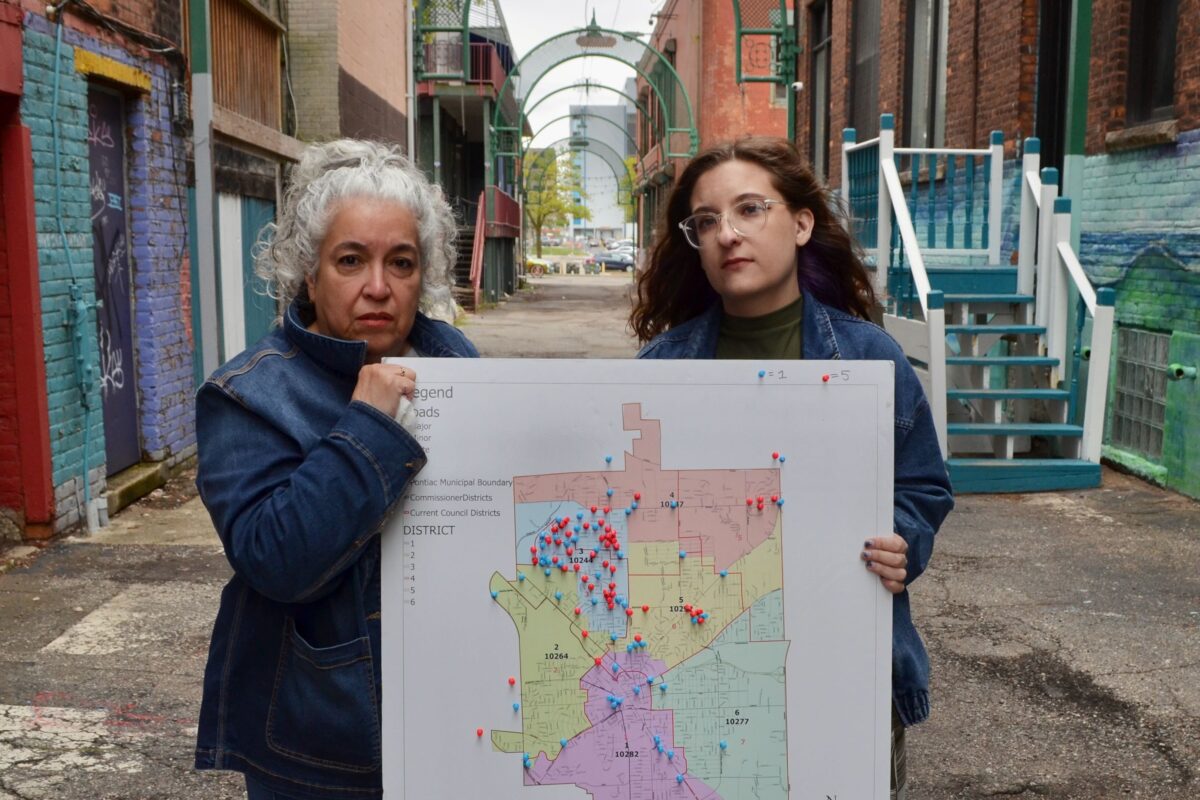
She and Huyck maintain a display board with a map of Pontiac dotted with pushpins. Every blue pushpin represents one immigration arrest, every red pin represents five, and every dark purple pin represents 10.
The pins are clustered in Pontiac City Council District 3 on the north side, the heart of the Latino community in the diverse city.
District 3 Councilman Mikal Goodman said of the environment in Pontiac: “I know what my community feels like. And I know what it feels like right now. And they are not the same.”
‘If there’s no 287(g) agreement, then what is it?’
CAFE advocates frequently observe Oakland County sheriff’s deputies at the scene of immigration arrests in Pontiac, and receive calls about traffic stops made by deputies where immigration agents subsequently show up, the group’s organizers said.
“There’s no 287(g) agreement, so why are the police helping ICE? If there’s no 287(g) agreement, then what is it?” Reyes said, referring to ICE 287(g) cooperation agreements that delegate authority to local police to perform some immigration enforcement functions.
The Taylor Police Department is the sole law enforcement agency in Metro Detroit with a 287(g) agreement.
The Oakland County Sheriff’s Office does not engage in federal immigration enforcement, spokesperson Stephen Huber said in a statement to Planet Detroit.
“The courts have consistently made clear that immigration enforcement is a federal responsibility. Our focus remains on enforcing state and local laws and protecting the safety of our communities,” he said.
Immigration authorities and the sheriff’s department do intersect when a person is arrested on state or local charges and held at the Oakland County Jail, Huber said.
Once state and local legal processes conclude, federal agencies may take custody of the person, “like any other law enforcement agency with lawful authority or pending charges,” he said.
The Oakland County Board of Commissioners adopted a resolution in February in opposition to civil immigration enforcement activities by ICE and related agencies on nonpublic Oakland County-owned property unless required by law or with a valid judicial warrant or court order.
The resolution also opposes the wearing of face coverings by immigration agents.
The board of commissioners has a Democratic majority, while Oakland County Sheriff Michael Bouchard is a Republican.
ICE says officers follow the law
ICE did not comment on questions regarding enforcement in Pontiac or any interactions with the Oakland County Sheriff’s Office.
ICE officers enforce the country’s immigration laws as set forth by Congress and carry out their duty in accordance with law, policy, and procedure, a spokesperson said in an email.
“We welcome and encourage any law enforcement agency in the state of Michigan to work alongside us in the interest of public safety and national security.”
ICE made 3,298 arrests in Michigan in 2025, according to the Deportation Data Project.
Pontiac Police Department disbanded during emergency management years
The Oakland County Sheriff’s Office took over law enforcement in the city Aug. 1, 2011 from the former Pontiac Police Department, which was decimated by layoffs.
The policing contract began under Michael Stampfler, the second of three emergency managers appointed by the state to oversee Pontiac’s finances. The state’s financial emergency declaration ended in August 2013.
Councilman Goodman said he understands the need for functional services in the city, and noted he was a preteen when the deal was struck for Oakland County deputies to patrol Pontiac.
“And that was our option,” the councilman said. “But even in doing that, you’re giving up control and power that municipalities and the citizens should have.”
Mayor Mike McGuinness said the city discusses immigration enforcement with the sheriff’s office, “particularly in regard to ensuring delineation of sheriff mission focus and distinction between external agencies.”
McGuinness took office as mayor in January.
“I’m not detecting widespread coordination between the Oakland County Sheriff team and they contend that they are not engaging in immigration enforcement actions with ICE,” he said.
McGuinness said he does not want to preset terms for the next contract negotiation with the sheriff’s office, which is more than two years out.
Immigration “is a serious matter that will likely be an area of emphasis,” he said in an email to Planet Detroit.
Immigration arrests ‘hurting our residents’: Pontiac mayor
A resolution calling for safe access to sensitive community locations and responsible conduct by ICE in the city received unanimous approval March 3 by the Pontiac City Council.
The resolution names churches, schools, daycares, city government facilities, and voting locations as sensitive community spaces that “require heightened care” from agencies operating in the city “to avoid actions that could chill access, deter participation, or create an atmosphere of fear or intimidation.”
The council passed an emergency ordinance June 16 that declares a one-year moratorium on the expansion or establishment of detention facilities in Pontiac.
McGuinness consistently hears concerns around immigration enforcement, and the fear of immigration raids is high, he told Planet Detroit in an emailed statement.
“The fear transcends immigration status, with American citizens also very fearful they could be profiled and swept up. These actions are heartbreaking, and it’s hurting our residents.”
Immigrant neighbors make Pontiac stronger, the mayor said.
“And it’s got to be said: nothing good comes from masked, armed federal agents serving as judge, jury, and executioner in America’s streets. I pray that those tactics don’t descend on Pontiac and I work to keep a tempered tone so as to not make Pontiac’s people a target.”
Pontiac children caught in the middle
Immigration arrests are affecting attendance and enrollment in Pontiac schools, said CAFE’s Reyes and Huyck.
“Pontiac School District is going to feel a great loss come September when these kids aren’t showing up,” Reyes said.
Many of the Pontiac parents CAFE interacts with may not be U.S.-born — and many of their children are, she said.
When the children deport to join their parents and avoid being left behind, “those are American citizens that are leaving,” Reyes said.
“That’s the future. We are becoming a country that’s aging quickly.”
Huyck, who teaches preschool, said childhoods are being taken away.
“They can’t go to the park. They can’t go outside. They can’t leave their houses, really at all.”
Reyes said Pontiac children are traumatized.
“They don’t know what to do, and they’re afraid that if they go home, their mom may not be there.”
CAFE places funds on the commissary accounts of immigrants held in detention.
“We want them to call home, to talk to their children,” Reyes said.
“Can you imagine? Their children want to hear from their dad or their mom, or an older brother or sister.”
MORE FROM PLANET DETROIT
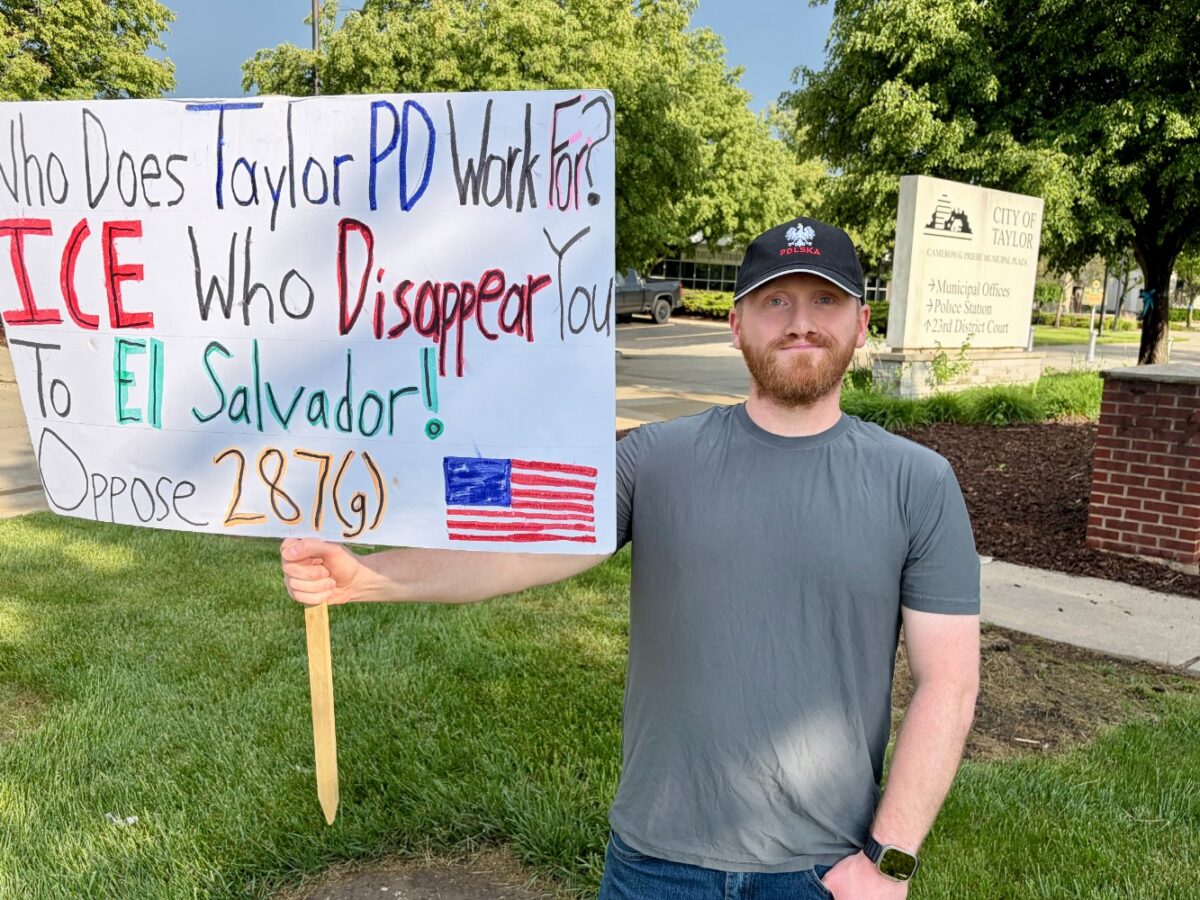
Taylor’s cooperation agreement with ICE: ‘Shameful’ or ‘nothing at all’?
Taylor is the only Metro Detroit community with an ICE cooperation agreement. Advocates say it threatens immigrants, while the police chief says critics have blown the partnership out of proportion.


Afghan asylum seeker detained 68 days in Michigan, released after legal fight
Immigration lawyers fight detentions through habeas corpus petitions as arrests more than quadruple in 2025.

‘You didn’t try to get my vote’: How Democrats lost Dearborn, and what it would take to win it back
After a historic 35% swing away from Democrats in 2024, Arab Americans are reshaping Michigan politics.
