

Overview:
- Detroit City Council is directing the Sheffield administration to study alternatives to DTE Energy after an F2 tornado highlighted ongoing power infrastructure problems.
- The Sept. 3 tornado damaged 115 locations, including 55 businesses and about 44 residential properties.
- Council votes unanimously to extend emergency declaration after the tornado.
By JASMINE SNOW and CHRISTINE FERRETTI
BridgeDetroit
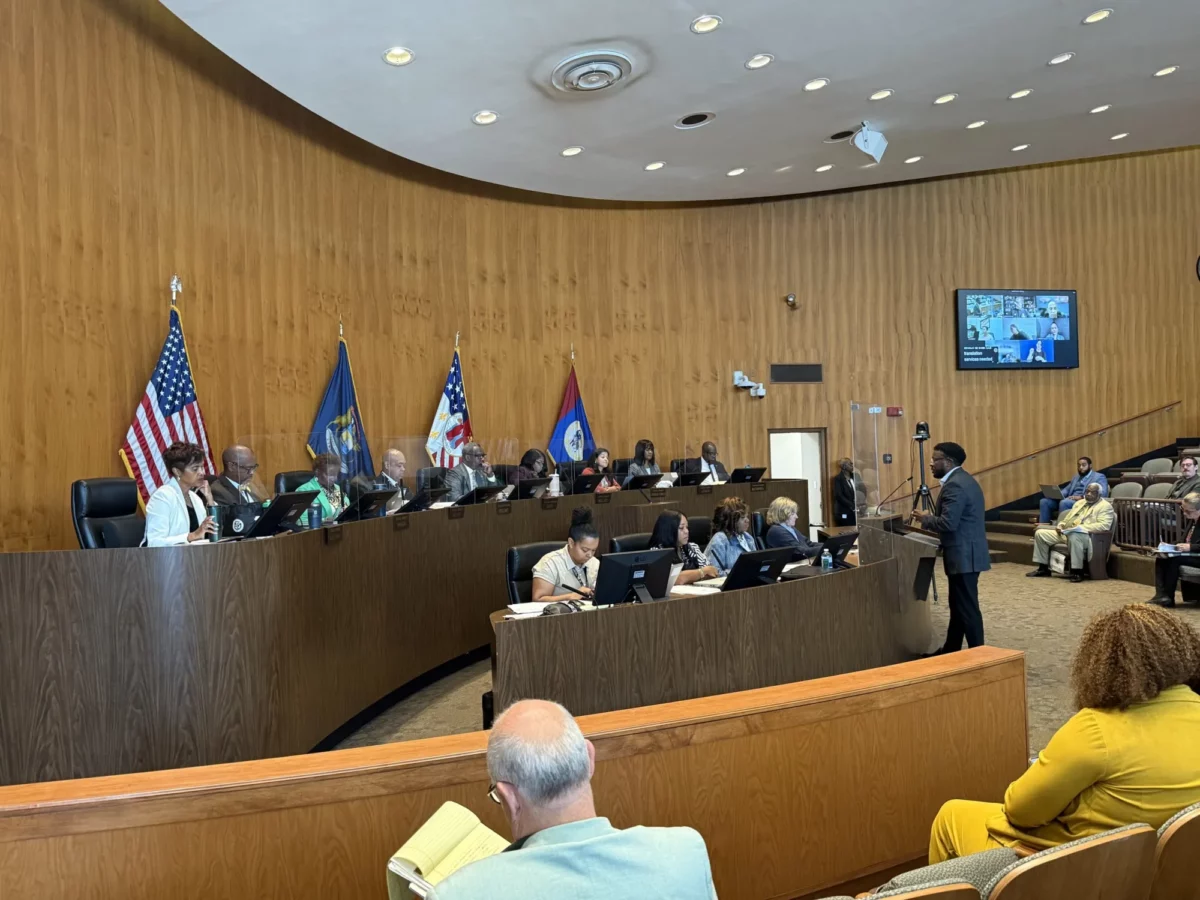
City Council members want to explore options to reduce Detroit’s reliance on DTE Energy following a damaging tornado — and in anticipation of increasing climate change-related severe weather patterns — which members say reinforces weaknesses in the system.
At Tuesday’s council meeting, people generally expressed support and appreciation for city workers’ swift response to F2 tornado damage that rocked the east and west side. However, many — neighbors and Council members alike — spoke about longstanding issues with the city’s power infrastructure, including persistent price hikes and outage issues predating last Thursday’s storm.
Amid the multitude of critiques, there was one common denominator: DTE’s near-monopoly in the city’s energy landscape.
As Detroit’s main source of power and gas, DTE has come under fire repeatedly since the power merger in 2001. Residents and several council members say that needs to change.
In-line with previous criticism, Council Member Angela Whitfield-Calloway argued DTE has a “monopoly” on the city’s gas and electricity and that the Sheffield administration should explore how Detroit can diversify its options.
“We have to look into our options. We, the citizens of the city of Detroit, want options,” she said during a Tuesday morning briefing about the Sept. 3 tornado response. “We don’t want to be locked into DTE.”
She and other council members spoke about former providers, like MichCon (gas) and Detroit Edison (the predecessor of DTE).
“It (DTE) hasn’t been a good deal for the city of Detroit. There’s outages when there shouldn’t be,” Whitfield-Calloway said. “We know there’s pressure on very old infrastructure.”

Council Member Gabriela Santiago-Romero added that other communities, like Wyandotte and Ann Arbor, are exploring or implementing alternative, community-owned energy sources.
Santiago-Romero said she has voted no on all DTE projects because “we’re paying so much and getting so little,” and asked the Council’s Legislative Policy Division to draft a report on what other municipalities are doing.
“Quite frankly, I feel like we’re being robbed,” Santiago-Romero said.
Mayor Mary Sheffield’s Chief of Staff, David Bowser, who led the Tuesday briefing, said Detroit’s Office of Sustainability is evaluating best practices, and that the administration supports the idea of diversifying options and studying what’s being done elsewhere.
Emergency declaration extended
Following Bowser’s briefing, the council voted unanimously in favor of a resolution to extend the mayor’s executive order for an emergency declaration after severe damage to buildings and homes on the east and west sides and power outages all across the city.
The extension aims to address the “continuing threats to the public health, safety, and welfare, as well as property damage in the affected area,” bounded by Sylvester Street, Chene Street, McClellan Avenue and East Jefferson Avenue on the lower east side, as well as Belle Isle.
Hilton Kincaid, director of the city’s Office of Emergency Management & Homeland Security, said 115 locations in the city were touched by the tornado, though not all of them severely.
Detroit’s Buildings, Safety Engineering, and Environmental Department (BSEED) Director David Bell said about 55 businesses were affected, 20 of those sustaining major damage. Bell said 24 single-family homes were impacted, as well as about 20 multi-family dwellings.
As of Sunday, 254 trees were cleared from over 60 blocked streets, according to Crystal Perkins with the city’s General Services Department.
“Improve Detroit (app) has been our No. 1 reporting tool on this,” said Perkins, encouraging residents to continue using the app to report downed trees, damage and debris.

Mayor Mary Sheffield’s Chief of Staff David Bowser said the administration moved quickly to ensure that communications were put out to residents in Spanish, French, Arabic and Bengali — especially in light of the emergency-based gaps identified with the city’s translation services earlier this summer.
Despite DTE “standing with” Detroit in the tornado response — per Sheffield’s administration — and attending the Sept. 4 press conference, DTE representatives were not invited to attend yesterday’s council meeting. Bowser said he and Hassan Beydoun, group executive of economic development and counsel to the mayor, would be taking agenda items to DTE and seeking their attendance at upcoming meetings.
DTE did not address BridgeDetroit’s questions about the prospect of the city exploring other utility options, but the company said in a statement that it has invested more than $1 billion since 2021 to “strengthen and modernize the electric grid that serves Detroit.”
“It’s been our honor and privilege to power Detroit for more than 125 years, and we share the goal of city leaders and residents alike: stronger reliability and bills that stay as low as possible.” DTE Energy said in an emailed statement.
The company pointed to other efforts over the past year to strengthen infrastructure, trim hundreds of trees and replace electrical poles.
“…While there is more work to do, those investments are helping build a more resilient system that can better withstand extreme weather and support the city’s continued growth.”
Seniors building compliance issues
During the meeting, several council members and commenters made note of some senior centers impacted by power outages and lack of food following the storm. Angela Whitfield-Calloway said several senior buildings in her district do not have working generators on-site — something they are required to have, per a city-wide ordinance.
Bell said BSEED is working with the Law Department to bring the buildings without working generators in line with regulations. There are 111 senior buildings in Detroit.
“The ones that are (in violation) will get a violation notice and in the end will get a final warning letter, and we’ll work diligently with the Law Department to bring those buildings into compliance,” he said.
A BSEED spokesperson on Tuesday wasn’t immediately able to tell BridgeDetroit how many of the buildings were out of compliance or for how long.
Perkins encouraged Detroiters to report any further issues via the Improve Detroit app. If they don’t have access, they can call the GSD office at (313) 224-1100.
Council Member Scott Benson noted an earmark of $1 million in the last budget to manage tree maintenance in the public right-of-way and inquired if it was being used to clean up tornado damage or if it had been used to address damage from July storms.
Perkins said the prior storm was the largest GSD had seen, with 1,000 calls from residents and close to 600 trees needing removal. She said that storm cleanup cost about $750,000.
“So far today, for (the Sept. 3) storm, I am not able to calculate. But it will be a hefty amount,” she said.
Benson asked whether an emergency declaration would allow the city to be reimbursed — not just for cleanup but also to bolster the department’s ability to cover costs of future cleanup efforts that are unaccounted for in the city’s budget to staff and manage the work.
The councilman asked the council’s legal division to draft a resolution encouraging the Sheffield administration to identify and replace $1 million to the forestry department to ensure Detroit continues to fund the maintenance of its portfolio of city-owned trees.
“When we’re trying to improve our department, we can’t keep up if we continue to have storms of this level,” Benson said.
MORE FROM PLANET DETROIT

Detroit teens speak out: ‘They just need someone who’s willing to listen’
Detroit teenagers say they’re not asking for excuses — they’re asking to be heard. Youth advocates and educators agree: investing in mentorship, activities, and encouragement can prevent problems before they start.


Detroit museum, zoo millages on the November ballot: What’s at stake?
Voters in Wayne, Oakland and Macomb counties will decide on a Detroit Zoo renewal and a new operating millage for two Detroit museums.

Hazardous chemical leak in Toledo prompts evacuations, shelter orders
Thousands of Toledo residents were ordered to evacuate or shelter in place after a chemical release from an industrial facility Tuesday night. The ongoing leak involves glycidyl methacrylate, used in plastics and coatings.

