

Overview:
- Ann Arbor for Public Power aims to collect 5,000-plus signatures to place a question on whether to create a city-owned electric utility on the November ballot..
- Supporters say public power would improve reliability and affordability while helping achieve the city's carbon neutrality goals, citing recent ice storms and outages.
- DTE Energy opposes the effort, and says a city takeover would cost $1 billion upfront and lead to higher utility bills without improving service.
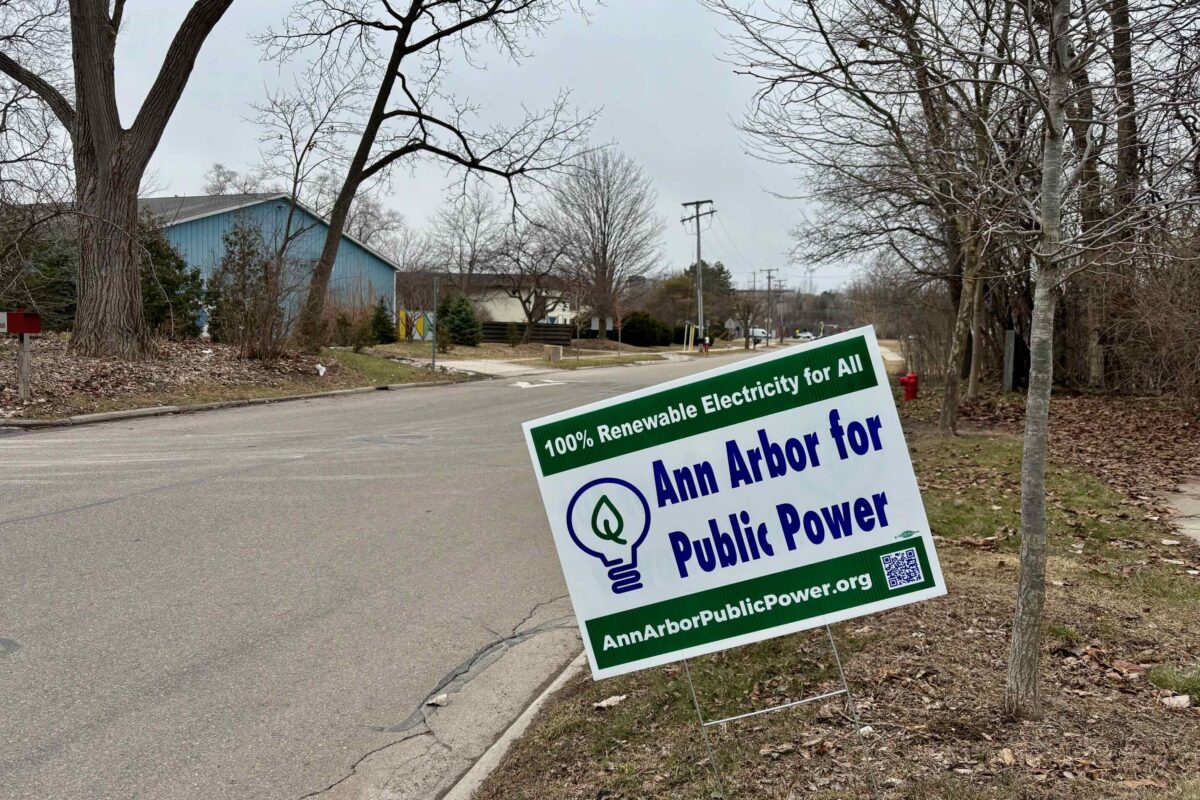
Campaigners are collecting signatures for a ballot initiative that would create a city-owned electric utility in Ann Arbor, a step toward taking ownership of the city’s grid away from DTE Energy.
A public utility is needed to improve reliability and affordability, and help advance the city’s climate goal of achieving citywide carbon neutrality, several of the 15 or so attendees at an organizing session Saturday told Planet Detroit.
Ann Arbor resident Michael Nowak said he began volunteering with Ann Arbor for Public Power, the group behind the ballot initiative, following a February 2023 ice storm when he lost power for almost a week and the fish in his aquarium died.
Nowak’s parents live in Holland, Michigan, which has a publicly owned utility.
“My parents are always like, ‘Oh yeah, it’s so great; they fix everything in an hour,'” Nowak said, adding that he wants to see Ann Arbor receive the same level of service.
DTE spokesperson Ryan Lowry said in a statement that the utility has improved reliability in Ann Arbor in recent years and is working toward meeting the state’s clean energy goals.
Campaigners need to collect around 5,000 signatures by mid-June to give the Ann Arbor City Clerk enough time to approve signatures by the July 28 deadline, Jacob Adams, administrative assistant to the clerk, told Planet Detroit.
🗳️ Civic Action Toolbox
Why it matters
A petition drive could put a question on Ann Arbor’s November ballot, allowing voters to decide on the creation of a city-owned utility. Those backing the effort say it would improve energy reliability and affordability and help the city meet its climate goals. DTE Energy says a city-owned utility will be expensive for the city, while failing to help to deliver cheaper or more reliable power.
Who's making public decisions
If petitioners gather around 5,000 valid signatures by mid-June, Ann Arbor voters could choose whether to create a city-owned utility governed by a board of elected and appointed officials. This would be a stepping stone toward purchasing DTE’s assets in the city.
Civic Actions: What You Can Do
What to watch for next
Campaigners for a city-owned utility are asked to submit signatures for a ballot question by mid-June. The Ann Arbor City Clerk has until July 28 to approve the signatures.
Did you take action? Let us know.
Civic resources compiled by Planet Detroit
A simple majority is needed to pass the ballot measure in November, Adams said.
The utility would be a placeholder until 2028, when voters would choose five board members, according to Brian Geiringer, executive director for Ann Arbor for Public Power. City council would appoint four more representatives.
Ann Arbor could then vote on a ballot proposal to acquire DTE’s assets in 2030, with a 60% majority required for the measure to pass, Geiringer said.
The campaign has 50 petition circulators, Geiringer said at Saturday’s meeting. The group’s goal is to collect at least 6,500 signatures, but ideally as many as 10,000 to help spread awareness ahead of the election, he said.
Public power backers on the ballot in November
Several candidates in Ann Arbor’s November election support the municipalization effort, including mayoral candidate and Washtenaw County Commissioner Yousef Rabhi and City Council candidate Dave Zeglen. Both are democratic socialists.
Ann Arbor City Council narrowly failed to approve a municipalization study on March 3, 2025, in a 5-5 vote. Mayor Christopher Taylor, who is seeking reelection, voted in favor of the study.
Councilmember Dharma Akmon was among the five who voted against the study. Ann Arbor’s situation isn’t comparable to communities that built grids from the ground up, and acquiring DTE’s power grid would be extremely expensive, she said.
“The legal fight alone will be lengthy, expensive and contentious,” she said.
“DTE will use every legal tool available to delay, obstruct, and extract the highest possible value, and very few communities have successfully taken over their investor-owned utility, even after spending tens of millions of dollars trying.”
Akmon is not seeking reelection in November.
DTE’s Lowry said the company has improved reliability significantly over the last two years, and is supportive of Ann Arbor’s clean energy goals.
A February 2025 municipalization study commissioned by the utility showed taking over DTE’s grid would cost the city $1 billion upfront, without delivering better reliability and cleaner energy, and would lead to higher utility bills, he said.
Ann Arbor for Public Power challenged the report after its release, arguing it relied on false and misleading assumptions that inflate the cost of municipalization.
In 2024, Ann Arbor voters approved the creation of a sustainable energy utility (SEU), with 79% voting in favor of the proposal. Residents and businesses will be able to subscribe to the utility and receive a portion of their energy from rooftop solar and battery storage, but the utility will not take over DTE’s grid.
DTE did not oppose the creation of the SEU, with Lowry telling Planet Detroit in 2024 the SEU would “provide Ann Arbor’s residents and businesses with another option to reduce their own carbon emissions.”
Public power backers stress long-term benefit
Nowak, with Ann Arbor for Public Power, compared starting a municipal utility to buying a house.
“There’s going to be this huge upfront cost,” but the city will save money in the long run, he said.

Ann Arbor for Public Power says on its website that a phase two feasibility study is needed to determine the cost of the city’s distribution infrastructure, including power poles, wires, transformers, and substations.
Michigan public utility customers pay 25% less than those served by investor-owned utilities, according to a report from the American Public Power Association, a trade group representing community-owned utilities.
Nationally, public power customers experienced 1.5 fewer hours without power in 2023 than other customers, according to the group.
One of the most high-profile recent efforts to create a public utility, Maine’s 2023 Pine Tree Power ballot proposal to take over the state’s investor-owned utilities, failed with 70% voting against it, according to Maine Public.
Lucy Hochschartner, deputy manager for Pine Tree Power, told Canary Media the group was outspent 30-to-1 by political action committees opposed to the initiative.
City council candidate Zeglen told Planet Detroit on Saturday that Ann Arbor could be a good place for a municipalization push because the city has the resources to fight legal challenges by DTE.
Voters may support the creation of a public utility because they’re being hit hard by rate increases and inflation, and there’s a growing awareness of the role DTE’s political spending plays in the state, Zeglen said.
“When I knock on doors, nobody has a good story about DTE,” Zeglen said.
DTE declined to comment on the candidate’s statement regarding its political spending.
Editor’s note: This story has been updated to clarify that Ann Arbor for Public Power has 50 petition circulators.
MORE UTILITIES NEWS
Data center moratorium bills reflect public sentiment, says Michigan lawmaker
Three bipartisan bills in Michigan would prevent state and local government from issuing permits for data centers until April 2027, giving lawmakers time to address concerns about energy demands and community impacts.

GLWA hikes water rates 5.8%, faces affordability concerns, aging infrastructure
Utility board says increase needed to invest in aging infrastructure, while residents say higher prices will force them to choose between paying for water or food and medicine.
Court finalizes $100 million judgment against DTE Energy for Zug Island air pollution
This story was produced with support of Internews’ Earth Journalism Network.DTE Energy and three of its subsidiaries must pay $100 million for Clean Air Act violations at EES Coke Battery on Zug Island within 90 days, according to a final judgment entered in federal court Tuesday. The facility must come into compliance with the Clean…