

Overview:
- Detroit Zoological Society has tracked mudpuppy salamanders on Belle Isle for 15 years to monitor Detroit River health
- Mudpuppies absorb water through their skin, making them sensitive indicators of pollution and water quality changes
- The salamanders' population is declining regionally due to pollution, invasive species, and shoreline development

The mission of the Detroit Zoological Society is to create meaningful connections between people, animals and the natural world so all can thrive.
The wind off the Detroit River on an early April morning will find every gap in your jacket, but a small crew from the Detroit Zoological Society doesn’t seem to mind. They stand on the concrete rubble at Sunset Point, the westernmost tip of Belle Isle, around 9 a.m., pulling mesh traps out of water cold enough to make your hands ache just looking at it.
They’re there for mudpuppies, a fully aquatic salamander most people have never heard of.
Mark Vassallo, the Zoo’s amphibian curator, hauls a trap onto the rocks and opens it. Inside, sitting in a few inches of river water, is a mudpuppy about the length of a forearm. It’s a female, brown and slick, unremarkable at first glance, until you notice the ruby red gills fanning out from behind the animal’s head, fluttering slightly in the cold water.
“This particular species has external gills that it utilizes to get oxygen out of the water,” Vassallo says. “They live all the time in the water. They’re fully aquatic.”
Over the next couple of hours, the joint team from the Zoo and the Nature Center works through their traps one by one. Each mudpuppy is weighed, measured for length, and scanned for a passive integrated transponder tag, a small chip about the size of a grain of rice, implanted under the skin. If the scanner beeps, they have a returning animal, one they’d seen before, whose growth and movement they could track over time. If not, the mudpuppy gets a new tag before going back into the river.
David Dimitrie, the zoo’s director of conservation, explains what the tags make possible.
“We can put a tag in it, and they’ll be able to track their movement and their survival over the course of their lifetime,” he says. Following individual animals this way, year after year, builds a picture of the population that a single snapshot never could.
That picture matters. Mudpuppy numbers have been declining across the Great Lakes region for the past several decades, driven by pollution, invasive species, and shoreline development that destroys the habitat they depend on. Belle Isle still has a relatively healthy population, but the trend line in the broader region gives the monitoring work a quiet urgency.
The Detroit Zoological Society has been running this program on Belle Isle for 15 years alongside partners such as Herpetological Resource and Management, Belle Isle Aquarium and Dr. Nick Jew of MedVet Hilliard. The science behind it is simple enough to explain in a sentence: mudpuppies are an indicator species for the Detroit River, and their health tells us something about the health of everything around them.
Amphibians absorb water directly through their skin. That makes them sensitive to pollution and changes in water quality.
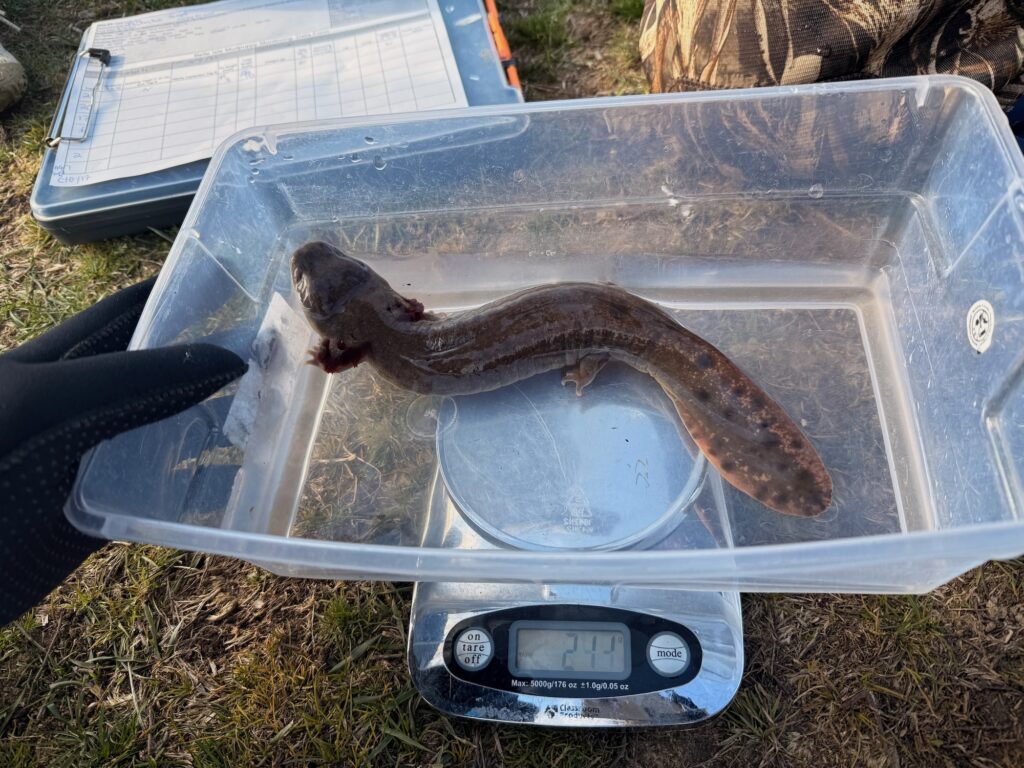
“Amphibians have very porous skin,” Vassallo says. “They take pollutants through their skin, and that makes them more susceptible and vulnerable to impurities in the water. So by tracking these animals, we’re tracking the overall health of this waterway.”
Dimitrie puts it more simply: “As we see a healthy mudpuppy population, we know that indicates that this ecosystem is doing well.”
A healthy population also means the food web is intact. Vassallo notes that mudpuppies eat invasive round gobies and zebra mussels, and they’re food for larger game fish.
“They’re a really important part of the waterway,” he said. Anglers who find them sometimes think they’re pests, or venomous, or that finding one means something is wrong with the water. “In fact, when mudpuppies are around, that means that the ecosystem’s doing really well,” he says.
What mudpuppies need, it turns out, isn’t complicated. They hide, feed, and lay eggs in gaps between rocks and rubble along the shoreline. On Belle Isle, the concrete slabs piled along some stretches of the park make good mudpuppy habitat. The irony is that shoreline cleanup efforts have sometimes removed exactly the kind of rough structure the animals rely on, which helps explain why researchers are paying close attention to where mudpuppies show up and where they don’t.
The Belle Isle Nature Center, which sits on the island and is operated by DZS, provides the local base for this kind of fieldwork. The partnership makes practical sense: the zoo brings veterinary expertise, research staff, and the infrastructure to support long-term studies, while the nature center offers proximity to the river, trained staff familiar with the island, and a direct connection to the communities that use Belle Isle every day. More than 4 million people visit the island each year. Most of them have no idea there are salamanders living in the water a few feet from the shoreline.
That’s part of what DZS is trying to change. The mudpuppy research isn’t just about collecting data points, though the data matters. It’s also about making the case that the Detroit River is a living system worth paying attention to. The zoo’s Conservation Action Plan, updated in November 2025, puts the work under the heading of “Great Lakes Conservation,” alongside efforts for piping plovers, eastern massasauga rattlesnakes, and Kirtland’s warblers. But the mudpuppy program has a quality the others don’t: it happens right here, in the river that runs through the city, on an island most Metro Detroiters know.
The team also collects water samples from the Detroit River during each monitoring visit, tracking environmental conditions alongside the animal data. Over time, they hope to connect shifts in water quality to changes in the mudpuppy population, creating a fuller picture of how the river is doing and where the pressure points are. Dimitrie says the zoo is working with field partners on habitat restoration projects along the river and new methods for tracking individual mudpuppies and their movement.
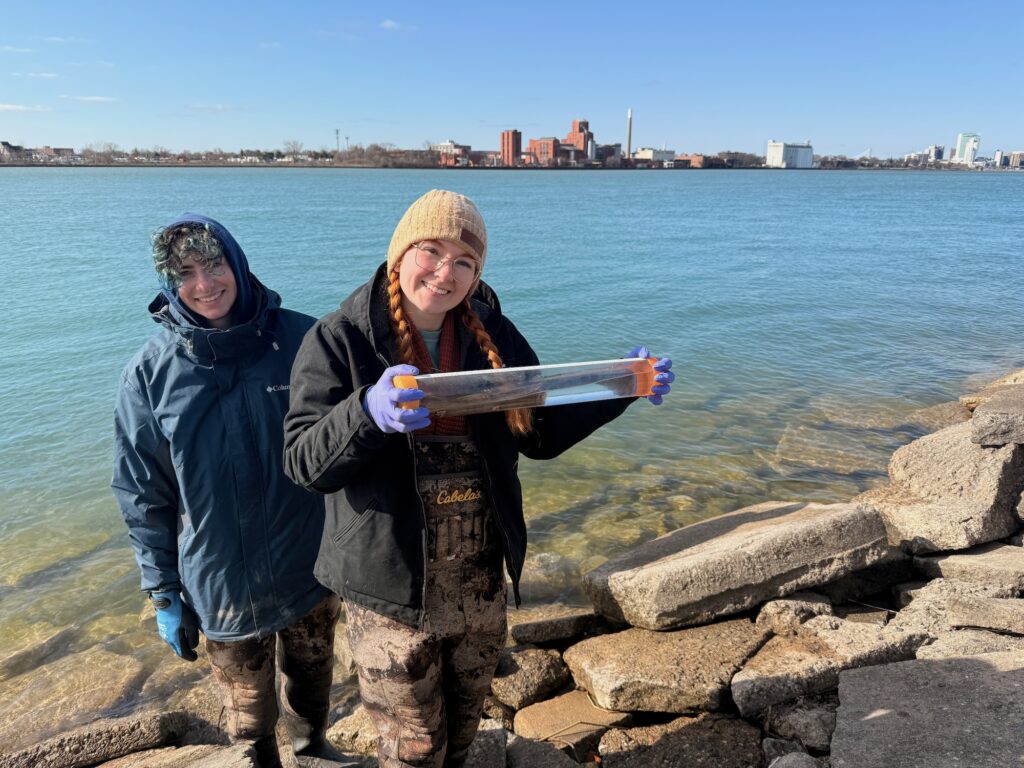
The research has no planned end date by design. Conservation monitoring works best when it’s sustained, when you can compare this year’s numbers against a decade of baseline data rather than guess from a single season.
There’s also a narrow window for this kind of fieldwork. Mudpuppies prefer cold water, and they move into the shallows along the shoreline only when temperatures drop. As the river warms through spring and into summer, they’ll retreat to deeper, cooler water, well beyond the reach of the traps set off Sunset Point.
By May, they’ll be far from the shoreline, and the millions of people who visit Belle Isle over the summer won’t have any reason to think about what’s living below the surface. The DZS team will be back when the water cools down.The Detroit Zoological Society operates the Detroit Zoo and the Belle Isle Nature Center. Learn more about their conservation work at https://detroitzoologicalsociety.org.