

Overview:
- Michigan residents saw individual health insurance premiums jump this year, with Blue Cross Blue Shield plans increasing 24%.
- Blue Cross controls 65% of Michigan's commercial health insurance market, and its PAC spent over $663,000 on elections in the last year.
- Blue Cross lobbying has blocked reforms including legislation to make co-pays count toward deductibles and streamline medication approvals, state lawmaker says.
A Michigan ballot initiative to bar state and local political donations from monopoly companies and other large enterprises doing business with the state continues to gather signatures ahead of a May 27 deadline.
🗳️ Civic Action Toolbox
Why it matters
Michigan residents are paying 20% more for health insurance this year. A state lawmaker says Blue Cross Blue Shield’s political influence has blocked reforms that could save families hundreds or thousands of dollars annually.
Who's making public decisions
Michigan voters will decide on the Michiganders for Money Out of Politics ballot initiative if organizers submit at least 356,958 valid signatures to the Secretary of State by May 27.
Civic Actions: What You Can Do
Organizations to Follow
What to watch for next
Are you taking action? Let us know.
Civic resources compiled by Planet Detroit
Much of the attention on the Michiganders for Money out of Politics ballot initiative has focused on potential impacts to Consumers Energy and DTE Energy, which have spent heavily on politics as residents complain of poor reliability and high bills.
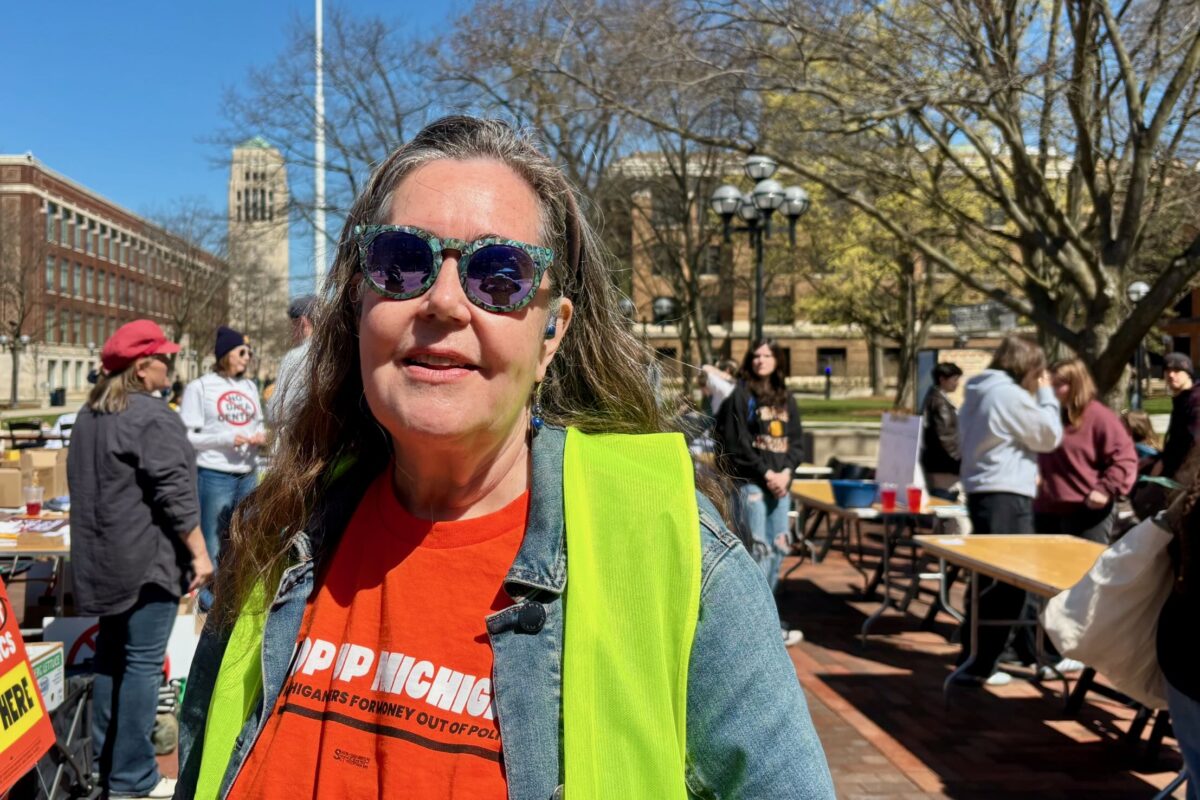
Blue Cross Blue Shield of Michigan (BCBSM) is the elephant in the room, Ann Arbor resident and MMOP volunteer Lauren Sargent said at an April 11 anti-data center rally in Ann Arbor.
The insurer is in a contract dispute with Michigan Medicine, with an agreement set to expire on June 30.
The University of Michigan hospital system argues it needs to modestly increase reimbursements to offset the growing cost of care or extend its contract.
Blue Cross has said the hospital system is asking for 44% payment increases over the term of a new contract.
The insurance company has hurt efforts to ensure Michiganders can access affordable health care, Sargent said.
Blue Cross is a nonprofit mutual company, with an employee-supported political action committee, or PAC, that makes political donations.
Blue Cross’s PAC is funded entirely by employees “who represent all political viewpoints and voluntarily contribute their own money to our collective work in advancing quality health care in our state,” spokesperson Gabby Abel told Planet Detroit in a statement.
“This ballot proposal silences their voices, so we oppose it,” Abel said of the MMOP ballot initiative.
Sargent criticized the insurer’s support for Michigan Gov. Gretchen Whitmer during the 2018 Democratic gubernatorial primary over Abdul El-Sayed, who went on to become Detroit’s health director.
El-Sayed, who’s running for U.S. Senate this year, is a vocal supporter of “Medicare for All.”
In 2018, Whitmer called promises for single-payer health care “deceptive” and built on “buzz phrases,” The Detroit News reported at the time.
According to a 2018 Detroit Metro Times report, Whitmer’s campaign brought in roughly $145,000 in donations from a fundraiser organized by Blue Cross executives.
Whitmer received $58,000 from the Blue Cross PAC during the 2022 election cycle, according to the Federal Election Commission.
Sargent, of Ann Arbor, said she’s always believed health care is a human right.
“You shouldn’t need to have a wallet biopsy to see if you qualify,” she told Planet Detroit.
Michiganders’ health care costs on the rise
Michiganders are paying more for health insurance in 2026, with the expiration of federal Affordable Care Act subsidies contributing to higher insurance premiums.
Roughly 25,000 fewer Michiganders were enrolled in Affordable Care Act (ACA) health insurance plans at the beginning of 2026 than at the same time last year, according to data from the Centers for Medicare and Medicaid Services.
Individual monthly premiums for ACA marketplace plans in Michigan went up 20.2% on average this year, while Blue Cross Blue Shield of Michigan and Blue Care Network plans increased 24% and 23%, respectively, according to the Michigan Department of Insurance and Financial Services.
A 2025 American Medical Association report ranked Michigan fourth among states with the least competitive insurance markets. Blue Cross made up 65% of the commercial health insurance market, the report found.
Over the last several years, Michigan lawmakers have introduced legislation that state Rep. Carrie Rheingans (D-Ann Arbor) said could bring down prices for Michiganders and ease the administrative burden on insurance customers and health care providers.
This includes a bill to ensure all co-pays go toward meeting a patient’s deductible and annual out-of-pocket limit as well as legislation to reform “step therapy,” where insurers require patients to try and fail with cheaper and often less effective medications before accessing their physician-prescribed treatments.
Blue Cross lobbies on any sort of health insurance bills at the state level, Rheingans said.
“Multiple colleagues have told me they’re not going to co-sponsor ‘MICare‘ because they don’t want to piss off the health insurance companies,” Rheingans said, referring to the single-payer, Medicare for All-type health insurance plan she proposed in legislation introduced in April 2025.
The MMOP ballot initiative specifically focuses on actors like Blue Cross whose influence over state politics is “getting way out of hand,” Rheingans said.
Blue Cross Blue Shield’s PAC spent over $663,000 on state and federal elections between Jan. 1, 2025, and March 31, 2026, and made over $1,253,000 in contributions in 2023 and 2024, according to the Federal Election Committee.
MMOP will need to collect 356,958 signatures to put its question on the November ballot.
The group had collected 371,000 signatures as of May 4, with a goal of obtaining 560,000 signatures, an MMOP spokesperson told Planet Detroit. The deadline for submitting signatures for a ballot initiative is May 27, according to Michigan Department of State spokesperson Sam May.
The Michigan Secretary of State’s office encourages ballot question committees to submit a significant number of signatures exceeding the minimum required because of the likelihood some will be found to be invalid during the verification process.
Blue Cross blocks money-saving reforms: State rep
Previously introduced legislation to change health insurance practices that was opposed by insurers could have saved Michigan residents hundreds or thousands of dollars annually, Rheingans said.
“Within a year or two, patients and providers would feel the difference,” she said, adding these reforms would have reduced the time providers spend trying to get medication authorized by insurers.
These changes include HB 4719, introduced by Rheingans in 2023, to ensure patient co-pays go towards meeting deductibles, and the “step therapy” legislation introduced as HB 5339 in 2023.
Blue Cross’s Abel said the company is not supportive of proposals that would further strain rising care costs, including “proposals related to copay accumulators that ignore the high costs of the drugs” and “prescriptive requirements for prior authorization that could have harmed patient health outcomes.”
Blue Cross and other industry leaders are working together to standardize, streamline, and improve prior authorization systems used for some procedures and treatments, Abel said.
The company weighed in directly on 2023 mental health parity legislation, HB 4707, which would have required insurers to cover medically necessary treatment for conditions like eating disorders, addiction, and mental illness.
Gabriel Basso, Blue Cross state government relations manager, argued before a June 2023 meeting of the House Insurance and Financial Services Committee that requirements for insurers to receive out-of-network services would mean a customer might decide to “receive my treatment on the beach in Malibu.
“We’d be forced to pay full freight for that,” he added.
Rheingans said deductibles, copays, and other barriers mean the population is unable to access care and gets sicker over time.
The MICare legislation would make insurance companies obsolete in Michigan, using public dollars to finance care for everyone, she said.
Sixty-five percent of U.S. voters support Medicare for All, according to a 2025 poll from the progressive think tank Data for Progress. Rheingans said advancing such legislation in Michigan could require reining in Blue Cross’s political influence.
“MICare is going to be a lot more possible if MMOP passes,” she said.
Emma Freer, a health care analyst with the nonprofit American Economic Liberties Project, said Michigan’s fight over monopoly political spending comes at a critical moment as other states advance significant health care reforms.
“There is a lot of need and momentum for reforms,” Freer said.
In 2025, Arkansas passed a law preventing pharmacy benefit managers from running pharmacies, a move Arkansas Gov. Sarah Huckabee Sanders said would help lower drug prices.
Oregon lawmakers passed a bill last year that could prevent private equity investors from taking over health care practices. The legislation closes what its supporters say is a loophole in state law that mandates doctors hold a minimum 51% stake in most medical practices, but which companies have exploited by hiring their own doctors and listing them as clinic owners, the Oregon Capital Chronicle reports.
“This initiative is very timely,” Freer said of the MMOP effort. “There are a lot of test cases that are either in the works or happening in other states that very likely could also make it to Michigan in the next couple of years.”
MMOP COVERAGE

Ballot drive to end DTE political contributions clears state canvassers board
Michiganders for Money Out of Politics now must collect 356,958 signatures within 180 days.

Group behind effort to ban DTE, Consumers political spending lays groundwork
Organizers behind proposed ballot initiative to ban political spending by Michigan utilities hold town halls to educate voters and volunteers.


DTE, Consumers political contributions in crosshairs of Michigan ballot drive
Organizers say ballot measure is needed to break DTE, Consumers’ influence and improve reliability and affordability for Michigan ratepayers.