

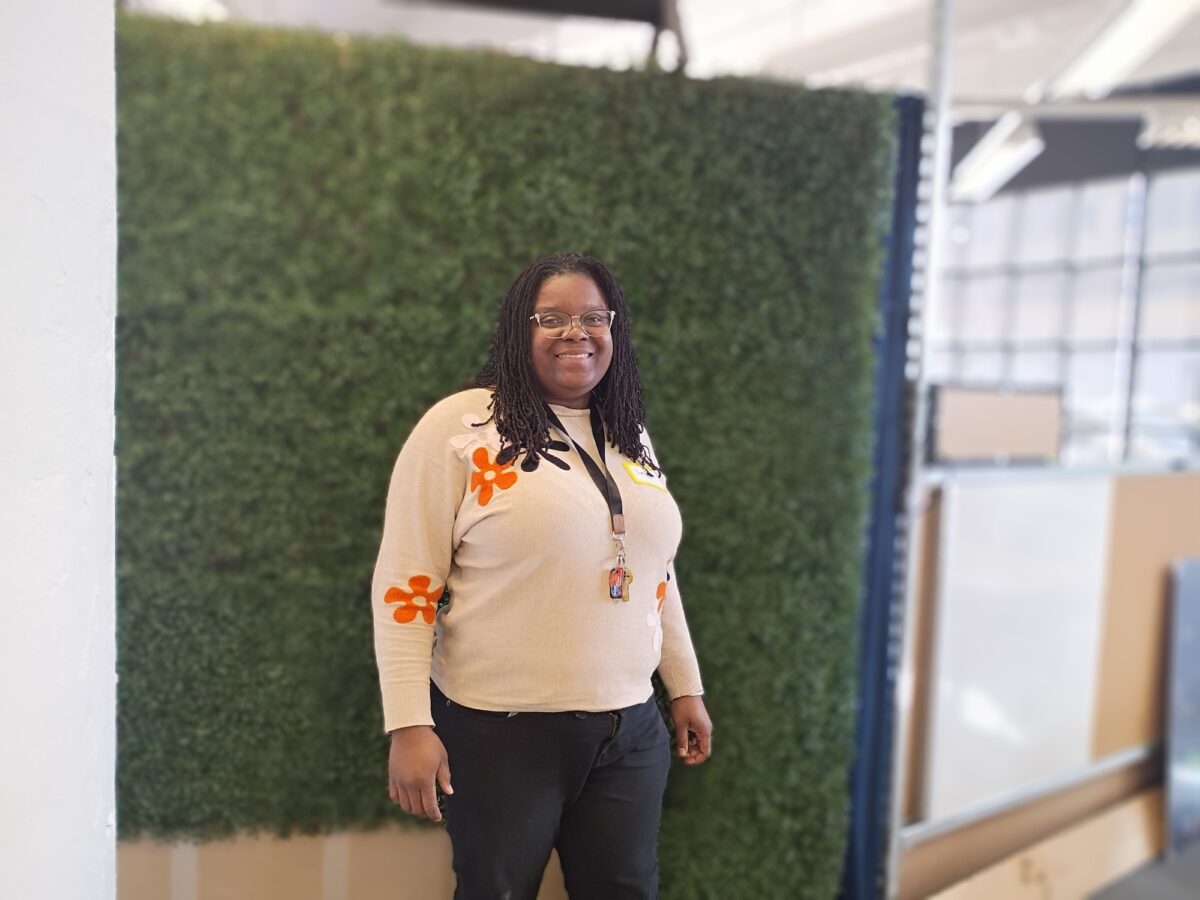
Overview:
- Latia Leonard developed asthma at age six or seven, which she connects to poor air quality and water shutoffs in her Detroit neighborhood
- Leonard now works as a program manager with the Michigan Environmental Justice Coalition, managing grants for 25 community organizations statewide
- The MI Healthy Climate Community Accelerator funds projects in environmental justice and climate-impacted communities across Michigan
Planet Detroit’s neighborhood reporters are local residents who cover health, environment and climate issues in their neighborhoods. The Lab is made possible with the generous support of the Kresge Foundation.
Latia Leonard was around six or seven when she developed asthma. She still remembers the hospital visits and her first inhaler. As she got older, she came to see her illness as rooted in her environment: the air in her home and the conditions in her neighborhood. She isn’t alone in that.
That early concern for her own health led her to link her asthma to the poor air quality she grew up with and to start looking for sources of environmental hazards in the home.
Today, Leonard works with the MI Healthy Climate Community Accelerator through her role as a program manager with the Michigan Environmental Justice Coalition. She is channeling her lived experience and growing expertise into efforts that expose hidden hazards in the air.
The program funds and supports community organizations across Michigan. Latia’s own focus is storytelling: she wants to use her camera to give people a clearer picture of what they’re breathing.
What side of town did you grow up on?
I grew up on the east side of Detroit, in the Jefferson area. That’s where I went to middle and high school.
How did you get into environmental justice?
My family was impacted by water shutoffs, and as I got older I realized what a systemic problem it was. I started connecting the development of my asthma to the water shutoffs and poor air quality, and I channeled that energy into getting involved in environmental justice. People like me don’t have a voice, and I want to be part of creating that space for everyday people. Something as simple as not changing an HVAC filter can create a toxic little environment that leaves someone unable to breathe for the rest of their life.
What age were you when you developed asthma?
I was around six or seven.
What kind of work do you do with the MI Healthy Climate Justice Accelerator?
Grant funding with nonprofits and community-based organizations. We work with 25 organizations across the state of Michigan, and they all have different missions and focuses, everything from youth development to general community development to clean energy and solar. When we launched the accelerator, one of the few criteria was that an organization had to be in an EJ or climate-impacted community, and that it had a project it wanted support and funding for.
What do you love about your role, and what would you like to see more of?
What I love about my current role is that historically, communities like Detroit and other predominantly Black, brown, and poor communities have been disinvested in. I get to work with folks who are on the ground creating solutions. I’d also love to see a greater emphasis on environmental justice, and an expansion of city- and community-driven projects that bring in partners.