

Overview:
- Van Buren Township Planning Commission approved final site plans for Google's 1-gigawatt data center and accompanying utility substation on 282 acres north of I-94.
- The facility will use 2-3.6 million gallons of water daily and employ 50-200 people.
- Read details on the projected noise, water usage, and power demands from the hyperscale data center.
The site plans for a 1-gigawatt Google data center and an accompanying electrical substation received final approval last week from the Van Buren Township Planning Commission.
🗳️ Civic Action Toolbox — see how you can get involved
Why it matters
The Van Buren Township data center could affect nearby residents' quality of life through noise, dust, and climate impacts.
Who's making public decisions
The Van Buren Township Planning Commission granted the site plan approval. The Michigan Public Service Commission oversees DTE's contracts and proposed gas plants, and EGLE regulates wetland and stream impacts.
Upcoming Meetings
Contact Your Representatives
Civic Actions: What You Can Do
What to watch for next
Watch whether Van Buren Township adopts stricter data center zoning rules, and how regulators rule on DTE's proposed natural gas plants in Milan and Handy townships ahead of the planned December 2027 startup.
Are you taking action? Let us know.
Powered by Civic Action Toolbox
Residents have said the “Project Cannoli” data center proposed by developer Panattoni could bring noise to the nearby Haggerty subdivision, harm water resources, and impact energy reliability and affordability.
Project backers say it represents a boon for jobs and investment that will bring significant tax dollars to the area.
The commission is compelled to approve the project because it’s a principal permitted use under the township’s zoning rules, Van Buren Township Planning Commissioner Jeffrey Jahr said Wednesday, Oct. 14.
“I feel that the applicant has met all of the objective specific requirements for us to grant the request,” he said.
Saline Township, in neighboring Washtenaw County, was sued by a data center developer that alleged exclusionary zoning in September 2025 after the township board denied the rezoning needed for Oracle and OpenAI’s 1.4 GW data center.
Whether Van Buren Township places more restrictions on data centers will need to be evaluated, Jahr said, adding that he is leaning toward doing so.
Residents say they’re already dealing with noise, dust
Township residents said Wednesday they are already dealing with noise and dust from the project. Several people played recorded dump truck noise on their phones.
Over 2,700 people have signed an online petition opposing the data center.
Van Buren Township resident Tracy Osborne, who lives next to the data center site, said he’s concerned about the impact constant data center noise could have on his daughter with special needs.
“My concern is not simply whether this facility meets a number on a noise report,” he said. “It is whether neighboring families will be able to enjoy their homes without continuous disruptive equipment noise.”
A Panattoni spokesperson told Planet Detroit in a statement that the company takes resident concerns seriously, including noise and dust, and is committed to minimizing impacts.
Multiple parties are working in the area, including utility providers, and not all work is associated with the project, the spokesperson said.
Representatives for Panattoni said Wednesday that the I-94 Service Drive will be used for site access during construction — not Haggerty Road — to minimize resident impacts.
Here’s how the data center could impact residents.
How big will the project be?
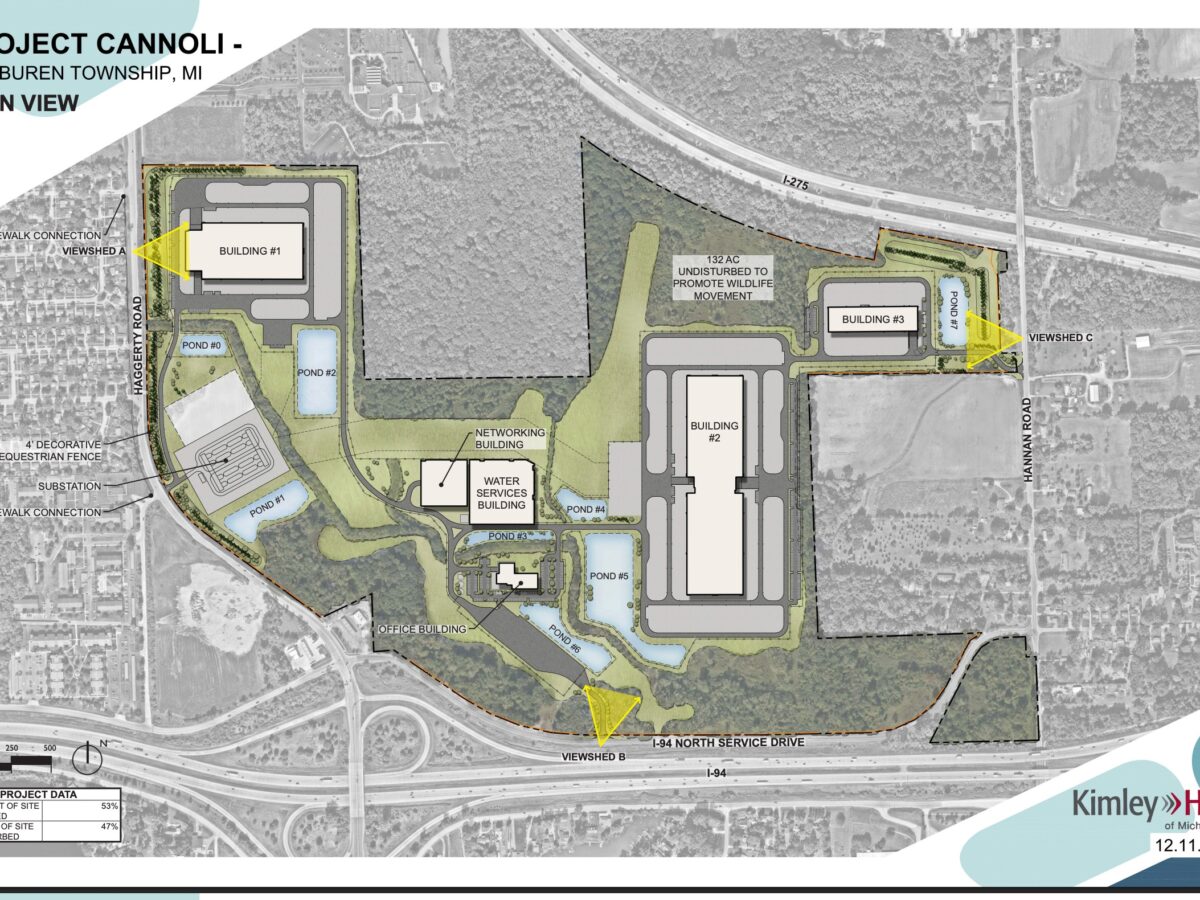
The project is set to occupy 282 acres north of I-94, east of Haggerty Road, west of Hannan Road, and south of Wayne County Community College.
The project will permanently impact 13.55 acres of wetlands, require six culverts in regulated streams, and fill and abandon 573 linear feet of a stream, John Jones, an environmental quality analyst with Michigan’s Department of Environment, Great Lakes, and Energy (EGLE), said in June.
Developers will offset wetland and stream impacts by purchasing wetland mitigation bank credits in the Huron River watershed and creating 1,174 feet of new stream channel on the property itself, Jones said.
Forty-five percent of the acreage at the site will remain undeveloped under a conservation easement, Josh Capps, Panattoni’s director of data center delivery, said Wednesday.
The data center will use roughly 1 GW of electricity, according to the township’s frequently asked questions document. One gigawatt is roughly equivalent to the power used by 800,000 homes.
What are the economic impacts?
The project represents a “generational investment from one of the best companies in the world,” Adam Kramer, president of data centers for Panattoni, said Wednesday.
The data center will require 9.8 million labor hours for its construction and employ 50-200 employees on site, he said. Developers have already awarded $2 billion in contracts to Wayne County businesses, he said.
The data center is projected to be the largest taxpayer in Van Buren Township and one of the top five taxpayers in Wayne County, Kramer said in February.
How much noise will the project produce?
Modeling shows the data center will comply with Van Buren Township’s noise limit of 67 dBA, Paul Kammer, an engineer with the consulting firm Fishbeck, said Wednesday.
dBA is a weighted decibel scale for judging loudness, with 67 falling between the volume of a normal conversation and a vacuum cleaner, according to a Yale University decibel chart.
Panattoni’s Capps said sound from the facility would largely fall below the area’s ambient nighttime noise. The loudest noise will be to the south and east of the facility, with anticipated dBA readings of 62.1 and 59.7, respectively, he said.
Buildings are being used to block noise from leaving the site, Capps said.
The Kimley-Horn noise study for the project says there are plans for two, 40-foot-high noise walls.
How much water will the project use?
Two of the Google data center buildings will use closed-loop cooling systems, and one will employ water-intensive open-loop cooling. The developer estimates total water usage of 2 to 3.6 million gallons per day, according to a January township document. This water will be purchased from the township.
Kammer said that during wet weather events, the data center will be required to store cooling water discharge on site to reduce stress on the township’s sewer system.
Panattoni’s Capps said the facility will have four storage tanks that will allow it to sequester water from a 500-year storm.
Will backup generators create air pollution?
The township previously said the data center will use Tier 4 backup diesel generators, which it called the Environmental Protection Agency’s “highest standard for clean air.”
Panattoni’s Kramer said Wednesday the number of generators planned for the site has been reduced from 200 to 22.
Diesel generators can emit pollutants like carbon monoxide and nitrogen oxides, or NOx. NOx can aggravate respiratory diseases, especially asthma, and lead to hospital admissions and emergency room visits.
Long-term exposures can contribute to the development of asthma and increase susceptibility to other respiratory diseases. NOx reacts with other chemicals to form ozone, which can trigger asthma attacks and aggravate lung disease.
What are the Google data center’s utility impacts?
The Michigan Public Service Commission approved DTE Energy’s contracts for the Google data center on Oct. 1, including requirements for Google to pay for the development of up to 1,600 megawatts of renewable energy and 480 MW of battery energy storage by DTE Electric.
As part of the contracts DTE filed in March for the Google data center project, the utility modeled a “proxy” 727 MW gas plant for 2033, similar in size to a 700-MW plant it’s now proposing in Milan Township. The utility is also proposing a 1,400 MW natural gas plant in Handy Township.
The addition of 2.1 GW of natural gas generation, with an estimated combined cost of $6.4 billion, could add costs for residential ratepayers under existing cost allocation rules, Katie Duckworth, an Environmental Law and Policy Center attorney, previously told Planet Detroit.
Ratepayer advocates say other DTE customers could pay for “stranded assets” if a data center uses less power than anticipated, or ceases operations.
The Google contracts include an 80% “minimum billing demand,” which refers to the minimum amount of the facility’s contracted demand that will be charged each month.
Michigan Attorney General Dana Nessel argued for a 90% minimum billing demand in an Aug. 3 brief filed with the MPSC, among other ratepayer protections.
DTE spokesperson Ryan Lowry previously said Google will cover the full cost of powering its data center. DTE’s contract is expected to have nearly $1.7 billion in “positive affordability benefits” for customers, according to the utility.
How will the Google data center impact climate?
The data center’s climate impacts may depend on how much energy it’s able to draw from renewable sources and how much is sourced from new and existing fossil fuel generation.
DTE spokesperson Colleen Rosso previously said several factors influenced the utility’s plan to increase its gas-fired capacity, including the loss of 3 GW in power generation from the forthcoming retirement of the coal-fired Monroe Power Plant.
Natural gas is primarily methane, a potent greenhouse gas that produces carbon dioxide when burned. Pipeline leaks can lead to methane emissions. The EPA estimates that methane is more than 28 times as potent as CO2 in trapping heat in the atmosphere.
Natural gas with carbon capture and storage that traps at least 90% of CO2 emissions is classified as clean energy under Michigan’s 2023 clean energy law. The law requires the state’s electricity generation to transition to 100% renewable sources by 2040, a standard DTE said it will meet.
The natural gas power plants for which DTE is seeking approval will be “carbon capture ready,” meaning they will be designed so this technology can be added in the future.
“These gas plants will be producing carbon emissions and other air pollutant emissions like all gas plants do,” Duckworth, with the Environmental Law and Policy Center, previously said.
When will the Google data center come online?
The data center is expected to begin service in December 2027 and achieve maximum load by December 2028, the Michigan Public Service Commission said in early October, citing DTE Electric.
DATA CENTER NEWS
‘What environmental racism looks like’: Protest targets University of Michigan computing center
A University of Michigan regent joins residents, labor representatives, and township officials at protest against planned $1.25-billion computing facility in Ypsilanti Township, where critics say the tax-exempt project targets a lower-income community while providing few local benefits.

Michigan regulators OK DTE contracts for Google data center
Michigan’s utility regulator voted unanimously Thursday to grant conditional approval for DTE Energy contracts to power Google’s 1-gigawatt data center project in Van Buren Township.
How data centers factor into DTE’s 20-year power plan
DTE Energy’s long-range power plan would more than double the utility’s electric capacity over 20 years, including two natural gas plants that environmental groups say are needed primarily to serve major data centers in Southeast Michigan.