

Overview:
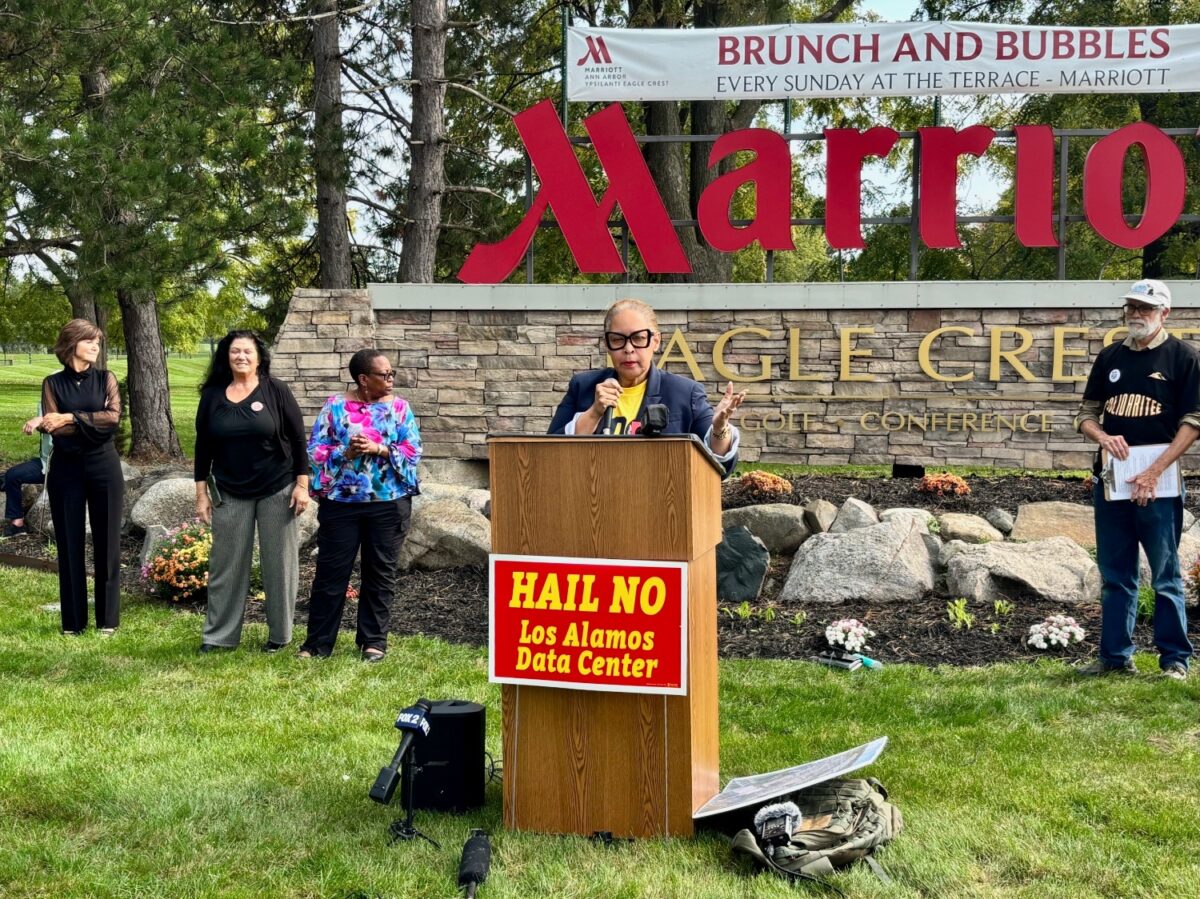
- U-M regent Paul Brown joins protesters opposing the university's $1.25-billion computing center project in Ypsilanti Township.
- The 100-megawatt facility would create around 250 permanent jobs, and draw power equivalent to roughly 80,000 homes while sending no property tax revenue to the township.
- Ypsilanti Township enacted moratorium on electrical infrastructure for facilities like U-M's, and the local utility passed a similar moratorium on water.
A public university charged with advancing the public good shouldn’t build a project in a community where it’s unwanted, University of Michigan Regent Paul Brown said Thursday.
🗳️ Civic Action Toolbox
Why it matters
Ypsilanti Township residents and officials are concerned a 100-megawatt University of Michigan and Los Alamos National Laboratory computing facility could increase electric bills, add other costs, and create environmental impacts. The university pays no local property taxes and is exempt from local zoning rules.
Who's making public decisions
The University of Michigan Board of Regents has the authority to stop or proceed with the project, according to university officials. The Ypsilanti Township board has passed multiple resolutions in opposition to the $1.25-billion project.
Upcoming Meetings
Contact Your Representatives
Civic Actions: What You Can Do
Organizations to Follow
What to watch for next
Watch for efforts by Ypsilanti Township to block the project; the outcome of state Rep. Jimmie Wilson Jr.'s legislation to rescind a $100-million state grant for the project; and any developments at the University of Michigan Board of Regents.
The regents are scheduled to meet next Oct. 15 in Flint, but a time and details are to be determined.
Are you taking action? Let us know.
Powered by Civic Action Toolbox
Brown spoke at a protest over the University of Michigan and Los Alamos National Laboratory’s planned $1.25-billion computing center project on the Huron River in Ypsilanti Township, ahead of a university town hall meeting on the facility.
“It is inexcusable that the University of Michigan has not spent time in the community, going door to door, neighborhood to neighborhood, living room to living room, and answered every one of your questions,” Brown said.
The U-M regent, a Democrat serving on the board since 2019, released a statement in opposition to the university project in September. In the statement, he named the project’s location in a natural setting on the Huron River and opposition from residents as reasons why it does not have his support.
Nearly every speaker Thursday referred to the 100-megawatt Michigan and Los Alamos project as a data center. The university maintains the facility is a high-performance research computing center.
Thursday’s protest follows more than a year of intense community opposition to the project, with Ypsilanti Township residents and officials criticizing the university’s outreach and transparency.
The University of Michigan did not respond to a request for comment on the protest.
U-M’s Ypsilanti Township land acquisitions
The regents, including Brown, voted unanimously in favor of acquiring vacant land at 6630 Rawsonville Road and 10221 Textile Road in Ypsilanti Township for a total of $2.6 million on Oct. 17, 2024.
On June 12, 2025, the regents unanimously approved the purchase of 124 acres at 10455 and 10635 Textile Road for the facility for $65,000 per developable acre.

Brown was joined Thursday by Amir Makled, an attorney and Democratic candidate for the regents board. Makled said he wants to know what the data center will cost the community.
Several speakers said the Ann Arbor university is targeting a neighboring community with more low-income areas and communities of color for a project that will add costs for Ypsilanti Township without providing substantial benefits.
The university pays no local property taxes and is exempt from local zoning rules.
Residents will not benefit, says Ypsilanti Township activist
Ypsilanti Township resident and community activist Leah Mills-Chapman said the project is “what environmental racism looks like.” The Textile Road site is across the street from an apartment complex with low-income, Black residents, she said.
“The residents of this township will not benefit at all from this project,” Mills-Chapman said. “The institution is the only one that benefits.”
A university webpage says the project will be used for research in medicine, materials science, clean energy, engineering, and national security, including modeling “to ensure the safety and reliability of our nation’s existing nuclear stockpile as it ages, without the need for live testing.”
Chris Kolb, the university’s vice president for government relations, said at a September town hall the project will create 30 to 50 technical support jobs at the Textile Road site; 200 higher-level research jobs; and 300 temporary construction jobs.
The facility will not draw water from or discharge water into the Huron River, according to the university. It will use around 100 megawatts of power when fully operational.
It aligns with the university’s commitment “to reach net-zero emissions for purchased electricity by 2027, as the university has already secured large-scale solar power agreements to account for the center’s academic energy needs,” according to the college.
Construction on the project could begin in late 2027, according to the university.
Labor representatives push back on data center
Thursday’s protest was notable for its inclusion of voices from organized labor who oppose the Michigan project.
Several large unions in the state support data center construction and the potential jobs they could bring, including the Michigan Building and Construction Trades Council, which represents nearly 100,000 workers.
Michelle Deatrick, vice president of the Huron Valley Area Labor Federation and chair of the Democratic National Committee Environment and Climate Crisis Council, said U-M’s messaging around the project has been misleading, and its size means it qualifies as a “hyperscale data center.”
A 100 MW data center is generally considered a hyperscale facility, and can use as much power as 80,000 homes, according to The Joyce Foundation.
“This is not a zero emissions facility,” Deatrick said. “The university calls it that, but that only counts what comes out of the building itself and ignores the power plants upstream that supply the energy for the facility.”
Tad Wysor, executive board member for the Huron Valley Area Labor Federation, said broad opposition to the data center exists among the federation’s 39 affiliated unions, including many Michigan employees.

Although the facility’s construction would create much-needed short term construction jobs, it’s important to balance this fact against the longer-term realities for workers, Wysor said.
Once constructed, the project would create “almost zero local jobs,” despite substantial investments from a state university and $100 million from a state economic development fund, he said.
“It’s time for us all to think bigger and creatively work together to put that kind of public money into real, broad-based local economic development projects,” he said, adding that these kinds of projects could create large numbers of long-term, well-paid union jobs for local residents.
U-M erred in selecting Ypsilanti Township: Municipal lawyer
The University of Michigan is among the nation’s wealthiest universities, but it will contribute nothing to police and fire services in Ypsilanti Township while residents struggle to pay their property taxes or afford food and gas, said township attorney Doug Winters.
“Of all the places that you could have picked, you picked the one area that was the area you felt had the least amount of political and financial resistance,” he said. “That was a mistake.”
Winters said the township is resilient, and the board has authorized his office “to use all legal means available to stop this data center.”
The Ypsilanti Township Board of Trustees approved a six-month moratorium in August on new, major electric infrastructure.
The vote followed a 12-month moratorium on supplying water to resource-hungry facilities, including hyperscale and midsize data centers, artificial intelligence computing facilities, and high-performance computational centers approved by the Ypsilanti Community Utilities Authority in April.
In December, state Rep. Jimmie Wilson Jr., D-Ypsilanti, introduced legislation to rescind a $100-million Michigan Strategic Fund and Michigan Economic Development Corp. grant for the project.
U.S. Rep. Debbie Dingell, D-Ann Arbor, called for a pause on the project in September, citing a lack of transparency and unanswered questions about the facility’s operations, and its impacts on Ypsilanti Township residents, including the potential for increased energy costs.
MORE ON YPSILANTI TOWNSHIP

Data center news: Dingell calls for pause on University of Michigan’s Ypsilanti Township supercomputing project
U.S. Rep. Debbie Dingell calls for pause on the University of Michigan’s planned $1.25-billion computing facility in Ypsilanti Township, citing lack of transparency. Plus: Warren and Dearborn advance data center moratoriums, a poll shows nearly two-thirds of Michigan voters oppose the facilities, and Oracle posts six-figure jobs for its Saline Township project.


University of Michigan’s Ypsilanti Township computing center plans meet with anger at town hall: ‘Enormous distrust’
Ypsilanti Township residents confront University of Michigan officials at a town hall Wednesday over plans for a 100-megawatt computing center, raising concerns about noise, energy use, and what they say is the university’s lack of transparency.


University of Michigan confirms Huron River site for $1.2 billion computing facility: Ypsilanti Township vows to fight back
The University of Michigan confirms plans to build $1.2-billion data center in Ypsilanti Township over local objections, sparking vows of resistance from township officials concerned about environmental impacts and lack of transparency.