

Overview:
- Over 1,500 green infrastructure projects across Southeast Michigan watershed groups now capture 19 million gallons of stormwater annually.
- Detroit's Far West Stormwater Improvement project redirects stormwater from 210-acre area into two basins in Rouge Park, eliminating late-night calls about basement backups to the president of a neighborhood association.
- Small, residential rain gardens help, but large-scale solutions of 30-50 acres are needed to manage the volume from increasingly intense storms, says University of Michigan engineering professor.
Ethan Bakuli reported this story while participating in a Solutions Journalism Network accelerator program for coverage of the health impacts of seasonal climate issues in Metro Detroit.
Danny Dolley speaks with pride and wisdom about the rain gardens that border his porch steps.
The longtime Chandler Park resident, who’s experienced multiple basement backups and yard flooding, enrolled in a master rain gardener class taught by the Sierra Club and the nonprofit Friends of the Rouge.
🗳️ Civic Action Toolbox — see how you can get involved
Why it matters
Green infrastructure projects can reduce basement flooding and sewer overflows that plague Metro Detroit, helping to combat the costly property damage and health hazards that have affected residents during intense rainstorms.
Who's making public decisions
The Detroit Water and Sewerage Department, Southeast Michigan Council of Governments, watershed councils, residents, and nonprofits are designing and constructing green stormwater management infrastructure across Metro Detroit.
Organizations to Follow
What to watch for next
The Clinton River Watershed Council is launching its Rain to Roots program this fall in flood-prone Macomb County communities, offering free stormwater consultations and rain garden installations. The Rain Catchers Collective, representing four watershed councils, is seeking $12.5 million in state funding for its green stormwater infrastructure work.
Are you taking action? Let us know.
Powered by Civic Action Toolbox
The class walked him through the benefits of growing native plants as a means of reducing localized flooding, and collecting runoff before it enters the nearest storm drain.
“I never noticed flooding in my yard or house until the flood of summer 2021, where my whole basement floor was covered wall to wall in water,” said Dolley.
Detroit is one of 700 older, urbanized U.S. communities, mostly in the northeast and Great Lakes region, that have century-old combined sewer systems, according to the Environmental Protection Agency. The systems funnel waste and stormwater to treatment plants in the same pipe.
While innovative for the 19th century, the method became obsolete by the mid-20th century as newer communities installed separate — or sanitary — sewer systems, reducing the chance of sewage overflows when heavy rainfall overwhelms sewer capacity. The discharges are known as combined sewer overflows, or CSOs.
In areas like Southeast Michigan, where the price of separating the region’s combined sewer system would run into the billions, nonprofit, city, and regional leaders are increasingly embracing nature-based, cost-effective solutions to divert stormwater runoff.
Since 2024, the organizations stewarding the region’s four major watersheds— the Clinton, Detroit, Huron, and Rouge rivers – formed the Rain Catchers Collective, a coalition aimed at protecting the quality of the region’s lakes and rivers through rain collection practices like rain gardens and barrels.
The collective represents almost 5 million people, said Ric Lawson, director of programs at Huron River Watershed Council and a leader of the collective.
“We’re focused on what residents can do individually at their homes and then public places in municipalities, so doing small to medium scale efforts, and those can be rain gardens, but they can also be green roofs and porous pavement and bioswales,” he said.
‘What we’re really looking for is repeatability’
As intense rain storms inundated Southeast Michigan over the last decade, Lawson said demand across the region has increased for alternatives beyond the costly and traditional approach of installing, repairing, and replacing gray infrastructure.
Over 1,500 green stormwater infrastructure — GSI — projects have been installed across the Rain Catchers Collective’s four watershed groups, capturing and filtering over 19 million gallons of water, according to Lawson.
The Rain Catchers Collective is seeking $12.5 million in state funding to expand its residential program, develop a network of native plant suppliers, and train a workforce to install and maintain projects, according to documents shared with the Michigan Legislature.
The seed funding would boost the watershed collective’s capacity to standardize GSI practices across the region, and improve local resilience to future storms.
“What we’re really looking for is repeatability,” said Lawson. “They’re small, but we want to do a ton of them. We want to teach everybody how to do it, so that when we add that all up, we’re then really scaling up to much larger capture and treatment.”
Early stumbles in the lead-up to the Rain Catchers Collective were important lessons for the road ahead, Lawson said. They included invasive species infestation, owner neglect, and limited budgets.
“What we found through those past projects on our own is that it’s really critical that you keep maintenance going for the first three years,” he said.
“After three years, if you get these established, they really stabilize, and then the maintenance is really low level.”
The projects need overflow capacity to ensure additional stormwater doesn’t “go into the neighbor’s basement or flood their own basement,” he said.
Rainier climate calls for large-scale stormwater solutions
Residential, small-scale GSI designs capture stormwater up to the first inch of rainfall. Large-scale projects can collect up to millions of gallons of stormwater, occasionally in the form of a 100-year, 24-hour storm event.
With single family residential lots typically ranging from as small as one-tenth of an acre in Detroit to one-third of an acre in the suburbs, researchers are cautious about expecting too much without large-scale investment.
“Rain gardens are good things to do,” said Glen Daigger, an engineering professor at the University of Michigan.
“They’re not going to solve this problem” due to the size of nature-based solutions that are required to deal with stormwater volumes, he said.
“You’re talking about 30 or 40 or 50 acres” for such projects, Daigger said, rather than quarter-acre residential parcels.
Lauren McPhillips is a Penn State civil and environmental engineering professor who studies the use of green infrastructure for stormwater management.
As communities brace for intense rainfall brought on by warming temperatures, it’s sparked conversations around green infrastructure to reimagine the future of urban planning, McPhillips said.
“It doesn’t make sense to build a whole bunch of underground storage and basins to hold all of that water. We have to think about ways that we’re keeping people safe in some way and thinking strategically about how to manage those larger events,” she said.
Blue spot analysis, which identifies flood-prone areas along land depressions, “can help us a lot in figuring out the balance in terms of where it makes sense to put green infrastructure,” McPhillips said.
The Penn State professor noted Copenhagen’s “Cloudburst” urban planning approach, which reconfigured the Danish capital over the the last decade-and-a-half.
The city has areas “that are safe to flood,” such as parks, athletic fields, and open space around housing complexes, she said.
Elements of Copenhagen’s climate-resilient approach have been replicated in cities such as New York.
Using $3.2 million from the EPA, the Southeast Michigan Council of Governments launched a grant program this spring to help local counties, towns and schools design networks of green infrastructure projects that can collectively reduce as much as 11 million gallons of stormwater runoff over the course of a year.
“We’re opening the door for projects for green infrastructure, small scale and large scale,” said Kelly Karll, manager of SEMCOG’s Environment & Infrastructure Group.
Small rain gardens will not solve the region’s chronic flooding issue, Karll said.
“They help a little bit, shave off the peak, maybe a little water quality. We need big features to manage runoff, and some of this funding can help.”
GSI in cities
The 1972 Clean Water Act required U.S. communities to limit the discharge of pollutants into bodies of water. GSI was initially adopted at scale by cities with combined sewer systems that reached consent decrees with the federal government.
In Seattle, one of the early U.S. innovators of GSI, the region’s RainWise program installed over 2,600 residential rain gardens and cisterns, managing 37 million gallons of water annually.
Growing research suggests GSI can reduce the urban heat island effect; attract pollinators, birds and butterflies; and collect microplastics before they reach local drains or streams.
Penn State’s McPhillips said nature-based flooding solutions add up.
“You start to slowly chip away at those nuisance flooding issues for the people that are living downslope. Whatever people can do to be holding back water on their parcels – all those little bits of improvement are going to add up eventually to some more noticeable improvement downstream.”
Stormwater program launches in flood-prone Macomb County cities
The Clinton River and its watershed span Macomb, Oakland and St. Clair counties, and roughly 1.5 million people. More than 55% of the region is covered in impervious surfaces like roads, parking lots, driveways, sidewalks, and building rooftops that prevent water from soaking into the ground, according to the Clinton River Watershed Council.
For years, the watershed council has served as a hotline for flood-prone communities seeking solutions to street or basement flooding, said Kaleigh Snoddy, a CRWC education and stewardship manager.
This fall, the watershed council is launching Rain to Roots, one of a handful of programs it offers to manage stormwater runoff alongside the Rain Catchers Collective.
Rain to Roots offers free stormwater consultations and rain garden design and installation at cost in the Macomb County pilot communities where it’s being piloted.
“Every time it rains, it’s millions of gallons all flooding into the river at once, and we just don’t have the forests, the wetlands, the ecosystems to absorb that at this time,” said Snoddy.
In 2020, First Street Foundation published a National Flood Risk Assessment, flagging high-risk areas for flooding in the next several decades. The southern portion of the Clinton River watershed, encompassing Detroit suburbs like Center Line, Sterling Heights, and Warren, is included.
A 2017 survey conducted by the Macomb County Health Department found that residents in Warren and Sterling Heights are among those who self-reported psychological-emotional challenges after an August 2014 storm caused over $1 billion in property damage.
The Rain to Roots program will launch in the Macomb County communities, which have waterways that rank among the lowest in water quality in the Clinton River watershed, Snoddy said.
The cities are the source of frequent calls to the watershed council about flooding, she said.
“Up ’till now, it’s been phone calls — so actually getting out there and seeing the residents” is significant, she said.
‘A more rational approach’ to Detroit River watershed
As GSI is rapidly adopted, researchers argue the natural history of the Detroit region’s marshland must play a bigger role in how city and regional engineers design large-scale projects.
Bill Shuster is a Wayne State University engineer who previously studied cost-effective solutions for CSOs at the EPA.
While Detroit needs large-scale green infrastructure, it could run the risk of “degrading the landscape by over-engineering and costing a lot of money,” he told Planet Detroit.
Shuster collaborated with the nonprofit Eastside Community Network and residents to develop a Detroit River watershed management plan.
It’s designed to identify the neighborhoods with the highest stormwater volume contribution to the combined sewer system, and determine what interventions are needed in each area, he said.
“Massive volumes of wastewater” are funneled from suburban communities to treatment facilities in Detroit, Shuster said.
Strategic placement, minimal land erosion, and fortifying private sewers should be among the region’s priorities to protect downstream residents, he said.
“It’s taking what I consider a more rational approach into seeing the landscape for what it is, and not what we want it to be.”
In Milwaukee, the wastewater authority managed to reduce the number of CSOs polluting Lake Michigan from 50 per year down to roughly two.
Bre Plier, director of integrated watershed management at Milwaukee Metropolitan Sewerage District, said the achievement is in large part due to the 28.5-mile Deep Tunnel system, a method of gray stormwater infrastructure that stores roughly 521 million gallons.
It was developed beginning in the 1980s to reduce Lake Michigan pollution.
The Milwaukee region has roughly 175 million gallons of built green infrastructure, said Plier, made up of large-scale projects undertaken by MMSD and municipalities.
“Part of the reason we’re able to do green infrastructure and have some of this additional focus on that now is because we already have had those investments made historically into our system, and so we’re able to kind of take that next inch forward from there,” said Plier.
MMSD is preparing to pilot a residential GSI program in conjunction with assisting residents in disconnecting their downspouts and replacing lateral sewer lines.
Detroit wraps west side GSI project, calls about basement backups end
A $1 billion, 7-mile Upper Rouge CSO tunnel project was canceled in 2009, according to Wastewater Digest. The project was planned for the far west corner of Detroit, bordering Rouge Park.
The city pivoted during the Great Recession, said Sam Smalley, deputy director of Detroit Water and Sewerage Department.
In lieu of the $1 billion project, the city reached an agreement with Michigan’s environmental regulator to use green stormwater infrastructure in order to comply with federal pollution standards, spending $41 million instead.
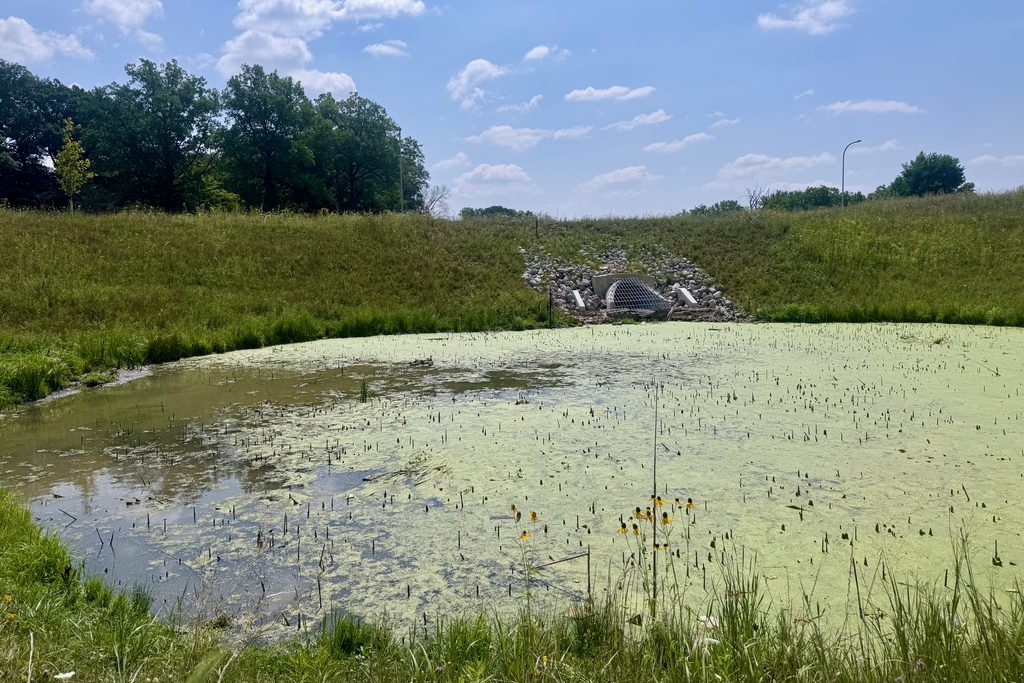
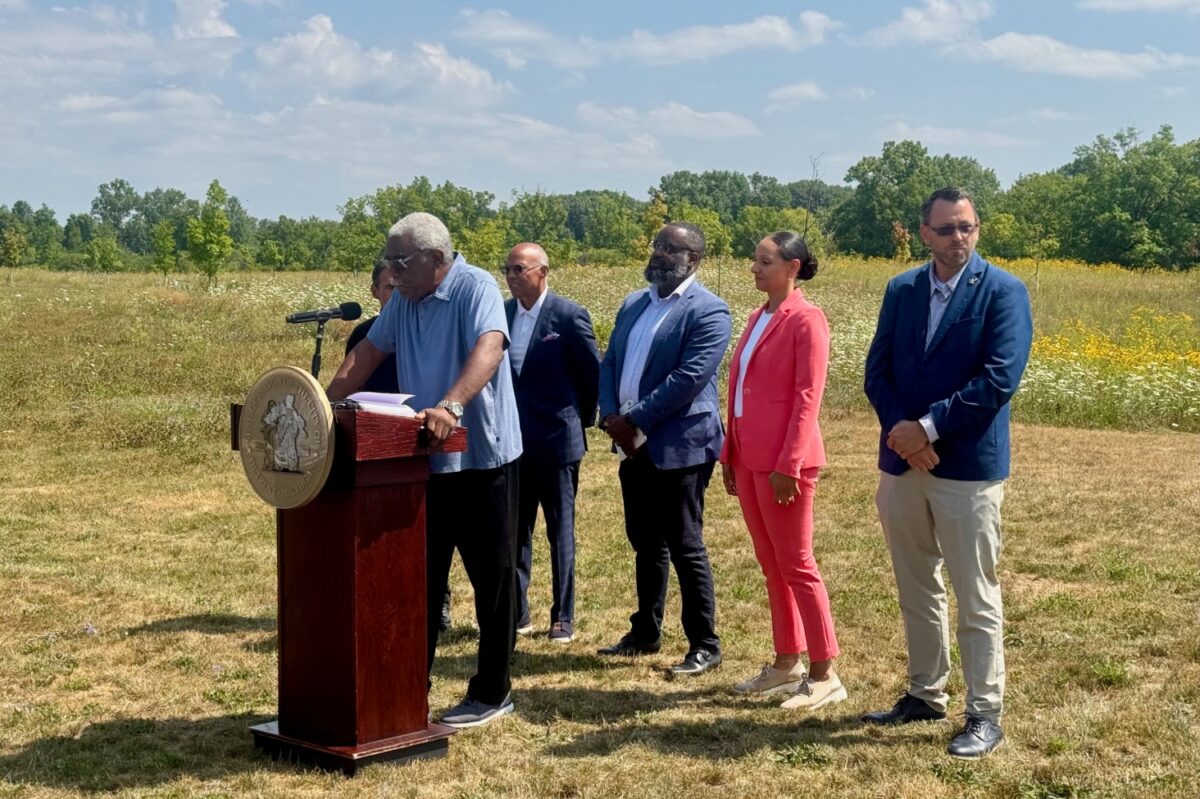
In late July, Smalley and other DWSD officials announced the completion of the Far West Stormwater Improvement Project, which will redirect stormwater from over 210 acres of surrounding neighborhood into two newly constructed stormwater basins in Rouge Park.
It’s the city’s largest green stormwater infrastructure project to date, and will collect up to 119 million gallons of stormwater each year.
The project, Smalley said, is part of the city’s comprehensive approach to reduce CSOs and basement backups, including replacing and repairing water mains and sewer lines, and disconnecting downspouts for residential homes in the Far West area.
Detroit is expanding its GSI footprint through large-scale projects being studied or designed citywide, and through the city’s Post-Construction Stormwater Infrastructure Ordinance, which requires new developments to install GSI, Smalley said.
Arthur Edge, president of the Far West Detroit Civic Association, said the solution is a long time coming.
Edge has been on the receiving end of late night calls about basement backups across his neighborhood, he said.
“The project went forward, and now, I do not get any of those calls,” said Edge.
Southwest Detroit rain gardens
In Southwest Detroit, the community nonprofit Urban Neighborhood Initiatives recently offered free rain garden installations to residents.
Flood mitigation, walkable green spaces, and butterfly habitats were among the priorities residents mentioned in a community survey conducted in the aftermath of the June 2021 storm, said UNI communications director Alyssa Avila.
Sidewalks and streets in the neighborhood flood frequently, creating accessibility issues, and residents routinely report standing water in their front yards, she said.
UNI’s process to install rain gardens has spotlighted certain barriers to entry, Avila said, such as lack of educational resources for first-time homeowners, and disposable income to install and maintain their property.
The density of the housing stock in the Springwells neighborhood makes some lawns less than ideal for rain gardens, she added — and ownership is a factor too.
“A lot of residents are renters,” Avila said. “People can be less invested in putting money toward infrastructure projects like rain gardens when they don’t own the home.”
Almost half of all Detroit housing units are renter-occupied, compared to 29% across the wider metro area, according to Census data from the 2024 American Community Survey.
Rain gardens help return Detroit land to nature
Seven years into maintaining his rain gardens on Detroit’s east side, Dolley said the green spaces expanded his interest and advocacy around addressing flooding and basement backups in his community.
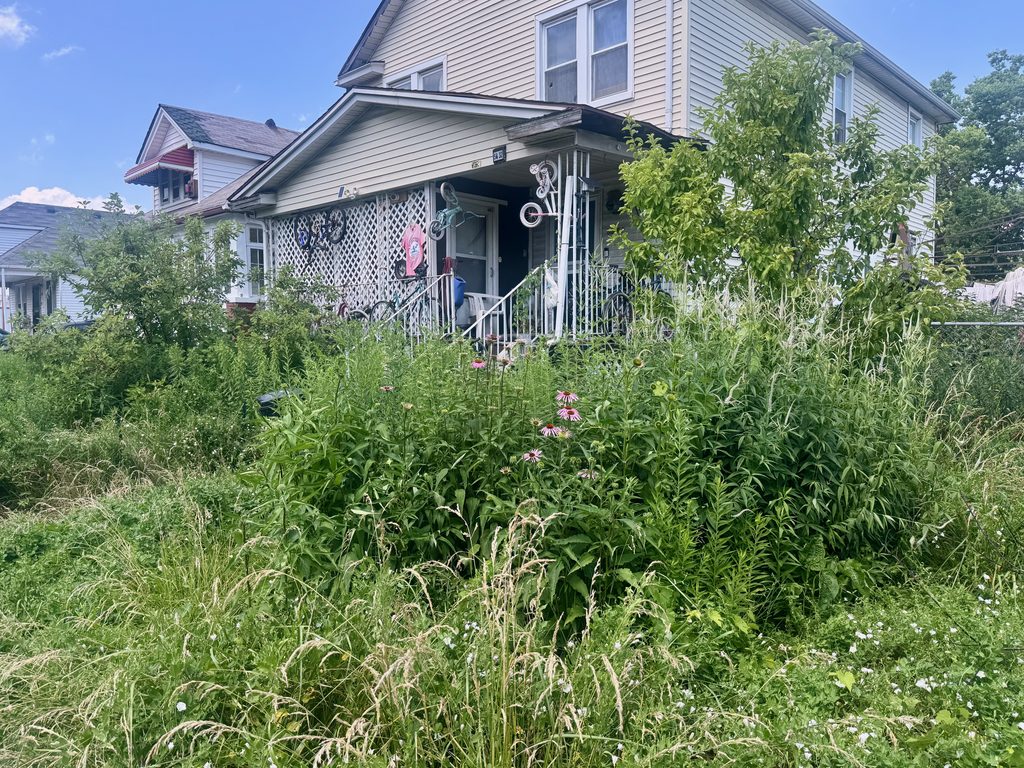
He keeps track of rainfall using a rain gauge from the Eastside Community Network, and created a digital comic book to educate others on the use of rain gardens.
“Once I learned about the combined water system, it’s not a benefit for the house, it’s a benefit for the system,” said Dolley, referring to rain gardens and how they affect the combined sewer system.
The rain gardens help “let some of the strain off” the combined sewers, and invite residents to “return the land toward how nature once held it,” he said.
MORE FLOODING COVERAGE
Southeast Michigan’s flood cleanups continue in courtrooms, boardrooms: How are we rebuilding for stormier future?
Precipitation has increased 15% across the Great Lakes region in seven decades, straining Metro Detroit’s aging infrastructure. A regional task force aims to develop flood mitigation strategies by spring 2027.

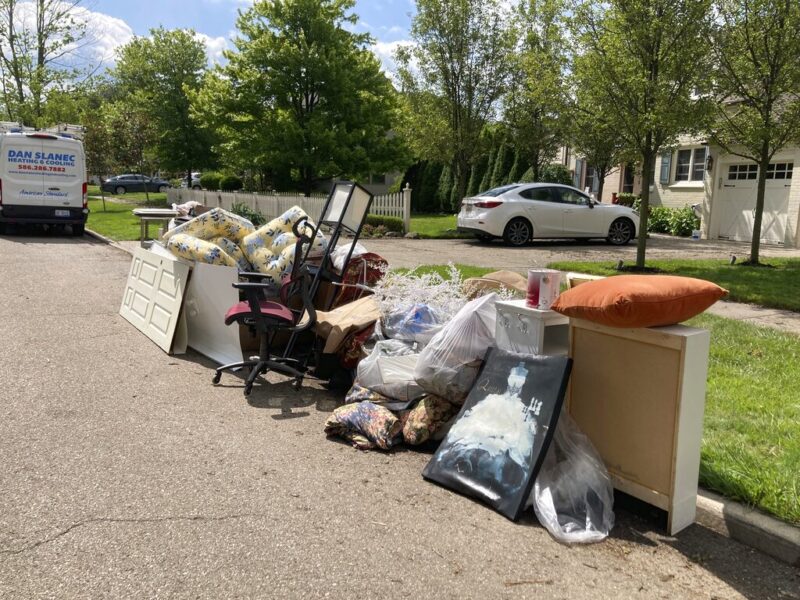
Mold takes hold in Metro Detroit basements after floods, sewage backups
Frequent heavy rainfall in Southeast Michigan over the last decade has raised awareness of indoor mold among homeowners and renters. As water recedes after a flood, mold can develop within as little as 48 hours.
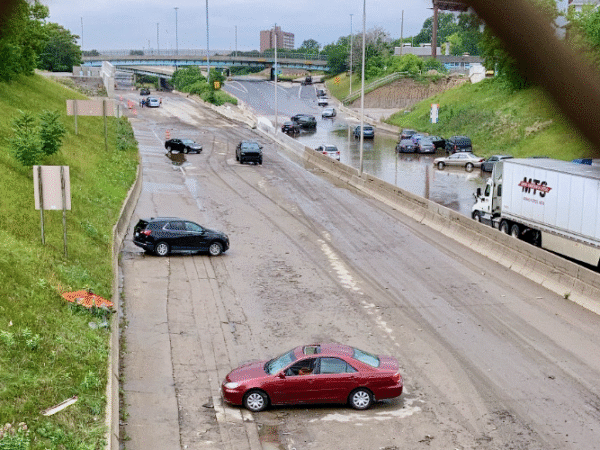
Repeat flooding is creating public health crisis in Detroit: ‘Long-term trauma’
Ethan Bakuli reported this story while participating in USC Annenberg’s Center for Climate Journalism and Communication and Center for Health Journalism 2025 Health and Climate Change Reporting Fellowship as well as a Solutions Journalism Network accelerator program for coverage of the health impacts of seasonal climate issues in Metro Detroit. In the waning days of…
