

Overview:
- An EF-2 tornado with 115 mph winds cut a 3.5-mile path from Detroit's east side to Belle Isle on Sept. 3, damaging 101 properties and injuring one person.
- A University of Michigan and Planet Detroit analysis finds areas of potential light siren coverage in areas near the tornado's path.
- Sirens are designed for people outdoors, so officials urge residents to sign up for Detroit Alerts 365, turn on phone emergency alerts, and pick a shelter room before the next warning.
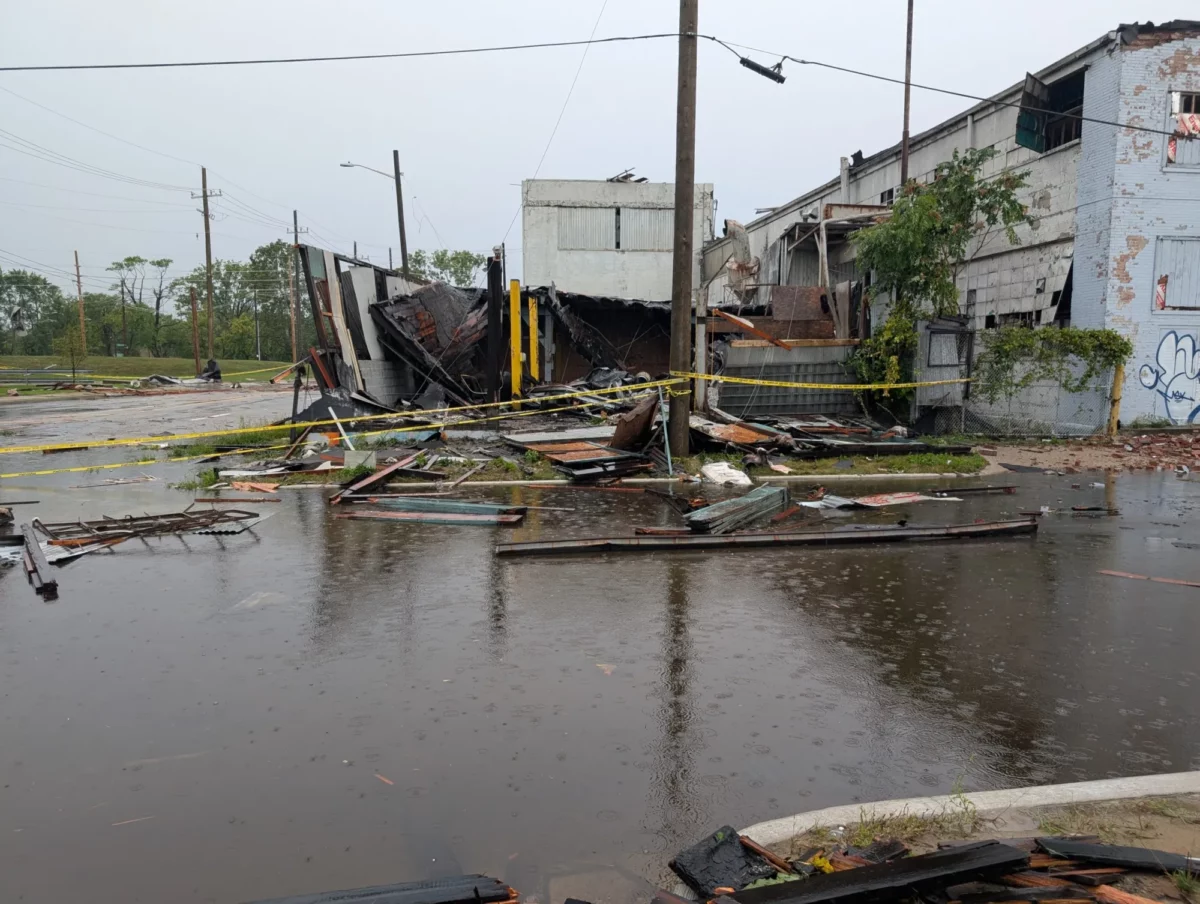
An EF-2 tornado with estimated 115 mph winds cut a 3.5-mile-long path through Detroit’s east side to Belle Isle on Sept. 3. It was the city’s first confirmed tornado since 1997.
🗳️ Civic Action Toolbox — see how you can get involved
Why it matters
The first tornado to strike Detroit since 1997 touched down Sept. 3, 2026 on the east side.
Who's making public decisions
Detroit's 911 dispatchers set off tornado sirens. The National Weather Service issues tornado warnings.
Civic Actions: What You Can Do
- ✓Register for Detroit emergency alerts →
Officials urge residents not to rely on outdoor sirens alone, so confirm that wireless emergency alerts are enabled on your phone and look for the Detroit Alerts 365 sign-up through the City of Detroit's official website. - ✓Read Detroit's hazard mitigation plan →
The city is updating its hazard mitigation plan, which includes tornado siren locations. - ✓Look up your Detroit City Council member →
Find your council member on the Detroit City Council page to see who represents your district if you have questions about tornado response or siren coverage.
Contact Your Representatives
- ✓Mary Sheffield
Mayor of Detroit
313-224-3400 · Contact
What to watch for next
Watch for any changes to Detroit's emergency warning system in the city's next hazard mitigation plan, which is updated every five years.
Are you taking action? Let us know.
Powered by Civic Action Toolbox
The tornado lasted four minutes. What Detroiters heard, saw, or felt before it arrived depends on their distance to a siren and if they saw another form of alert, such as on their smartphone.
Detroit has 56 outdoor sirens built to be heard outdoors. The city’s sirens operate at 130dB, said Chris Kopicko, spokesperson for the city’s Office of Emergency Management and Homeland Security.
While most of Detroit has audible siren coverage, some areas may have light coverage, according to an analysis by the University of Michigan School for Environment and Sustainability’s Detroit Sustainability Clinic and Planet Detroit that compares the city’s siren locations with how sound travels and fades over distances.
The siren network covers approximately 95% of the city, according to Detroit’s hazard mitigation plan.
They include the area of Mack Avenue and East Grand Boulevard, as well as Benson Street and East Grand Boulevard. Both intersections are near the path of the September tornado.
On the northeast side, the area around Schoenherr Street and Eight Mile Road may have coverage gaps.
On the northwest side, the area near Schoolcraft Road and Southfield Freeway also has potentially light siren coverage.
Kopicko did not respond to a request for comment on areas of possible light siren coverage in the city.
Map: Detroit’s siren network
Sound becomes quieter with distance. The map below estimates a siren’s volume at given distances.
Estimated siren volume across Detroit ranges from dark red, or above 77 dB, to clear, or below 63 dB, on the map below. For reference, a washing machine is 50-75 decibels.
Sound buffers are an estimate. Individuals may or may not hear sirens regardless of advertised decibel level. Some areas may not be able to hear a siren despite the map advertising a high decibel level, and vice versa.
West Shore Services built and maintained the sirens, according to the city’s Kopicko.
Map created using city of Detroit data.
‘The sky was completely green’
Islandview resident Christianna Plewka said the first signal of a weather emergency Sept. 3 was on their phone. After another phone alert of a tornado warning, the storm picked up drastically.
“The sky was completely green, and I could hear a deep roaring wind sound that I had never heard before. Soon after this sound began, the power went out.”
Plewka never heard a physical siren, they said: “Were it not for the alert through my phone, I would not have known about the tornado aside from the obvious precipitation, high winds, green sky etc.”
Plewka’s home sustained no serious damage.
How Detroit’s tornado sirens work
911 dispatchers set off Detroit’s sirens, and they’re used in the event of severe weather, an emergency, or national disaster, said the city’s Kopicko.
The city tests the sirens at 1 p.m. on the first Saturday of every month.
Sound from a siren spreads outward in all directions, and its energy thins out as the distance grows.
Each doubling of distance cuts the level by at least 6 dB, even in open air, according to NASA research.
Sound can bounce off hard buildings, be blocked behind them, or be absorbed by trees and foliage, according to NASA. Other sounds can also drown out a siren, such as the weather outside or appliances indoors.
Because sirens are designed for people outdoors, anything between the siren and the listener makes it harder to hear.
Detroit’s warning system could differ from its neighbors. For more information on how Detroit stays prepared for an emergency, click here.
If you hear the sirens outside of a testing time, the city’s guidance says to get indoors fast, to an interior, windowless room on the lowest level. Residents should tune in to local media, and keep checking phone alerts. The city asks residents not to call police, fire departments, or news outlets to ask about the sirens.
Detroit’s siren network used to be much smaller. Vandalism, copper theft, and demolished buildings left fewer than 20 sirens working in Detroit before a 2015 rebuild, Metro Times reported that year.
Michigan’s tornado trend
Michigan recorded 33 tornadoes in 2025, and 29 to date in 2026, said Trent Frey, meteorologist at the National Weather Service’s Detroit/Pontiac office.
Michigan averages 15 tornadoes annually, according to the state.
The number of EF-1 and greater tornadoes is stable year-to-year in recent scientific literature, Frey said.
The number of “tornado days” when an EF-1 or greater twister occurs is decreasing on average, while the number of tornadoes that occur on those days is increasing, he said.
“There are also some trends noted within seasons — a decreasing trend in the spring and summer, and an increasing trend in the fall and winter — but again, these balance out when looking at annual numbers.”
Complex atmospheric conditions combine to generate a tornado, and researchers continue to develop tools to discern potential human influence from natural variability, Frey said.
“So far, the majority of research stops short of connecting historical changes in tornado behavior to a warming climate.”
Frey said the variables that can affect tornado trends include:
• Increasing city footprints, with more things for tornadoes to damage.
• Improving technology. Modern radar better detects tornadoes.
• Changes in reporting and surveying methods.
“The large majority of ‘extra’ tornadoes identified by improved technology are weak, which is why EF-0 tornadoes are commonly excluded in historical trend analysis,” the meteorologist said.
For example, Michigan has logged 14 tornadoes so far this year that were EF-1 or greater, he said; in 2025, 16 tornadoes were EF-1 or greater.
101 properties damaged by Detroit tornado
The NWS rated the Detroit tornado an EF-2, with peak winds estimated at 115 mph, a 3.5-mile-long path and a maximum width of half a mile.
A tornado warning covering Wayne County, including Detroit, was issued by the NWS at 3:48 p.m. Sept. 3. The city did not respond to a question on what time sirens sounded.
The tornado touched down at 4:14 p.m. near E. Hancock St. and Ellery Place in the McDougall-Hunt neighborhood. After crossing the Detroit River to Belle Isle, it lifted at 4:18 p.m., according to the NWS damage survey. The agency recorded one injury and no deaths.
Mayor Mary Sheffield declared a local state of emergency the next day.
Inspectors counted 101 damaged properties, 55 of which are businesses. By mid-September, crews removed 295 fallen trees and cleared 83 streets.
The last confirmed tornado inside city limits before 2026 hit on July 2, 1997. An F2 twister touched down in Northwest Detroit, Highland Park, and Hamtramck, causing nearly 100 injuries, according to the NWS.
Weaker EF-0 tornadoes touched down in Marysville on Sept. 2, and in Lincoln Park on Sept. 3, two minutes before the Detroit twister.
Lincoln Park was also hit by an EF-1 in April, Planet Detroit reported.
What to do before the next warning
- Pick your shelter now. The city advises an interior, windowless room on the lowest level.
- Don’t wait for a siren. Act on any warning. If you’re outside, in a car or in a mobile home, move to the nearest sturdy building.
- Sign up for Detroit Alerts 365.
- Turn on Wireless Emergency Alerts in your phone settings.
- Don’t call 911, police, fire or news outlets to ask about sirens, the city says.
Find more guidance on the NWS safety page.
Connor Wright’s fall 2026 internship is supported by the University of Michigan School for Environment and Sustainability’s Detroit Sustainability Clinic.
Dustin Blitchok contributed to this report.
MORE FROM PLANET DETROIT

Google data center wins final approval in Wayne County: What residents need to know
How Google’s Van Buren Township data center could impact water resources, air quality, utility bills, neighborhood noise levels, and more.

Ann Arbor council comes out against public power ballot proposal, says it could cost city $1 billion
Ann Arbor’s city council votes 10-1 in opposition to Proposal E, a public utility ballot measure, citing a possible $1-billion cost. The municipal utility effort’s backers dispute the figure.
Can green infrastructure fortify flood-prone Southeast Michigan? ‘We’re opening the door for projects’
As intense rainstorms overwhelm Metro Detroit’s century-old combined sewer system, residents, nonprofits, and government turn to rain gardens and large-scale green infrastructure to reduce flooding and protect water quality.