

Overview:
- Ann Arbor City Council votes to oppose ballot initiative to create a municipal electric utility, and directs the city attorney to challenge its legality.
- The council resolution says the effort could cost more than $1 billion; Ann Arbor for Public Power says the figure is "completely false," adding that the measure doesn't require buying DTE's assets.
- Ann Arbor voters decide on Proposal E Nov. 3. Acquiring DTE's grid would require a separate vote with a 60% majority.
Check out Planet Detroit’s 2026 Voter Guide to look up your races, compare candidates on environmental issues and follow Planet Detroit’s coverage, from governor to your state House district.
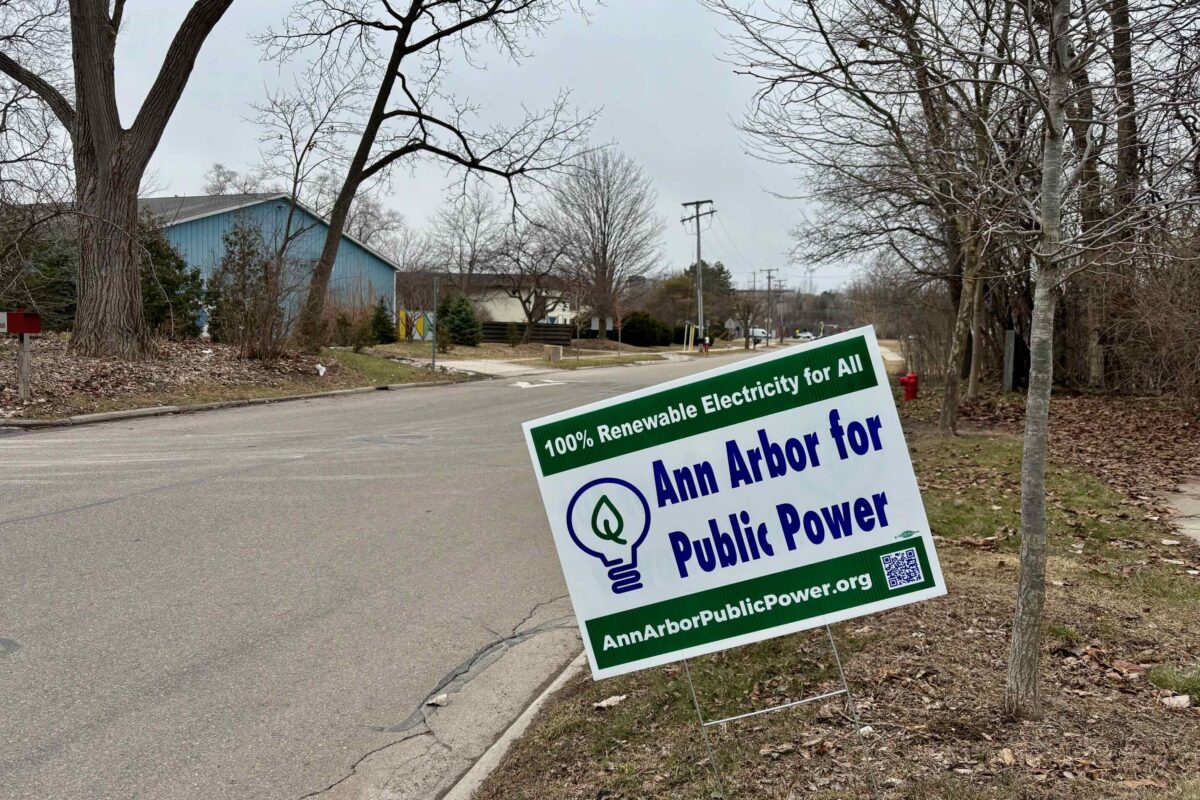
Ann Arbor’s citizen-led ballot initiative to create a municipal energy utility that could eventually replace DTE Energy is hitting resistance from the Ann Arbor City Council.
🗳️ Civic Action Toolbox
Why it matters
The fight over Ann Arbor's Proposal E could shape whether Michigan communities can pursue publicly owned utilities as a way to address electricity costs, outages, and clean energy goals.
Who's making public decisions
Ann Arbor voters will decide on the creation of a municipal utility with Proposal E on the November ballot. The Ann Arbor City Council and city attorney are positioned to challenge its legality, and a later acquisition of DTE assets would require approval from 60% of voters.
Upcoming Meetings
Contact Your Representatives
Civic Actions: What You Can Do
Organizations to Follow
What to watch for next
Watch the November vote in Ann Arbor on Proposal E, which needs a simple majority to pass, and whether the city attorney launches a legal challenge.
Are you taking action? Let us know.
Powered by Civic Action Toolbox
A council resolution, passed in a 10-1 vote on Oct. 5, says the effort could cost the city more than $1 billion. The resolution directs the city attorney to challenge the legality of the proposal “at the appropriate time,” arguing that it revises the city charter.
The city council approved a phase one study in 2022 of a full municipal utility that would provide 100% renewable electricity. A vote for a phase two study failed in 2025.
Backers of the Ann Arbor for Public Power ballot initiative say it’s the best way to improve energy affordability and reliability in the city, and accelerate the transition to renewable energy. The ballot drive’s opponents say the effort could prove extremely expensive, and set back Ann Arbor’s efforts to deliver clean energy and other city services.
If the city’s municipalization effort succeeds, it could create a road map for Detroit, where city council members recently directed Mayor Mary Sheffield’s administration to explore alternatives to DTE service, following a tornado that caused a widespread power outage in the city.
Public power needed for climate action, advocate says
Ann Arbor’s ballot measure, known as Proposal E, would create a public utility. A simple majority is needed to pass the ballot measure Nov. 3.
If it’s approved, voters would choose five board members in 2028, and the city council would appoint four.
Ann Arbor could then vote on a ballot proposal to acquire DTE’s assets in a future election. Approval from 60% of voters is required to move forward with the purchase.
Brian Geiringer, Ann Arbor for Public Power executive director, said at the Oct. 5 city council meeting that every radical climate solution — at the scale called for by the climate catastrophe — is met with establishment figures ringing alarm bells.
“I urge you not to go down in history as actively disrupting the people’s direct democratic process to take the proportionate climate action that you have refused to take,” he said.
Ann Arbor City Council Member Ayesha Ghazi Edwin said she supports public power in principle, but the city needs to prioritize other social welfare needs. She expressed concern about the ballot proposal’s cost and wording, which she said could take oversight away from council and give it to the utility board.
“I want public power pursued with clear safeguards, a credible financial plan, and meaningful public oversight,” she said.
DTE spokesperson Ryan Lowry said the company invested more in Ann Arbor’s grid in the last five years than in any five-year period in the company’s history. The investments have contributed to the city’s best reliability in 30 years, he said.
“We believe customers are best served by continued investment in the electric grid and the energy resources needed to support the community’s reliability, affordability and clean energy goals,” Lowry said.
Ann Arbor leaders cite cost in opposing city-owned utility
Multiple Ann Arbor council members object to the use of the word “shall” in the ballot proposal, which says the utility board “shall have all the powers and duties possessed by the city to construct, acquire, expand, operate, study and maintain the utility system.”
The ballot proposal would effectively require the city to take over DTE’s grid, which could cost more than $1 billion, the council resolution said.
Ann Arbor for Public Power calls this statement “completely false” in a response to the resolution, adding that Proposal E doesn’t authorize or require the purchase of DTE’s assets.
A rigorous cost analysis would be needed before such a step, and state law requires a three-fifths majority vote to acquire any utility that serves the public, the response states.
The group previously challenged the $1-billion cost estimate for acquiring DTE’s grid, arguing it relies on false and misleading assumptions.
Ann Arbor Mayor Christopher Taylor told Planet Detroit that people don’t understand the scale of the hundreds of millions of dollars that would be needed to acquire and improve DTE’s assets, and for the city to operate a new public utility.
Much of this cost would be incurred before the utility begins generating revenue, he said.
The expenses would put the city’s delivery of services at risk, including for life-and-death safety services, Taylor said. The proposal would also upend the city’s form of government, he said.
“It creates a department in the city that is not subject to city council,” Taylor said, adding the board would have the power to acquire property, make contracts, and hire staff.
In a Wednesday statement, Ann Arbor for Public Power challenged the idea that Proposal E would change the city’s form of government or that it would revise the city charter. It’s a charter amendment, according to the group.
In an Aug. 12 letter to Gov. Gretchen Whitmer, Assistant Attorney General Kimberly Pendrick wrote: “While this initiative petition provides the board with certain control over the electrical utilities, it does not appear to change ‘in the form of government’ nor does it appear to conflict with other charter provisions.”
Ann Arbor for Public Power said in its response to council that the model of a semi-independent municipal utility has long existed in cities like Lansing, Holland, Traverse City, Grand Haven, and Marquette.
‘More expensive to continue with DTE’: State senator
State Sen. Jeff Irwin, D-Ann Arbor, backs the proposal, and says he’s unmoved by the council’s resolution and arguments that a municipal utility would be too expensive, although he agrees the upfront cost is high.
“The problem is it would be even more expensive to continue with DTE,” he said. Municipal utilities manage smaller, denser footprints that are easier to maintain, decrease the cost per customer, and don’t need to return profits to shareholders, he said.
Cities obtain significantly better bond rates for financing utilities than private companies, Irwin said.
“When you look around the state and you look at all the municipal authorities, people have lower prices and greater reliability,” he said.
Michigan residential public utility customers paid 17% less per kilowatt-hour in 2024 than those served by investor-owned utilities, according to a 2026 report from the American Public Power Association, a trade group representing community-owned utilities.
Nationally, public power customers experienced 1.5 fewer hours without power in 2023 than other customers, according to the group.
What do municipal utilities mean for renewable energy?
Municipalization supporters say it’s Ann Arbor’s best path toward achieving 100% renewable energy, while opponents say it could undermine the city’s sustainable energy utility, or SEU.
In 2024, Ann Arbor voters approved the creation of an SEU, with 79% voting in favor of the proposal. Residents and businesses can subscribe to this utility and receive a portion of their energy from rooftop solar and battery storage, but the utility will not take over DTE’s grid.
Mike Shriberg, an energy and environmental expert and Ann Arbor resident, said there’s no inherent conflict between an SEU and municipal utility — but said the city has limited resources, and municipalization could pull staff away from energy and climate work.
Shriberg is part of Voters for a Sustainable A2, a group opposing Proposal E. Shriberg, a professor at the University of Michigan, spoke about the ballot question in his personal capacity.
Municipalization could also require the construction of costly substations to connect the utility to the transmission network, as existing substations are largely located outside the city, he said.
Although participation in the SEU isn’t required, Shriberg predicts it will be able to scale up more quickly than a municipal utility, with subscribers incentivized to join to save money.
Acquiring DTE’s grid would mean acquiring its problems, while the SEU will allow for resilient microgrids, and a grid buildout designed for distributed, clean energy sources, he said.
Ann Arbor for Public Power says it supports the SEU as a useful model for distributed generation and first step toward municipalization.
Voting for Proposal E wouldn’t take resources away from the SEU, because it doesn’t include any cost obligation, the group says.
The group argues the SEU will only meet a fraction of Ann Arbor’s energy needs, and municipalization is the only feasible path toward meeting the city’s 100% renewable energy goal.
A 2023 feasibility study commissioned by the city found the SEU would provide no more than 15% of the city’s energy by 2030.
Ann Arbor for Public Power’s Geiringer said DTE is continuing to build natural gas plants, and is incentivized to do so because it earns its return on equity on these kinds of capital projects.

Capital investments allow utilities to apply their state-approved returns on equity to a portion of project costs, generating revenue for shareholders. In DTE’s most recent rate hike, the Michigan Public Service Commission approved a 9.9% return on equity.
DTE has proposed the construction of two natural gas plants in its latest long-range plan, with an estimated combined cost of $6.4 billion.
Ann Arbor could enter into power purchase agreements with renewable generation companies to meet its decarbonization goals, Geiringer said. The contracts can allow developers to finance, construct, and maintain renewable energy projects.
DTE’s Lowry said the company is committed to complying with Michigan’s climate law, and is retiring coal generation and building enough renewable generation for 6 million homes.
“DTE is building more renewable energy than any other developer in Michigan, which works together with energy storage, natural gas and nuclear resources to provide reliable, around-the-clock power while advancing the state’s clean energy goals,” he said.
Ann Arbor public power backers say effort part of larger struggle
An Ann Arbor municipalization effort may reveal the legal and logistical risks of taking over the grid from a well-resourced utility.
Investor-owned utilities’ lack of investment in the grid costs residents, who pay for spoiled groceries and lost medicine during outages, Detroit City Council Member Gabriela Santiago-Romero told Planet Detroit in a statement.
Publicly owned electric utilities are the best way forward for improving affordability, reliability, and accountability, she said.
Geiringer said if Ann Arbor successfully creates a public utility, it would establish a legal precedent that other cities will need to start their own municipal utilities, and may help start a movement toward public power in DTE’s territory.
Replacing a behemoth monopoly will not be easy, but the more people who support Proposal E, the more power the movement will have, he said.
State Sen. Irwin said public power is an opportunity for communities to change the longstanding investor-owned utility model, and address the cost and reliability of electricity.
“The way we set this up 100 years ago doesn’t necessarily make a ton of sense, and it’s not really working out so great for us,” he said. “Maybe we should look at a different option.”
MORE POLITICS NEWS

Data centers, hazardous waste weigh on voters in Michigan’s 31st House District
Republican Laura Perry and Democrat Shannon Dare Wayne compete to replace retiring state Rep. Reggie Miller in a district grappling with a proposed Google data center and ongoing lawsuit over radioactive waste shipments to Wayne Disposal.


El-Sayed, Rogers face voter opposition to data centers in crucial Senate race
Abdul El-Sayed, Mike Rogers square off in key Senate race in Michigan, where 62% of likely voters oppose data centers.

Where’s the environment in Michigan election? ‘The vocabulary and framing has changed’
Environmental issues rank near the bottom of voter concerns in Michigan’s 2026 election, but climate and environmental policies are still shaping key races through debates over data centers, energy costs, and corporate accountability.