


Overview:
- 148 Michigan lawmakers and candidates sign a pledge refusing campaign contributions over $200 from monopoly utility PACs, lobbyists, and executives.
- Michigan lawmakers accepted $421,100 in utility donations in 2025, with utilities spending $1.6 million during the 2022 election cycle, according to Michigan League of Conservation Voters.
- The pledge comes as a separate ballot initiative seeks to ban political donations from monopoly companies.
A pledge to forgo campaign contributions from utilities has garnered 148 signatures from elected officials and candidates in Michigan, and organizers said there’s growing support for refusing such contributions.
🗳️ Civic Action Toolbox
Why it matters
Michigan elected officials and candidates sign a pledge to forgo campaign donations from utilities, with organizers saying there’s growing support for refusing such contributions.
Who's making public decisions
The Michigan Legislature has the authority to enact ratepayer protections, pass community solar bills, and raise or eliminate the state’s renewable energy cap. Voters may get to decide on the Michiganders for Money Out of Politics ballot initiative in November.
Upcoming Meetings
Contact Your Representatives
Civic Actions: What You Can Do
Organizations to Follow
What to watch for next
Watch for whether the Michiganders for Money Out of Politics ballot proposal qualifies for the November ballot after submitting over 560,000 signatures; 356,958 valid signatures are needed.
Are you taking action? Let us know.
Civic resources compiled by Planet Detroit
The nonprofit Michigan League of Conservation Voters (MLCV) “No Utility Money Challenge” asks lawmakers and candidates for public office to adopt a policy to not knowingly accept more than $200 in total contributions from monopoly utility political action committees (PACs) and lobbyists, executives, employee PACs, and other groups aligned with utility interests.
One-hundred-forty-eight lawmakers signed the pledge, which launched in 2025, as of Tuesday.
“For too long, a broken system has allowed DTE and Consumers to pump millions into politicians’ pocketbooks and campaigns and now, taking money from them is a political liability,” MLCV Deputy Director Bob Allison said in a press release.
Michigan lawmakers accepted $421,100 in utility campaign donations in 2025, according to MLCV. During the 2022 election cycle for the Michigan House, Senate, and statewide offices, lawmakers took in $1,607,340, the environmental nonprofit said.
‘My community is fed up’
State Rep. Donovan McKinney (D-Detroit), who is running to represent Michigan’s 13th Congressional district, signed the pledge. Utility influence has made it difficult to pass common sense legislation like the “ratepayer bill of rights” bills, he told Planet Detroit.
This legislation, spearheaded by McKinney, would increase compensation for outages, ensure outage credits are automatically applied to customers’ bills, and bar utilities from recouping outage credits through rate hikes, among other measures.
“My community is fed up,” McKinney said of his district, which covers parts of the east side of Detroit and Warren. The area was heavily impacted by the February 2023 ice storm, with neighborhoods experiencing multiple rounds of outages, McKinney said.
Consumers Energy spokesperson Brian Wheeler said in a statement that the company focuses on the political process “with a focus on compliance and transparency,” and customer funds are not used for political contributions.
DTE Energy spokesperson Jill Wilmot said the company’s political contributions are supported by DTE employees or shareholders, not customer revenue.
DTE previously told Planet Detroit that it reduced customers’ outage time by 60% in 2025, following a 70% improvement the year before.
Amy Bandyk, executive director of the Citizens Utility Board of Michigan, previously challenged the idea that customers don’t pay for political donations, saying “the revenue all comes from ratepayers.”
McKinney supports the Michiganders for Money Out of Politics (MMOP) ballot initiative, which would bar state and local political donations from monopoly companies and other large enterprises doing business with the state.
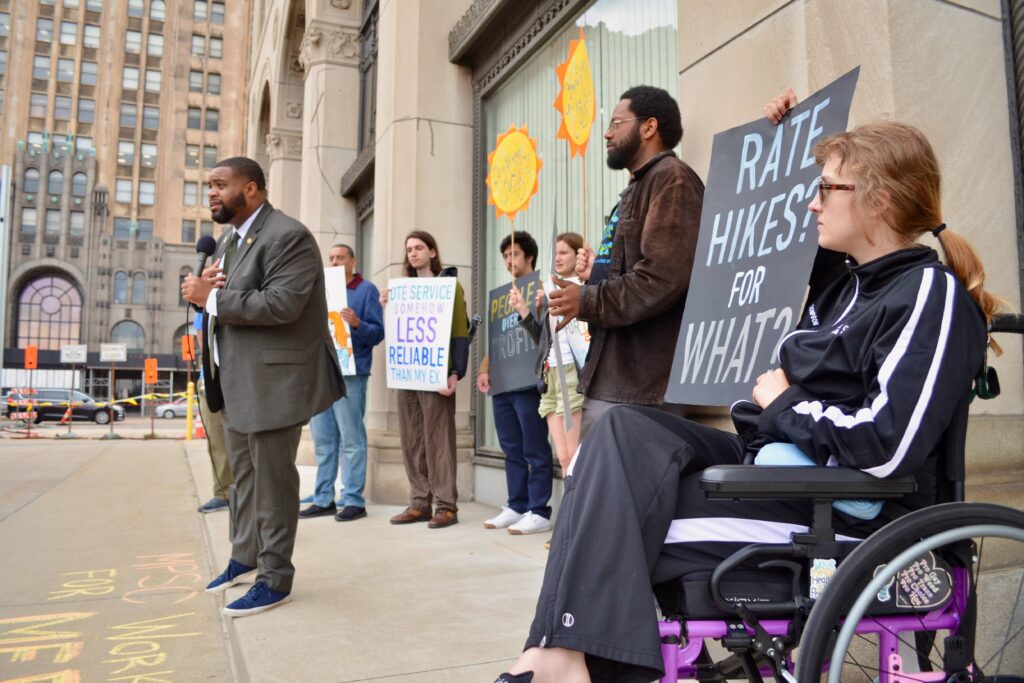
Recent polling from Progress Michigan, a progressive advocacy group, found 8 in 10 Michigan voters support the MMOP proposal, with strong bipartisan backing.
The group submitted over 560,000 signatures May 27 to place the proposal on the November ballot, MMOP Campaign Manager Courtney Otto said in a press release. The group needs 356,958 valid signatures to put the question before Michigan voters.
McKinney said that even with the MPOP ballot proposal on the table, legislators taking the “no utility money” pledge is a step in the right direction, adding that it signals that legislators can’t be bought.
“We have so much power influence over the utilities, we just don’t wield it,” McKinney said.
Utility spending harms energy transition, lawmaker says
State Rep. Natalie Price (D-Berkley), who is running to represent Michigan’s 10th Senate district, signed the no-utility-money pledge. Like McKinney, she said she’s never accepted contributions from utilities.
“It’s a good signal to voters that I’m accountable to them rather than to the utility companies,” Price said.
The narrow majorities Democrats and Republicans often hold in the Michigan House and Senate make it easier for utilities to pressure lawmakers who may be concerned about their parties’ ability to maintain power, Price said.
Utility companies’ resistance to community solar and raising the state’s cap on renewable generation could make it more difficult for the state to meet its climate goals, Price said.
Community solar allows residents to subscribe to offsite solar arrays and receive bill credits for the energy produced, while distributed generation includes things like rooftop solar.
The state caps participation in distributed generation programs run by utilities at 10% of a utility’s average five-year, in-state peak load.
Lawmakers tried to eliminate the cap in 2023 when it was set at 1% for DTE and 4% for Consumers, a move that was opposed by DTE.
DTE raised its cap to 6% in 2023 as part of a settlement, before state legislation lifted it to 10%.
DTE spokesperson Ryan Lowry said the company offers its MIGreenPower program to allow customers to support offsite wind and solar. Customers pay a surcharge through this program to offset their home energy use and receive credits.
“It is important community solar proposals do not have the opposite effect of their intended purposes, raising costs for all customers, which challenges affordability,” Lowry said.
Consumers Energy spokesperson Katie Carey touted the company’s programs to allow customers to offset energy use with offsite solar.
The utility would stand against any community solar policy that raises rates on customers, Carey said.
Consumers voluntarily raised its cap on distributed generation, and the utility still has space before hitting the 10% cap, she said.
Consumers would have to review any potential legislation on raising or eliminating the distributed generation cap before taking a position on it, Carey said.
Price said the no-utility-money pledge comes as Michiganders are paying more attention to rising utility rates and the role political spending plays in state politics, a change that she argues is good for the democratic process.
“I think it will make us a much stronger, transparent, and accountable government if people know how to be constructively critical about where our money comes from in politics.”
UTILITIES COVERAGE
Voices: How Michigan can enter age of energy abundance
Michigan utilities profit more from expensive gas plants than affordable solar, despite rooftop panels alone being able to meet nearly half the state’s energy demand, writes Richard Boehnke.

‘Weekend at Bernie’s’ coal plant costs ratepayers $180 million: Michigan AG
Michigan Attorney General Dana Nessel says Trump administration orders keeping the J.H. Campbell coal plant open have cost ratepayers $180 million, far more than the aging facility would recoup in profit.

DTE offers 2-year rate hike freeze if Saline data center opens on time: Nessel calls it ‘ransom note’
DTE Energy files for a $474-million rate hike, offers to pause increases for two years if rate case has “constructive’ outcome and Saline data center opens by target date.