


Overview:
- Democratic Senate candidates McMorrow, Stevens, and El-Sayed do not support a data center moratorium, despite growing public opposition.
- A recent poll shows 7 in 10 Americans oppose data centers near their homes, with Michigan voters rallying against the facilities across party lines.
- Environmental advocates say data centers could influence the competitive Senate race, as utility rate increases tie into broader cost-of-living concerns.
Data centers are an issue in Michigan’s Democratic primary for an open U.S. Senate seat, as the often power- and water-hungry projects elicit concerns statewide over possible impacts to utility ratepayers and the environment, as well as the threat artificial intelligence poses to jobs.
In a May 28 debate between three Democratic candidates for the state’s open U.S. Senate seat, former Wayne County and Detroit health director Abdul El-Sayed criticized state Sen. Mallory McMorrow (D-Royal Oak) for supporting the state’s data center tax breaks.
El-Sayed called for AI and AI corporations to be regulated as public utilities, and said they’re too dangerous to operate without government control.
McMorrow said she supports an artificial intelligence safety law, and a “token tax” on commercial AI use to generate funding for apprenticeship programs for jobs that the technology cannot easily replace.
When asked about AI and data centers, U.S. Rep. Haley Stevens (D-Birmingham) said it’s necessary to compete with China on developing technology, but she wants to protect Michiganders from data center costs.
The winner of the Democratic primary in the U.S. Senate race will face Republican Mike Rogers on the November ballot.
Data center issue crosses party lines in midterms
Environmental advocates have called on candidates to offer more specific plans for addressing data center impacts, including whether they support moratorium legislation, measures to ban nondisclosure agreements for communities, and legislation to bar tax breaks.
Amanda Robert, network director for the nonprofit Michigan Climate Action Network (MiCAN), said Senate candidates aren’t talking enough about the data center issue, a major community concern.
MiCAN hosts a monthly webinar that ordinarily attracts around 100 participants; its data center webinar attracted 600, she said.
People of every ideology, geography, and background are coalescing around the data center issue, Robert said.
“I’ve heard so many people on both sides of the spectrum saying they’re willing to break rank with their traditional party to vote for someone that supports their position on data centers.”
A May poll from the climate publication Heatmap found at least 7 in 10 people in the U.S. oppose a data center being built near their home — a sharp increase from last September, when Americans were evenly divided on the issue.
“Being anti-data center in Michigan is both good policy and good politics,” said Chris Gilmer-Hill, policy manager for the Michigan Environmental Justice Coalition, an environmental nonprofit.
A highly competitive Senate race in November could make the Democratic nominee’s position on data centers even more important to voters. The Cook Political Report classifies Michigan’s open Senate seat as one of the nation’s three true “toss up” races.
Data centers’ potential impacts on water and energy rates may also play into general cost-of-living concerns, several advocates told Planet Detroit.
Fifty-five percent of Americans said their financial situation is getting worse, according to an April Gallup poll. It’s the highest percentage since Gallup began gathering data on the topic in 2001.
Gilmer-Hill said he’s skeptical of any candidate who does not support a nationwide moratorium on data centers, and said he supports restrictions on state and federal data center tax incentives.
Moratorium legislation has been proposed in Michigan and at the federal level. Michigan lawmakers have introduced bills to bar nondisclosure agreements for officials considering data centers and repeal state tax breaks.
Michigan Gov. Gretchen Whitmer supports the projects. Whitmer signed data center tax break legislation and says data centers will create jobs and produce clean energy savings for residents.
Data center positions in US Senate race
None of the Democratic U.S. Senate candidates told Planet Detroit they support a moratorium.
Stevens’ priorities are keeping utilities from passing on data center costs to Michiganders and protecting well-paid union jobs, she said in a statement.
“We need to develop a clear, responsible policy framework to ensure these technologies are developed safely and securely,” Stevens said in a statement.
Stevens’ campaign noted her introduction of the Stop Unfair Electricity Prices Act in the House.
The bill would strip federal funding from investor-owned utilities that raise customers’ rates within a year of the last rate hike, or that raise rates in the second and third years out from a rate hike, unless they cut executive pay by twice the percentage of the rate increase.
In Michigan, utilities must wait a minimum of 12 months between rate hike filings under state law.
McMorrow said Michigan can show the country how to develop data centers the right way.
“That means data center companies, not Michigan families, will pay for their own energy, grid upgrades for the benefit of all ratepayers; pay their fair share in taxes to fund our schools, roads, and communities; and pay our workers by creating good-paying union jobs,” she said in a statement.
McMorrow’s “Data Centers Done Right” plan includes ratepayer protections, renewable energy requirements, and a ban on nondisclosure agreements, among other measures.
McMorrow’s “AI jobs plan” proposes a “token tax” on AI usage to generate funds for worker training and scaled-up access to unemployment insurance, Medicaid, the Supplemental Nutrition Assistance Program, and Temporary Assistance for Needy Families.
McMorrow’s campaign released a separate AI safety plan that looks to increase transparency and privacy standards for AI companies, and impose export controls to keep AI chips from going to “China and other adversaries.”
El-Sayed is focused on “creating federal safeguards as corporations attempt to flex their muscles to push through massive development without regulation,” he said in a statement.
He touted his “terms of engagement” for data centers that he said would ensure the projects create good union jobs, don’t increase rates, protect water, and respect local communities.
El-Sayed would support legislation to bar state or local tax breaks for data centers and eliminate the use of nondisclosure agreements, he said.
“Big tech doesn’t need more money,” he said. “Communities deserve to have a say without big corporations and utility monopolies coloring the process.”
Republican Rogers endorsed President Donald Trump’s artificial intelligence framework, Bridge Michigan reports. This calls for protecting ratepayers from data center costs and streamlining federal permitting for AI infrastructure.
Rogers recently became the subject of a meme after a staffer at a Rogers-affiliated digital agency posted an AI-edited image that made Rogers look like a muscle man.
Unions may weigh on data center positions
Gilmer-Hill said Senate candidates may be hesitant to take a stronger stance on data centers over fears of alienating unions. Some unions are vocal supporters of data center developments that could bring thousands of temporary jobs to the state, he said.
The Utility Workers Union of America (UWUA), which is part of the pro-data center group Michigan for Responsible Data Centers, endorsed McMorrow in the primary.
UWUA Executive Vice President Patrick Dillon said in a statement that McMorrow supports workers’ bargaining rights and union hiring preferences, while opposing “right to work” policies.
Stevens received the endorsement of Iron Workers Local 25, which is also part of Michigan for Responsible Data Centers. Stevens has a strong record of advocating for good-paying union jobs and worker training, the union said.
El-Sayed was endorsed by the United Auto Workers, which is not part of the data center group. The union praised El-Sayed’s refusal of donations from corporate political action committees and his support for Medicare for All.
Several advocates who spoke with Planet Detroit emphasized that McMorrow and Stevens have strong pro-environment voting records, in contrast to their Republican opponent.
The Michigan League of Conservation voters gives McMorrow a 97% lifetime score for pro-environment votes, while the national League of Conservation Voters (LCV) gives Stevens a 98% lifetime score.
El-Sayed did not receive a score from these groups, as he has not held elected office.
Mike Rogers received an 8% lifetime score from LCV over his 14 years in office.
The Rogers campaign did not respond to requests for comment.
Editor’s note: This story has been updated with a link to state Sen. Mallory McMorrow’s data center plan.
MORE POLITICS COVERAGE
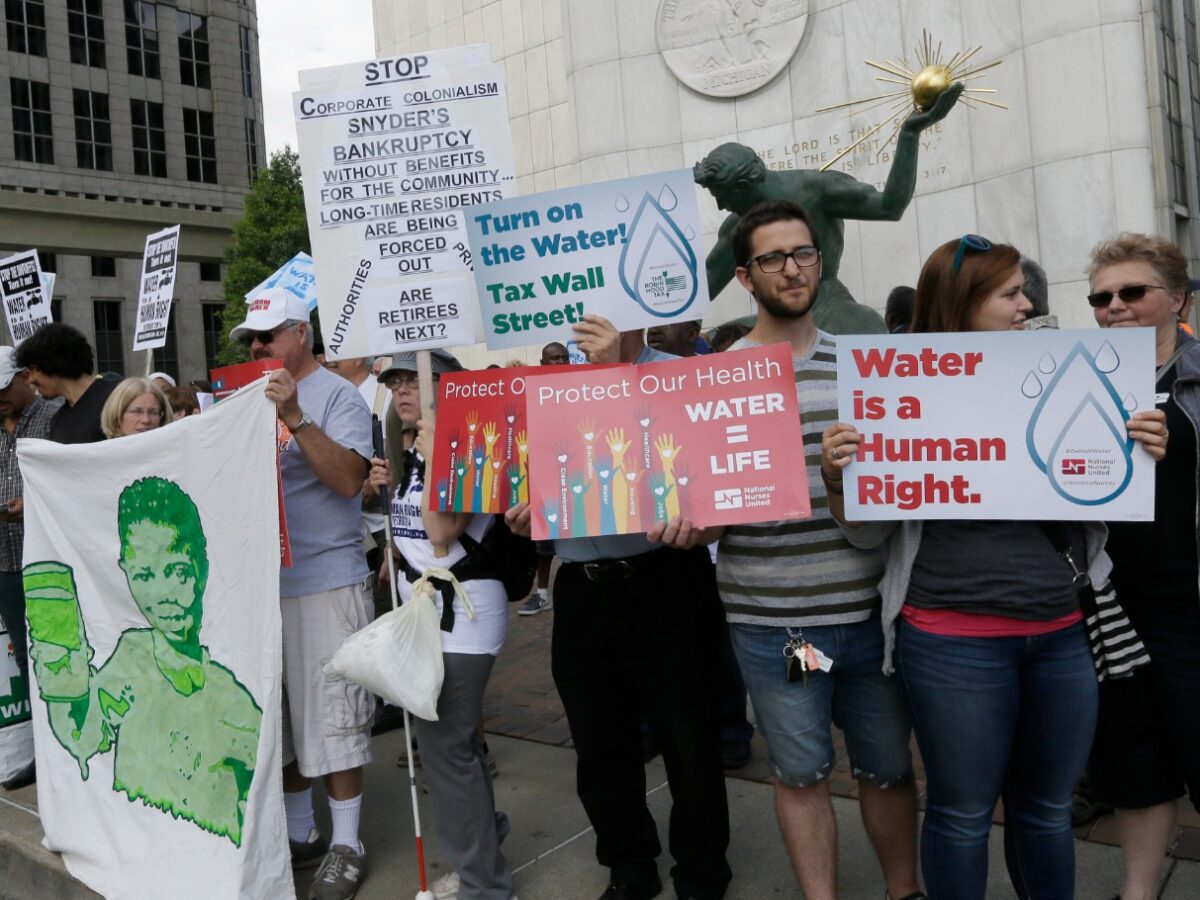
Guide: Michigan’s water affordability issue by the numbers
Between 6.59% and 10.75% of Michigan households are water-burdened, spending more than 5% of their income on water service, according to a University of Michigan study.


148 Michigan politicians sign ‘no utility money’ pledge
A pledge to refuse campaign contributions from utilities has attracted 148 Michigan elected officials and candidates, signaling growing concern about utility influence over state politics and energy policy.

‘You didn’t try to get my vote’: How Democrats lost Dearborn, and what it would take to win it back
After a historic 35% swing away from Democrats in 2024, Arab Americans are reshaping Michigan politics.