

Overview:
- Google's proposed 1-gigawatt data center in Van Buren Township would permanently destroy 13.55 acres of wetlands.
- Developers plan to offset impacts by purchasing wetland mitigation credits and creating new stream channels. Environmental advocates question why the project can't be built on a brownfield site instead.
- Public comment on the wetland permit is open until June 26.
Michigan regulators are reviewing a wetland permit for Google’s planned data center in Van Buren Township, which would destroy 13.55 acres of wetlands in a county that has already lost 90% of them to development.
🗳️ Civic Action Toolbox
Why it matters
The Google data center would destroy 13.5 acres of wetlands that help absorb floodwaters in Wayne County, which has seen historic flooding in recent years.
Who's making public decisions
Michigan’s Department of Environment, Great Lakes, and Energy will decide whether to approve the wetland permit, with additional environmental review by the EPA and U.S. Fish and Wildlife Service.
Civic Actions: What You Can Do
Organizations to Follow
What to watch for next
The public comment period on the wetland permit closes June 26, after which EGLE will decide whether to approve the wetlands permit for Google’s data center project.
Are you taking action? Let us know.
Civic resources compiled by Planet Detroit
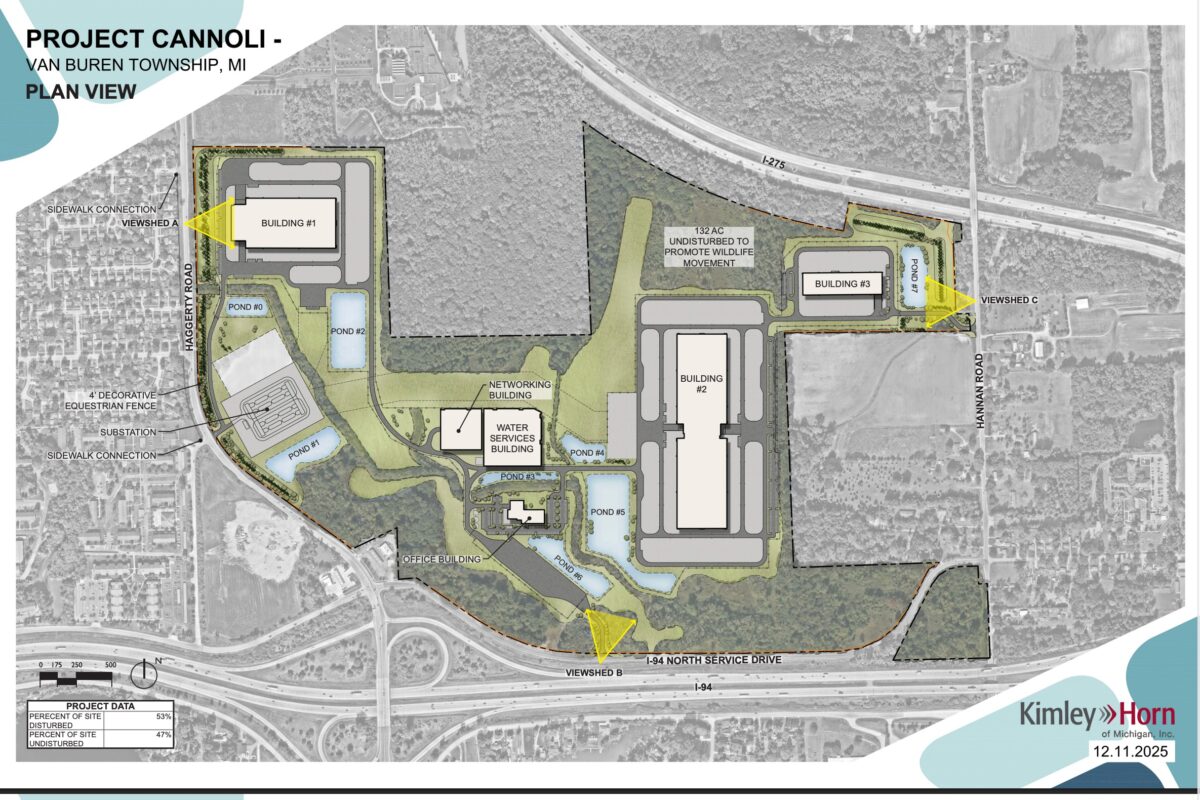
The 1-gigawatt “Project Cannoli” data center is planned for 282 acres at the intersection of Haggerty Road and I-94.
It would permanently impact 13.55 acres of wetlands, require six culverts in regulated streams, and fill and abandon 573 linear feet of a stream for building construction, said John Jones, an environmental quality analyst with Michigan’s Department of Environment, Great Lakes, and Energy (EGLE), said in an online public hearing Tuesday.
Developers will offset wetland and stream impacts by purchasing wetland mitigation bank credits in the Huron River watershed and creating 1,174 feet of new stream channel on the property itself, Jones said.
The developer, Panattoni Development Co, proposed purchasing 20.6 acres of wetland mitigation bank credits in its project application.
The Environmental Protection Agency will also review the project under provisions of Section 404 of the Clean Water Act, and the U.S. Fish and Wildlife Service will evaluate it for impacts to federally protected species, including bald eagles, Jones said.
The data center project requires soil erosion permit and utility installation approvals from the Wayne County Department of Public Services, according to a development agreement the township and Panattoni signed in May.
The township’s planning department granted preliminary site plan approval last month for the data center’s substation and switching station.
Adam Kramer, head of North American data centers for Panattoni, previously said the project would be the largest taxpayer in Van Buren Township and one of the largest in Wayne County.
‘Let’s not just get steamrolled’
The project application doesn’t adequately explain why so much acreage is needed, or why it can’t be developed on a brownfield site, Evan Rosin, a Wayne County Conservation District board member, told regulators Tuesday.
The region no longer contains much land with significant “ecosystem function,” and Google has the resources to mitigate and develop on a brownfield site, Rosin said.
“Let’s not just get steamrolled by this fervor for these massive data centers,” he said.
Panattoni looked at seven possible brownfield sites for the data center, including the McLouth Steel property in Trenton and Riverview, the former Ford Wixom assembly plant, and Detroit’s former Packard plant, the company said in a response to EGLE.
“We recognize that EGLE may argue that the project could simply extend its development timeline to accommodate a brownfield location and thereby avoid wetland impacts. However, for mission‑critical data center infrastructure, schedule flexibility is not discretionary,” the developers said.
EGLE’s Jones said there’s an opportunity to protect unaffected wetlands on the site with a permanent conservation easement.
Michigan has had some poor wetland mitigation projects in the past, Jones said, adding that wetland mitigation banks “have come a long way.”
Public comment on the wetland permit is open until June 26. Comments can be made during on EGLE’s public notice site or submitted by email to jonesj71@michigan.gov.
Wetlands and flooding in Wayne County
Attendees at Tuesday’s hearing said they’re concerned further wetland destruction in Wayne County could harm wildlife and ecosystems that help manage stormwater in an area that has seen historic flooding in recent years.
“Wetlands provide critical habitat for many species but also operate as a buffer for flooding and erosion,” Lauren Eaton, monitoring manager at the nonprofit Friends of the Rouge, said during public comments Tuesday night.
Wetlands have a sponge-like ability to absorb water and help the region weather the periods of intense rainfall and drought, Eaton said. She encouraged EGLE to deny the permit, arguing the region needs the natural features to prevent flooding.
Wetlands were abundant in Michigan before European settlement, covering 17% of the state’s land. Wayne County lost 90% of its wetlands to development by 2005, according to a state report.
DATA CENTER NEWS

Why data centers are key issue in Michigan’s Democratic Senate primary
Candidates in the closely watched Senate race need to offer specific plans for addressing data centers, environmental advocates say.

Allen Park planners reject proposed data center: ‘We’re gonna celebrate with one eye open’
Allen Park Planning Commission recommends the adoption of a six-month data center moratorium.

Substation for 1 GW Google data center clears planning commission despite overflow crowd’s objections
Van Buren Township planning commission grants preliminary approval for a substation serving Google’s planned 1-gigawatt data center Wednesday, despite concerns from overflow crowds about noise, property values, and infrastructure strain.