

Overview:
- The Army Corps reduces its Southeast Michigan flood study from $10.5 million over eight years to $5 million over four years, eliminating a formal report to Congress.
- The study now focuses on urban, rainfall-driven flooding rather than including riverine and coastal flooding.
- Solutions will be enacted through existing legislation rather than waiting for Congressional appropriations, potentially speeding up action, says Army Corps project manager.
The U.S. Army Corps of Engineers study to determine flood mitigation strategies for Southeast Michigan will no longer deliver a formal report to Congress after the federal government cut the project’s budget and timeline in half.
🗳️ Civic Action Toolbox
Why it matters
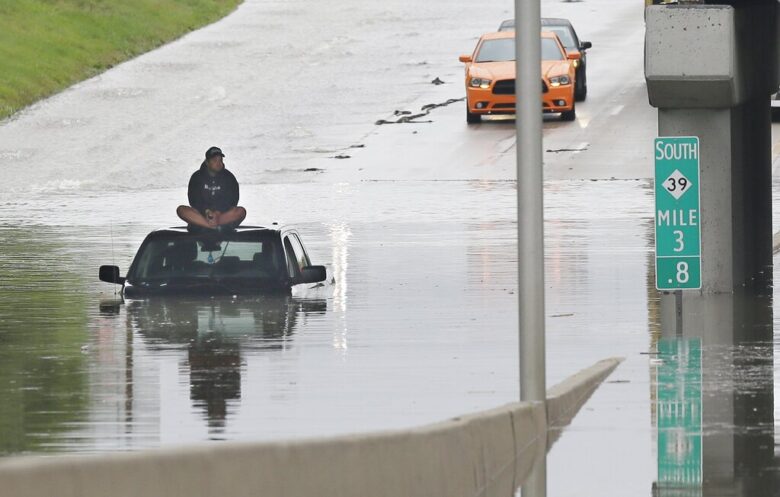
Metro Detroit residents have endured three federally declared disaster floods inside of a decade. A U.S. Army Corps of Engineer study is analyzing the watersheds, combined sewer service areas, rainfall, and flooding in Wayne, Oakland, and Macomb counties.
Who's making public decisions
The U.S. Army Corps of Engineers is determining flood mitigation strategies for Metro Detroit under Section 219 of the Water Resources Development Act, in partnership with the Great Lakes Water Authority.
Civic Actions: What You Can Do
- Explore the Army Corps flooding study
Visit the Army Corps page on the Southeast Michigan flooding study, which includes project details. - Attend the GLWA Board of Directors meeting
The Great Lakes Water Authority Board of Directors meets at 2 p.m. on August 26 at to discuss matters affecting the region's water systems. - Write a letter to the editor
Share your perspective with your community. - Register to vote or check your registration
Make sure your voice counts in the next election.
Organizations to Follow
What to watch for next
Watch for the next quarterly meeting announcement from the Army Corps of Engineers and further updates on the Southeast Michigan flooding study.
Are you taking action? Let us know.
Civic resources compiled by Planet Detroit
The new project scope is for a $5-million study over four years, Susan Rusinowski, senior Army Corps project manager for the study, said during the latest quarterly project update in July.
The study’s scope has shifted from including riverine and coastal flooding to focus on urban, rainfall-driven flooding, Rusinowski said.
This change is being made in response to both the reduction in funding and the preliminary results of the study, she said.
The project was first announced in 2024 as a first-of-its-kind, $10.5 million study to be completed in 2032. It’s an analysis of the watersheds, combined sewer service areas, rainfall, and flooding in Wayne, Oakland, and Macomb counties.
The Great Lakes Water Authority is co-leading the study and providing a 50-50, in-kind match.
Detroit and Southeast Michigan’s 4.8 million people wrestle with the long-term impact of major floods. The region weathered three federally declared disasters inside of a decade with the 100-year storms in August 2014, June 2021, and August 2023.
No aspects of the study were eliminated or reduced, but rather the analysis was “truncated,” Rusinowski said.
“Instead of identifying one solution that we would then push forward into our design and then finalize the report based on that, we’re really just kind of doing all of the upfront work to identify a number of potential projects,” she said.
‘We can really expedite the projects’
In place of a formal recommendation to Congress, the team will instead “expedite the implementation of solutions” under Section 219 of the Water Resources Development Act.
Detroit has several projects active through Section 219, including the tentative plan to disconnect lead pipes from the city’s water mains unveiled in May.
The study has so far found the majority of flooding occurs around combined sewer service areas, said Richard Smith, an associate dean at Wayne State University who has worked with flood-impacted communities in Detroit.
Given that fact, it’s unsurprising the budget and scope of the study were adjusted, he said.
“The federal government will not get involved with the sewer surcharge,” he said. “Sewer surcharge is a responsibility of DWSD,” he added, referring to the Detroit Water and Sewerage Department.
“It’s also, I think, safe to say that this report started under the previous federal presidential administration, and the current presidential administration has different priorities,” he added.
President Donald Trump proposes cutting the Army Corps of Engineers budget by 36% year-over-year, according to the Congressional data platform Legis1.
This follows actions taken in October to withhold $11 billion in water infrastructure grants from Democratic-led states.
The Army Corps’ Rusinowski said that under the Metro Detroit project’s original timeline, it would take roughly two years for the chief’s report to make its way through the Congressional appropriations process and move forward.
The recommending of solutions under existing legislation will eliminate that delay, she said.
“I think this is really, potentially a positive for the region just as far as the urgency with which we can deliver solutions,” Rusinowski said. “With this, we can really expedite the projects and the solutions that are going to come out, and so I see that as a positive.”
How Army Corps study is shifting
Any aspects of the study that may have overlapped with existing Army Corps studies — such as the analysis near Oakland County’s Red Run and the floodplain studies in Jefferson Chalmers and Canton Township — were removed.
The downsizing of the Detroit study was initiated in April after the Army Corps began its new “R.A.P.I.D. Planning Framework,” Rusinowski said.
In a flyer for the R.A.P.I.D framework shared with Planet Detroit, the letter R stands for “Risk Informed: Making decisions with minimum required data, not waiting for perfect information.”
Given the large scope and documented need for the Southeast Michigan study, the team applied for and was awarded an extension, allowing for a four-year, $5-million project, Rusinowski said.
GLWA spokesperson Stephen Jones said in a statement that the U.S. Army Corps keeps the utility updated through biweekly meetings.
The cost-sharing agreement is unaffected by changes in federal funding, he said.
“While the available funding and schedule do not provide for a complete Chief’s report, it does provide for development of a technical report documenting the analysis, findings, and recommended alternatives,” Jones said.
MORE FLOODING COVERAGE
Voices: What Detroit’s flooding crisis reveals about building resilient Great Lakes cities
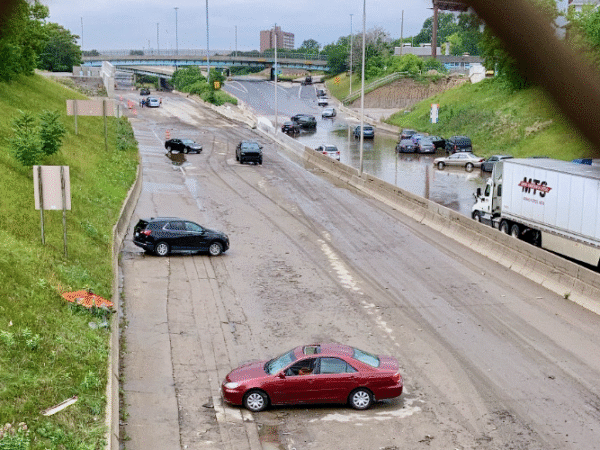
A major federal study is examining Detroit’s flooding crisis. The solutions must prioritize neighborhoods that have borne the brunt of aging infrastructure and climate change, say Tiana Starks and Sara Hughes.


Repeat flooding is creating public health crisis in Detroit: ‘Long-term trauma’
Ethan Bakuli reported this story while participating in USC Annenberg’s Center for Climate Journalism and Communication and Center for Health Journalism 2025 Health and Climate Change Reporting Fellowship as well as a Solutions Journalism Network accelerator program for coverage of the health impacts of seasonal climate issues in Metro Detroit. In the waning days of…


Residents share flood lessons as Great Lakes Water Authority tackles crisis
The Great Lakes Water Authority and the U.S. Army Corps of Engineers are collaborating on a multi-year study to explore flood management in Southeast Michigan, inviting public input to shape their findings.

