

Overview:
- A longtime energy justice advocate who worked alongside Ann Arbor staff says the City Council’s resolution and lawsuit against Ann Arbor for Public Power contradict shared values and undercut local control.
- While Proposal E does not guarantee municipalization, it's a commitment to a bold fight that could inspire public power campaigns across DTE’s territory and shift the balance of power, says Jackson Koeppel.
- The question before Ann Arbor is about big problems facing the whole country: skyrocketing utility bills, a spiraling climate catastrophe, and decrepit electric infrastructure, he says.
Fifteen years ago, I started my journey fighting for community-led solutions to the climate, affordability, and infrastructure crises as the founding executive director of a frontline energy justice organization in Highland Park.
In that time, I’ve participated in dozens of electricity rate case, resource plans, and working groups at the Michigan Public Service Commission. In more cases than not, I did so alongside staff from the city of Ann Arbor, whom I regarded as allies in efforts to address racial and economic inequities in infrastructure quality, collections practices, and clean energy access caused by DTE Energy.
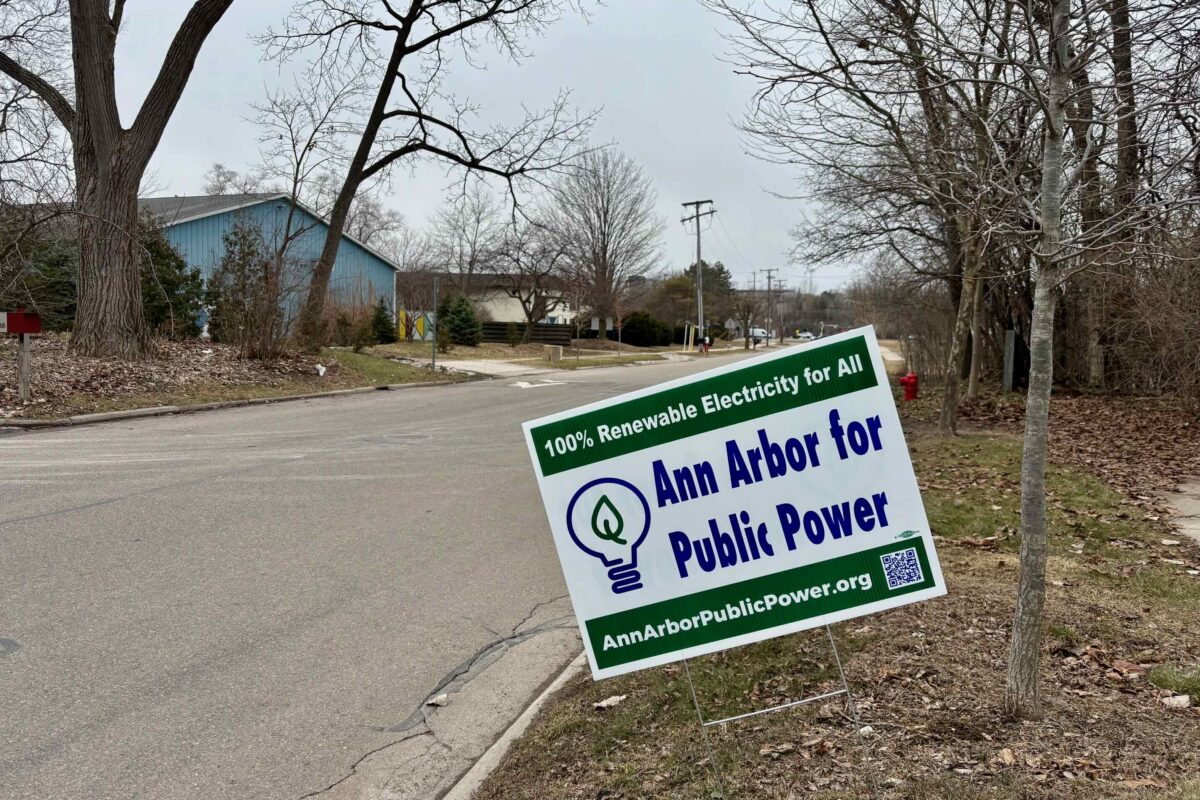
It’s because of this history that I am so profoundly disappointed by Ann Arbor City Council’s recent resolution and lawsuit against Ann Arbor for Public Power, or A2P2, which contradicts the values I once thought we shared.
The resolution formally opposes Prop E and the formation of a board that would consider steps toward forming a municipal utility. Further, it commits public money to sue A2P2 over the proposition, which they have done days before the election. Beyond the resolution’s alarmist inaccuracies, it sends a troubling message about the priorities of city leadership at a time when questions of democracy and the role of government are sharper than they have been in a generation.
The question before Ann Arborites is about big problems facing the whole country: skyrocketing utility bills, a spiraling climate catastrophe, and decrepit electric infrastructure.
I’m a fan of Ann Arbor’s work with the Sustainable Energy Utility, but let’s be frank — solar panels and geothermal for a couple hundred homes in a city with over 50,000 households does not come close to the needed scale of action. Rather than stepping forward to lead with ambition in the face of crisis, Ann Arbor City Council is telling its citizens that solving these problems at their actual scale is not their responsibility.
It’s reasonable for city leadership to be concerned about taking on these big challenges, but they remain unclear on who actually will. DTE Energy, whose neglect got us into this mess? Donald Trump and a runaway AI industry that are stripping the EPA for parts and undoing decades of climate action? The resolution states the city will “strengthen oversight and regulation” of DTE, but they don’t have that authority to do that — the MPSC does.
I’ve spent more than a decade in those trenches, alongside the city of Ann Arbor. We’ve no doubt averted some of the worst of DTE’s proposals, but the bills keep going up, and DTE keeps grinding forward to build data centers and gas plants.
Rather than stepping up to assert local control, Ann Arbor City Council is placing hope in a regulatory process in which it has little power. The council is giving up in advance at a time when we need boldness from political leadership at every scale of government.
The resolution cynically projects only the worst possible outcomes of attempting to municipalize, and envisions doing so as being in fundamental tension with the city’s other strategies. But there’s another way it could go.
Imagine instead: Prop E passes, and Ann Arbor elects a municipal utility board. Alongside the Sustainable Energy Utility and City Council, the board lead a second phase feasibility study and has the knock-down, drag-out fight with DTE, alongside community organizers and activists.
Against the odds, they win. All those years of hard-earned lessons from regulatory intervention and program development suddenly take on a newfound value. Ann Arbor buys out DTE and launches a municipal utility with the vision, strategy, and financial capacity to deliver affordable, clean, and reliable power to its residents. The city is longer appealing to an agency where it has no real authority, and is the decision-maker building the future Ann Arbor needs.
Alongside this groundswell, public power campaigns spring up across DTE’s service territory. Suddenly on the back foot, seeing threats on all sides, DTE is forced to negotiate with the communities it has most harmed. Progressive leaders win, and keep winning, up and down the ballot. They advance state and federal legislation to fund affordability, climate action, and local control that would have been unimaginable. Unimaginable, that is, before Ann Arbor proved the cartel is not as all-powerful as they want us to believe.
A vote for Prop E doesn’t guarantee any of this. It’s a commitment to fight for a future that coming generations deserve. It’s a future worth fighting for.
Planet Detroit’s Voices column includes opinion pieces from our community of partners and readers. These pieces express the voices of the authors and not necessarily those of the publication.
MORE PLANET DETROIT VOICES

VOICES: Faith, fairness, and the cost of keeping the lights on in Detroit
I have served the same Detroit community since 1990. When I first arrived, this was a neighborhood filled with working families. Many earned their living through Chrysler, Ford, General Motors, and the businesses that supported them. Block clubs were active, recreation centers were busy, and churches brought neighbors together. There was a shared belief that…


VOICES: After decades of grassroots greening, Detroit’s urban farms deserve a compliance pathway
A longtime Detroit grower argues the city needs dedicated funding and a grace period to help community farms meet regulations without losing the spaces that fed neighborhoods through crisis.


Voices: Strength in numbers. Tribal Nations are building energy sovereignty together.
Tribal Nations across Michigan and the Midwest are pooling knowledge and resources to build their own energy systems, even after federal Solar for All funding was cut, says MTERA executive director Daniel Wiggins Jr.

