

Overview:
- Protesters gather in downtown Saline ahead of virtual hearing Wednesday on DTE Energy's contracts for $7 billion data center.
- Speakers at the protest stress the need for communities to work together to defeat proposed data centers in places like Ypsilanti Township and Augusta Township.
- The data center contracts will not increase rates for existing customers, DTE Energy says in statement to Planet Detroit.
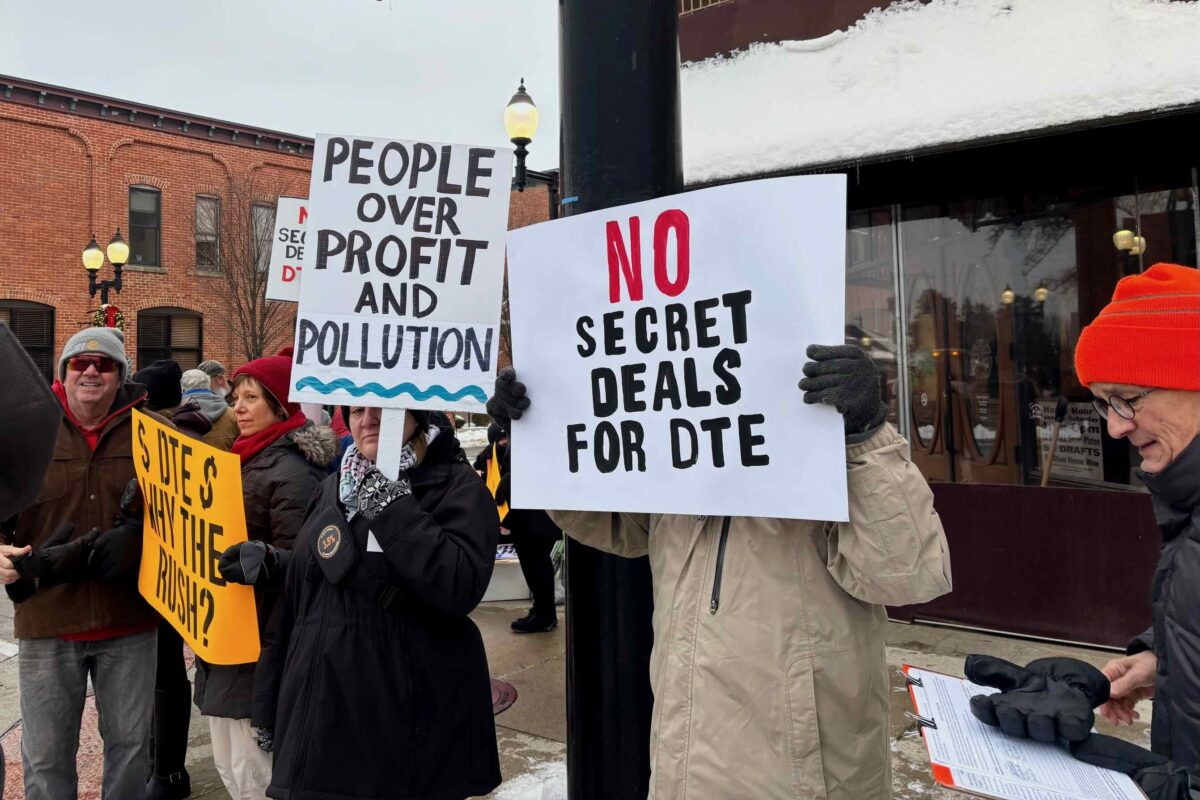
Around 100 people showed up Monday to protest DTE Energy’s efforts to advance a Saline Township data center project the utility would power — without official hearings on how the $7 billion development could impact the utility’s customers.
DTE is urging the Michigan Public Service Commission to greenlight its contracts to supply power to the planned Oracle and Open AI data center in Saline Township at its Friday, Dec. 5 meeting. The project’s costs will not impact other customers, and it could be canceled if not approved by Friday, according to the utility.
Protesters gathered in downtown Saline told Planet Detroit they do not trust DTE in terms of passing on costs to residential ratepayers, and said communities could be left paying for stranded assets if tech companies leave town before grid investments are paid off.
Grassroots organizers and politicians who addressed the crowd stressed the need for communities to work together to defeat proposed data centers in places like Ypsilanti Township and Augusta Township.
Michigan Attorney General Dana Nessel previously called attention to significant redactions to the data center contracts that DTE submitted to the MPSC. Many protesters Monday carried signs that said “No Secret Deals.”
Saline resident Mary Rasmussen told Planet Detroit that residents have little reason to believe DTE’s assurances that project costs wouldn’t be passed on to residential customers.
“They have a pretty bad track record in this area,” she said, calling attention to the power outages that have affected Ann Arbor and her community.

Rasmussen is not completely opposed to a data center, but said she wants the MPSC to open up DTE’s application for the facility’s electric contracts as a contested case. Otherwise, it will be “big business steamrolling over the little guy,” she said.
A contested case would allow for parties representing businesses, environmental interests, ratepayers, and others to submit testimony on the electric contracts for the Saline Township data center.
The MPSC announced a Wednesday, Dec. 3 virtual hearing on the project that Chair Dan Scripps said will “add an important element of transparency in evaluating DTE Electric Co.’s proposed special contract.”
Bryan Smigielski, a campaign organizer with the Michigan Sierra Club, encouraged protesters to participate in the hearing, to “protest the false show of transparency (and) tell them that we want a real contested case.”
Concerns linger that data center could cost other DTE customers
Jeff Rechten, a Bridgewater Township resident who lives near the data center site, said he wants Michigan regulators to consider both direct and indirect costs from the project.
DTE’s contracts may not contain sufficient safeguards to protect other customers from direct costs like paying for grid improvements or energy generation needed for the project, Rechten said.
He added that residents could also pay for the project in other ways, giving the examples of DTE using polluting coal energy to help power the data center or building additional solar capacity.
Rechten supports solar energy, but said data centers could mean that more productive farmland is needed to accommodate solar panels.
DTE spokesperson Ryan Lowry told Planet Detroit in a statement Monday the electric contracts submitted to the MPSC will not increase rates for existing customers, adding that the company is asking for additional safeguards to protect other ratepayers.
“Recently passed legislation by the state of Michigan ensures our customers will NOT subsidize data center rates,” Lowry said.
Ratepayer advocates and energy experts have told Planet Detroit that Michigan’s tax incentive legislation for large data centers included language to protect ratepayers, but provided little detail.
Douglas Jester, a consultant with 5 Lakes Energy, previously told Planet Detroit the existing framework for allocating costs could leave residential ratepayers and other customer classes paying for a portion of the electric generation needed solely to power large data centers.
He also warned that added demand from data centers without sufficient generation could lead to an increase in wholesale power costs that could be passed on to other customer classes.
A single, 1-gigawatt data center could increase residential rates by 5%-10% if protections aren’t added, Jester said.
DTE’s Saline Township project is expected to use 1.4 gigawatts of energy, roughly 25% of DTE’s present electric demand. The data center’s power demands represent enough electricity to power over 1 million homes, according to the Union of Concerned Scientists.
This Saline Township facility is one of many data centers being considered in DTE and Consumers Energy’s service territories.
Data center opponents say fight brings people together
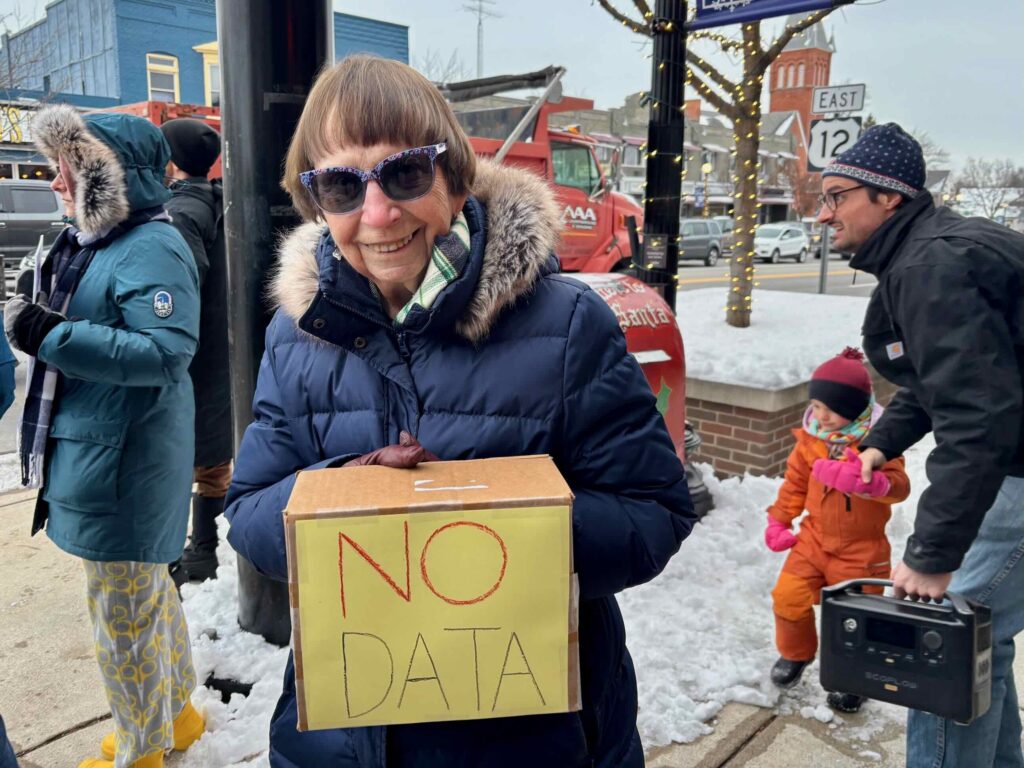
Bridgewater Township resident Josh LeBaron said resistance to data centers is politically unifying.
“In a deeply divided country, there’s something in this issue for everyone to hate,” he said.
Washtenaw County Commissioner Yousef Rabhi, an Ann Arbor Democrat, echoed this point and said people across political parties want to protect Michigan’s air and water and challenge corporate influence.
“You’re here because you say that it is wrong for corporations to have a sweetheart deal where they don’t have to have any public scrutiny,” Rabhi said.
He encouraged the protesters to join efforts in other communities to push back on data centers that he said are using public money to advance job-killing artificial intelligence technologies.
“This is a fight that we’re all in together.”
🗳️ What’s next? Tips for civic action
Why it matters
⚡ Opponents of a proposal to fast-track approval of an Oracle and Open AI data center in Saline Township say it could impact DTE Energy customers’ utility bills, which the utility denies. Data center power demands could make it more difficult for the state to meet its climate goals, depending on what generation sources are used.
Who’s making civic decisions
🏛️ The Michigan Public Service Commission, the state utility regulator, will consider DTE’s filing for the Saline data center and could allow for a contested case in which testimony can be submitted.
How to take civic action now
- 📅 Attend the public hearing on DTE Energy’s application, to be held virtually from 6:30-8:30 p.m. Wednesday, Dec. 3 on Microsoft Teams. Join via the Microsoft Teams link or by dialing 1-248-509-0316 and entering the conference ID 593258092# when prompted.
Those needing assistance to participate in the hearing may contact the MPSC’s executive secretary at 517-284-8090 in advance of the hearing. Follow the Sierra Club Michigan Chapter and Citizens Utility Board of Michigan for advocates’ viewpoints on MPSC activities.
- 📩 Email the MPSC at LARA-MPSC-commissioners@michigan.gov
- ✉️ Mail the Michigan Public Service Commission, PO Box 30221, Lansing, MI 48909
- 📣 Ask the commission if it will open DTE’s filing for the Saline Township data center as a contested case.
- 🗓️ What to watch for next The MPSC’s public hearing on DTE Energy’s application for the data center contracts will take place on Dec. 3, followed by a regular meeting of the commission in person and virtually at 1 p.m. Dec. 5.
Civic impact
🌍 Following and engaging with Michigan’s utility regulator is one way residents can influence the impact data centers have in the state.
⭐ Please let us know what action you took or if you have any additional questions. Please send a quick email to connect@planetdetroit.org.
MORE DATA CENTER REPORTING
DTE wants power deal for $7 billion data center approved by Dec. 5: ‘False sense of urgency’
DTE Energy’s fast-track application for electric contracts required for a $7 billion data center shows a lack of transparency, says renewable energy group’s attorney.

DTE contracts for $7 billion Saline Township data center face public hearing
DTE is asking Michigan’s utility regulator to approve special contracts for electric service for a 1.4-gigawatt data center in Saline Township.


Data centers in Michigan: What you need to know
As data centers proliferate across the Great Lakes, driven by AI’s soaring demands, communities face a dual reality: economic growth and environmental challenges.