


Overview:
- SEMCOG adopts the Southeast Michigan Healthy Climate Plan.
- Michigan's top environmental regulator says 2025 was "rough" in terms of federal support, but the state is committed to its climate goals.
- Read Planet Detroit's civic engagement tips for how you can have input on climate work.
The Southeast Michigan Council of Governments’ climate plan takes a Metro Detroit perspective on the work the state is doing.
That’s according to SEMCOG planner Tyler Klifman, who spoke at a recent engagement session held in Detroit by the Michigan Department of Environment, Great Lakes, and Energy.
The SEMCOG plan proposes an $83.4 billion investment in climate work by 2050 to reach net zero emissions in the region, he said.
The council’s executive committee adopted the Southeast Michigan Healthy Climate Plan at its meeting Friday, a SEMCOG spokesperson told Planet Detroit. The plan will be submitted to the Environmental Protection Agency.
Grosse Pointe Park Mayor Sheila Tomkowiak and Detroit City Council President Pro Tem Coleman A. Young II led the task force of about 80 that developed the plan.
Klifman said the $83.4 billion investment in climate work called for in the SEMCOG plan would return around $67 billion in direct savings.
In Southeast Michigan, 1.4 million residents living in 500 census tracts across 60 municipalities meet or exceed the criteria for equity and environmental justice burdens, according to his presentation.
Sixty-four-percent of Southeast Michigan’s greenhouse gas emissions are from residential and industrial buildings, the SEMCOG report said.
At the same time, SEMCOG found through engagement with the public that reducing utility costs is a priority, and the actions taken “should prioritize weatherization, no-cost energy audits, expanded rebates/grants, and equitable energy.”
EGLE director: Michigan is committed to climate work
Last year was “rough” in terms of federal support, but Michigan is staying the course on its climate goals, according to the state’s top environmental regulator.
“We’re just going to have to be more innovative in certain areas, and that’s part of why we’re here,” Phil Roos, the director of the Michigan Department of Environment, Great Lakes, and Energy, said at the Jan. 14 Detroit gathering that focused on the role of justice and equity in Michigan’s climate work.
The 2022 MI Healthy Climate Plan sets a goal of 100% carbon neutrality by 2050.
The impact of climate change in the state is far from abstract, Roos said, giving the examples of basement flooding due to weather, severe heat events, and increased air pollution that exacerbates asthma and other conditions.
“That’s the beauty of this and the sadness of this, that we’re already there and experiencing this right now.”
The state is doing climate work for a reason, said Jordan Power, senior climate action officer in EGLE’s Office of Climate and Energy: “It’s to improve the lives of Michiganders.”
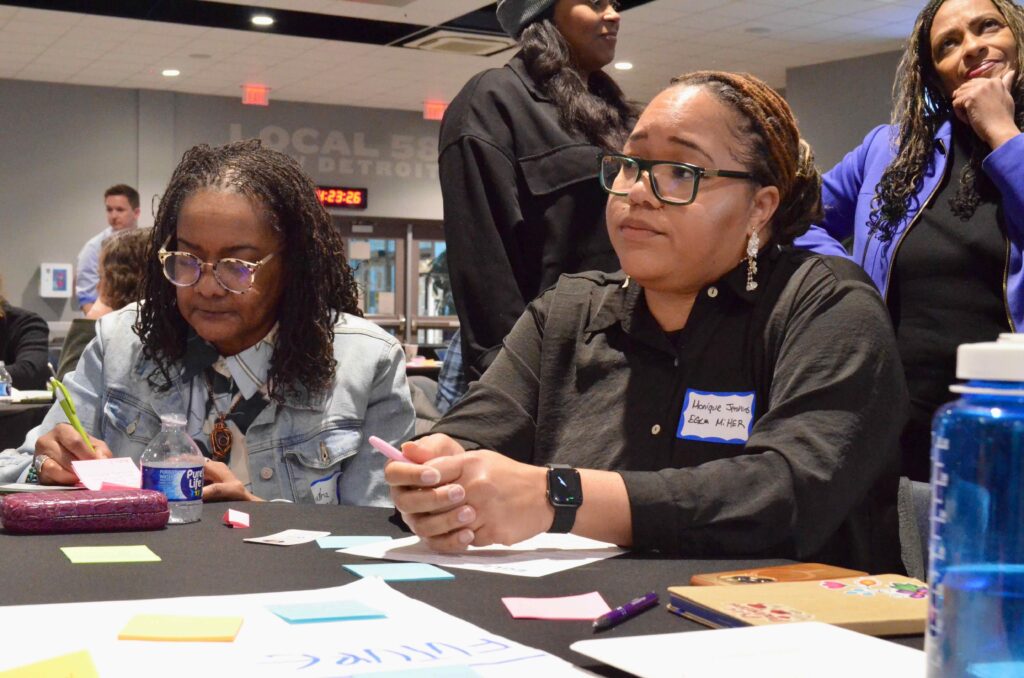
Power detailed Michigan’s 2021 greenhouse gas inventory at the engagement session, held at the IBEW Local 58 Zero Net Energy Center in Corktown.
The largest contributor to Michigan’s greenhouse gas emissions is electric power generation, Power said.
“As we look to decarbonize the grid, we also have opportunities to increase the resiliency of the grid.”
‘Positive and timely connection’
Attendees at the EGLE gathering held discussions at their tables on what they’re doing now as it relates to the MI Healthy Climate Plan; what the ideal future looks like; and what’s needed to get there.
Will Kitchen is new to Detroit, and told Planet Detroit he hopes to support and help move forward the climate goals as an individual and with the water technology nonprofit where he works, AquaAction.
Audra Carson, a lifelong Detroiter, said she’s a community advocate and entrepreneur in the climate action space.
“It is a positive and timely connection to people doing the work on the ground who have an interest in a sustainable future for the city of Detroit,” she said of the event.
🗳️ What’s next? Tips for civic action
Why it matters
⚡ The state of Michigan and Southeast Michigan Council of Governments’ climate plans aim to reduce greenhouse gas emissions and invest in sustainable infrastructure.
Who’s making civic decisions
🏛️ The Michigan Department of Environment, Great Lakes, and Energy and the Southeast Michigan Council of Governments.
How to take civic action now
- 📅 Attend Michigan Department of Environment, Great Lakes, and Energy public events. The agency’s MI Healthy Climate Conference is April 21 in Detroit.
- 📩 Email Michigan’s Office of Climate and Energy with questions or comments: EGLE-OCE@Michigan.gov
- ✉️ Mail EGLE, Deborah A. Stabenow Building 525 West Allegan St., P.O. Box 30473, Lansing, MI 48909.
- 📱 Call EGLE at 517-284-6700.
- 📣 Ask how federal actions could impact Michigan’s climate plan.
What to watch for next
🗓️ Future meetings on Michigan’s climate plan and updates on its progress.
Civic impact
🌍 Offering input and engaging with the state’s climate work can elevate the priorities of your community as Michigan aims to reduce greenhouse gas emissions and increase sustainability.
MORE FROM PLANET DETROIT
EPA drops health cost calculations for air pollution: How it could harm Detroiters
The agency will no longer consider health costs and deaths prevented when reducing two major pollutants, but will account for costs to industry.


Detroit gathering focuses on role of environmental justice in Michigan’s climate work
The engagement session aims to address community needs and the bigger climate picture, says Regina Strong, the state’s environmental justice public advocate.

State renews Detroit hazardous waste facility’s license, adds new restrictions: ‘Our community efforts have made a difference’
In the lead-up to the state’s decision, neighbors, elected officials, and environmental activists advocated for the closure of US Ecology Detroit South.

