

Overview:
- Marathon Petroleum seeks to expand its rail system and increase fuel loading operations in Southwest Detroit's 48217 zip code, which would increase emissions of ozone-forming pollutants and sulfur dioxide.
- State officials tell over 30 residents at a public hearing that state law requires them to approve permits that meet health standards, regardless of cumulative pollution impacts or compliance records.
- Proposed legislation by Detroit lawmakers would require EGLE to consider total regional health impacts from multiple pollution sources before issuing permits to facilities in overburdened communities.
At a Thursday public hearing on air permits for Marathon Petroleum and MPLX, several residents stepped out to take calls from loved ones in the hospital with cancer before returning to speak in opposition.
🗳️ Civic Action Toolbox
Why it matters
Who's making public decisions
The Michigan Department of Environment Great Lakes and Energy (EGLE) will decide whether to approve the permits after reviewing public comments submitted by the June 11 deadline.
Upcoming Meetings
Civic Actions: What You Can Do
Organizations to Follow
What to watch for next
Watch for EGLE’s final permit decision and response to comments after the June 11 public comment deadline closes.
Are you taking action? Let us know.
Civic resources compiled by Planet Detroit
The proposals would add emissions in Detroit’s 48217 zip code, a community surrounded by dozens of industrial pollution sources.
Over 30 residents attended the hearing hosted by the Michigan Department of Environment, Great Lakes, and Energy at the Kemeny Recreation Center in Southwest Detroit.
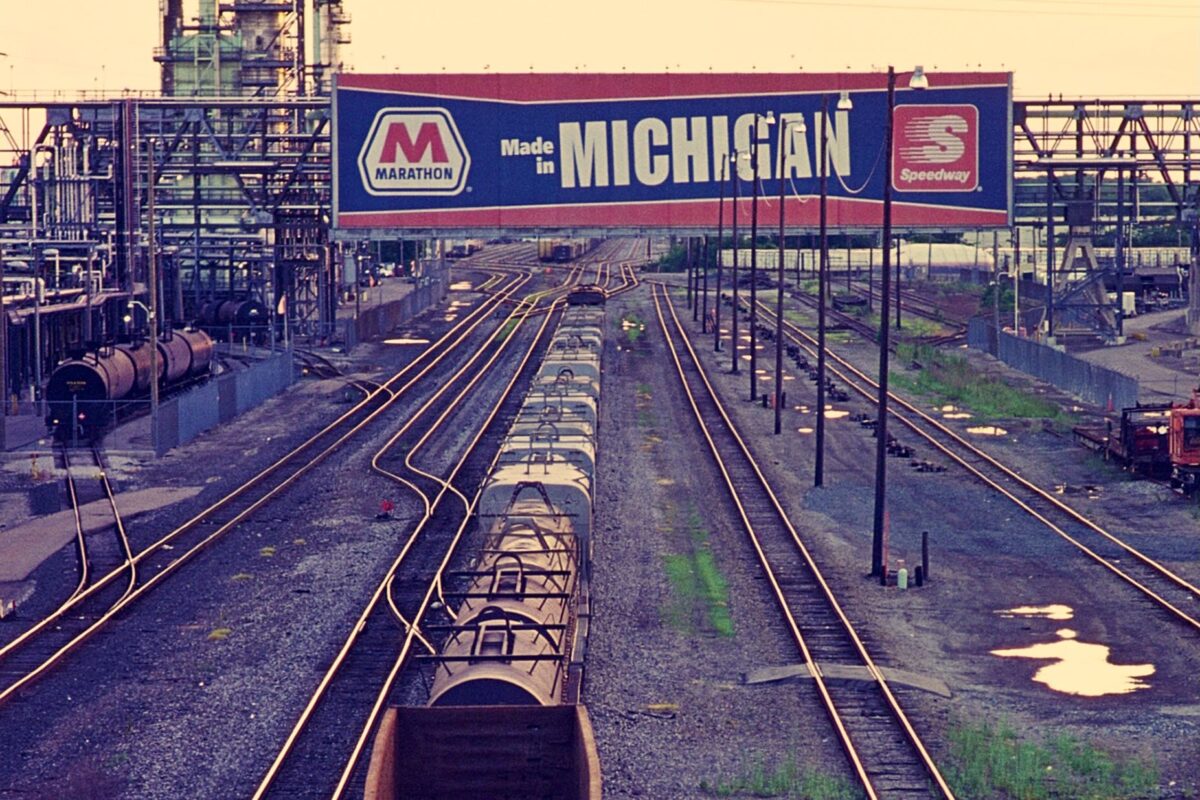
Marathon Petroleum Corp. is a refinery located across I-75 from the recreation center that produces gasoline, fuel oils, asphalt, propane, and other products, according to a technical fact sheet prepared by EGLE. It’s applying to expand its rail system to increase imports and exports.
MPLX, a facility that fills tanker trucks with Marathon’s light petroleum products on a six-lane loading rack, applied to use its vapor combustion unit pollution control equipment more frequently to support fuel loading operations.
State regulators estimate the projects would increase emissions of ozone-forming pollutants and sulfur dioxide.
The hearing underscored a longstanding frustration among residents: although Detroit’s 48217 zip code has some of Michigan’s highest industrial pollution levels, EGLE says it lacks the legal authority to consider cumulative impacts or a company’s compliance record when deciding whether to issue permits.
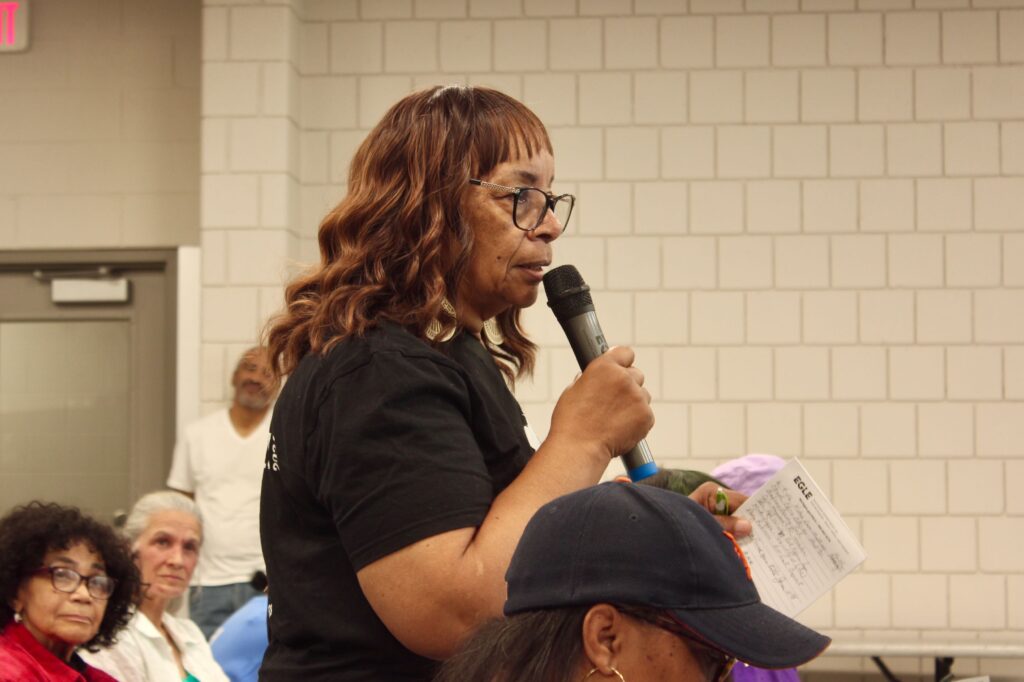
“We’re just voicing our opinions, and that’s a good thing … but what we’re doing tonight is a moot point,” said Jacqueline Conley, a resident of the area for more than 50 years.
The state is taking public comment on the permit applications until June 11.
The Marathon, MPLX air quality permit applications
If approved, the Marathon air quality permit would allow unloading of feedstock — raw materials like gasoil and paraffinic crude — by rail, including 24 warming stations and 12 racks to unload rail cars into storage tanks, said Andrew Drury, the lead EGLE permit engineer on the proposed project.
Marathon is proposing loading light distillates like kerosene and diesel fuel into rail cars, he said.
At the MPLX facility, tanker trucks emit gasoline vapor when they’re filled, Drury said. MPLX has two devices to control these emissions. The activated carbon vapor recovery system is the primary control device, and the vapor combustion unit is used as a backup, Drury said.
MPLX is proposing limited use of the vapor combustion unit instead of the vapor recovery unit, primarily during hot weather, so it can operate all six loading lanes at the same time, he said.
The proposed Marathon and MPLX projects are not directly related, Drury said. A combined public comment period is being held for both applications because they are considered a single stationary pollution source for regulatory purposes, but evaluated separately, he said.
Marathon and MPLX did not return a request for comment on this story.
What’s at stake for Detroit air quality?
Volatile organic compounds (VOCs), nitrogen oxides, and sulfur dioxide are among the pollutants that could increase with EGLE approval of the Marathon and MPLX proposals.
Marathon is proposing to balance emissions increases by installing enhanced controls on three refinery storage tanks that would cut VOC emissions by 2.6 tons per year, according to the state environmental regulator.
The Marathon permit could reduce truck traffic to the refinery by allowing more feedstock to arrive by rail, according to EGLE.
The facilities are located in Wayne County, which is in nonattainment for federal ozone standards.
After EGLE modeled worst-case emission scenarios, Drury said the projects would meet Michigan’s health-based standards.
The modeling simulates a grid of virtual air monitors surrounding the facility, and shows the concentrations of pollutants to which residents could be exposed in worst-case scenarios, he said.
In April, the EPA removed the Detroit River area from the sulfur dioxide nonattainment list after 13 years, citing a 57% pollution reduction.
Simone Sagovac, project director with Southwest Detroit Community Benefits Coalition, said “a lot of damage” was done during the period of nonattainment.
“That is a long time for the community to be breathing this air that exceeds health standards,” she said during public comment.
Sulfur dioxide can trigger asthma after short-term exposure and cause other respiratory problems. The pollutant can react with other compounds to form fine particulate matter or PM2.5, which is linked to cardiopulmonary problems and premature mortality.
Prolonged exposure to ground-level ozone can lead to respiratory illness, reduced lung function, exacerbated asthma and other chronic lung diseases.
The metro Detroit area was in nonattainment for ground-level ozone under the Clean Air Act from 2015 until 2023, and is again in nonattainment status due to a December decision by the U.S. Court of Appeals for the Sixth Circuit.
The Marathon and MPLX projects show the potential to increase emissions of volatile organic compounds and nitrogen oxide emissions, both of which contribute to the formation of ozone.
Detroit ranks 39th-worst nationally for ozone pollution, and received an F grade, in the American Lung Association’s 2026 air quality report.
In May, the Sierra Club said it will sue the EPA after the agency missed the February 2025 deadline to determine whether Detroit meets federal ozone standards.
Monitoring data shows the area should be shifted from moderate nonattainment to serious nonattainment, according to the environmental group.
Sagovac said EGLE should require an ozone impact analysis. If EGLE determines the new refinery equipment would affect the area’s ozone attainment, the agency should deny the permit, she said.
Many members in the crowd spoke with emotion of the health and quality of life impacts felt in the community due to industry, from asthma in infants, to being a cancer survivor, to being unable to open windows or enjoy a summer evening on the porch.
‘No legal choice’
When issuing a permit, EGLE does not have the legal authority to consider a cumulative impact analysis or deny a permit based on a company’s compliance record, EGLE previously told Planet Detroit.
The rules “on the books” are that if the project meets health-based standards, EGLE “has no legal choice” but to issue the permit, Drury said.
Mike Depa, an air quality toxicologist at EGLE who evaluated Marathon and MPLX’s proposed emissions against health standards, said: “We don’t take into account the existing health of the community, but that doesn’t mean that we didn’t evaluate it.”
EGLE said it evaluated toxic air contaminants under state rules and ensured compliance with federal EPA frameworks for criteria and hazardous air pollutants. The agency determined the projected emissions meet those standards.
Depa said the pollutants can have additive effects.
“Unfortunately, we don’t have the authority to regulate those cumulative effects in the way that most people are expecting,” he said.
“If you’re going the speed limit, you can’t get a ticket for going too fast,” he said.
The state Legislature could require regulation of cumulative impacts, Depa said.
Legislation introduced last year in the Michigan House of Representatives and Michigan Senate aims to change the way facilities are permitted by requiring EGLE to consider the total regional health impact of multiple pollution sources, such as industrial facilities and truck traffic, when issuing permits.
The Protecting Overburdened Communities Act was introduced by state Rep. Donavan McKinney and state Sen. Stephanie Chang, both Detroit Democrats, in July 2025.
“As we all know, we do not breathe one source of pollution at a time, and we experience the health harms of all the combined pollution we breathe,” McKinney said during a 2025 press conference.
RELATED NEWS

Why this Southwest Detroit native links language barriers to environmental health
Cynthia Gutierrez Navarro grew up in Southwest Detroit, where she saw how environmental issues and language barriers shape access to resources. Now she’s bringing that perspective to journalism.


After Zug Island pollution lawsuit, attorney urges community engagement
Annie Seaman worked on Zug Island for 40 years from 1973 to 2013. She wore all pink to a community meeting about pollution from the island, but the stories she tells about her time as a U.S. Steel Great Lakes Works employee are less than rosy. Seaman, who lives in Detroit, worked as a powerhouse…

Is your air safe? A guide to cumulative pollution impact in Southwest Detroit
Bills introduced the Michigan Legislature would require the state’s environmental regulator to conduct cumulative impact assessments. What does this mean for environmentally burdened Southwest Detroit?