

Overview:
- The Rights of Nature movement seeks legal standing for rivers and natural systems, allowing them to be represented in court.
- Toledo's Lake Erie Bill of Rights was struck down in 2020 after a farming corporation sued, highlighting tensions between corporate interests and environmental protection.
- Detroit River advocates say the movement represents a cultural shift toward viewing the river as a living entity deserving respect, rather than an industrial resource to exploit.
This story was produced in collaboration with the Detroit River Story Lab, a University of Michigan initiative that supports local efforts to center the river as a site of connection and belonging. The Lab’s local journalism portfolio includes the Detroit River Stories podcast series, the 100 Years Ago Today blog, and the Detroit River Beat, a collection of student-authored stories about the river’s role in sustaining human and more-than-human communities throughout the region.
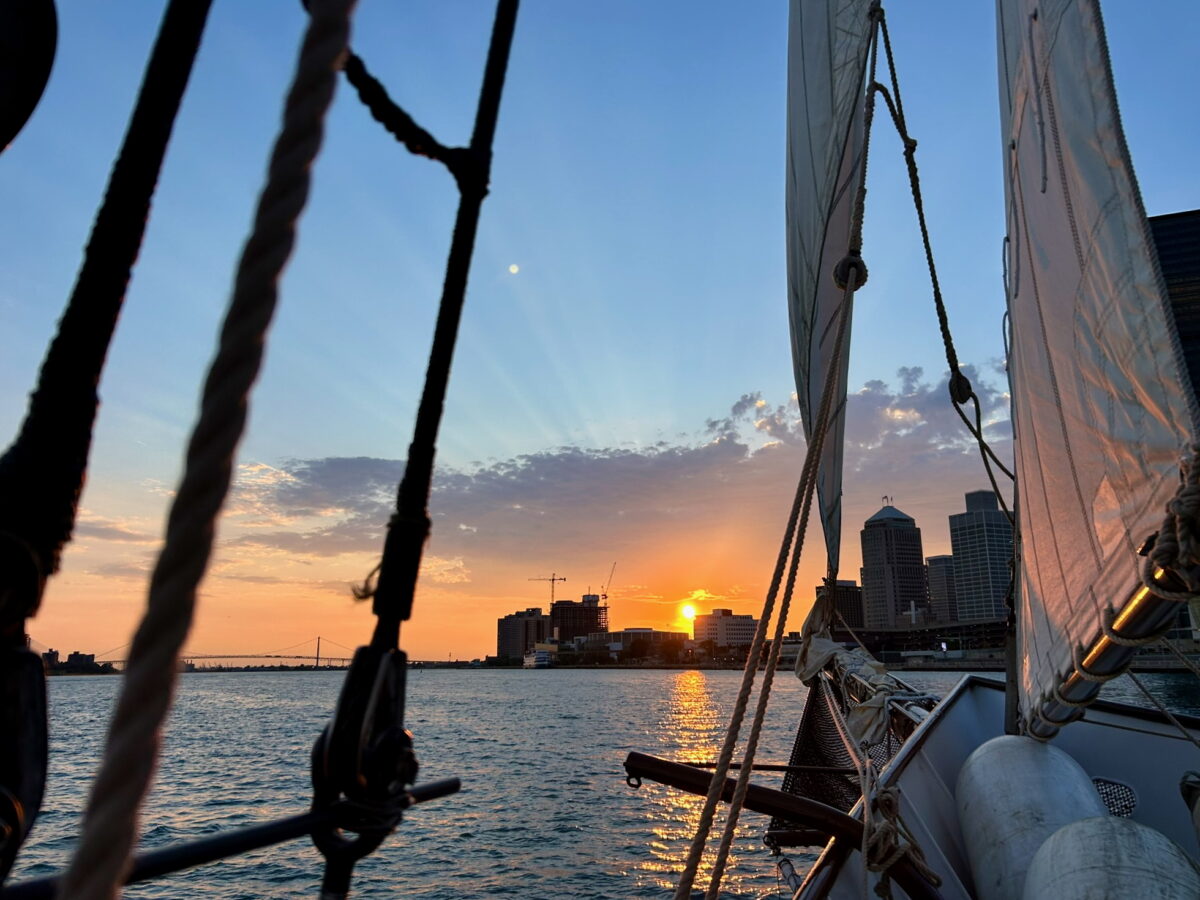
Sunset on the Detroit River can be magically serene. As the sun drops below the Windsor skyline, its dying rays sparkle across the smooth water towards the Detroit shore. Gulls dip into the water, and passing freighters mumble muted foghorn greetings to each other.
Tales of chemical legacies, industrial waste, and algal blooms are audible on the deck of a schooner navigating the calm river.
The speakers onboard represent a loose coalition of activists, community leaders, and storytellers who share a devotion to the river and a commitment to connecting younger generations with the rich history of the region’s defining waterway. An educator refers to the river as “she.”
Personalizing the river has become more common among stewards. The gesture reminds listeners of the value the river brings to their lives, families, and communities, while quietly challenging legal and economic frameworks that define a body of water by its usefulness to industry.
The rights of nature movement
In his recent bestselling book, “Is a River Alive?” journalist Robert Macfarlane explores the backstory and deeper implications of the educators’ personification of the river.
In researching his book, Macfarlane embedded himself with groups of activists seeking expanded legal standing for rivers on three continents. He discovered a profound local sense of connection with these waterways, revealing the “transformations [that] occur when rivers are recognized as both alive and killable.”
The global Rights of Nature movement has grown from the idea that natural systems such as rivers, forests, and wetlands should be recognized as rights-bearing entities under the law, which would allow them to be represented in courts.
This is not a new idea. In 2008, Ecuador enshrined the Rights of Nature in its constitution, giving nature the right to legal standing. Similarly, in 2017 the Whanganui River was granted legal personhood in New Zealand as a part of a legal settlement with the Maori tribe.
In the United States, Rights of Nature claims have sprung up across the country through ordinances relating to bodies of water, typically for the purpose of ensuring the protection of nature from pollution and destruction perpetrated by industry.
In 2006, Tamaqua Borough, Pennsylvania became the first U.S. community to pass an ordinance recognizing the Rights of Nature as part of a campaign to ban sewage sludge dumping in the coal-heavy area.
Developed in collaboration with the Community Environmental Legal Defense Fund (CELDF), the ordinance marked the beginning of a slow but steady shift both in the Great Lakes region and globally, as communities began to question how the legal standing of a corporation could outweigh that of a natural feature or landscape.
In 2018, inspired by the Tamaqua Borough ordinance, Toledoans For Safe Water advocated for the legal protection of Lake Erie using a piece of legislation referred to as the Lake Erie Bill of Rights (LEBOR).
LEBOR passed in 2019. Within a day, the Drewes Farms Partnership, a farming corporation from the Toledo area, became the first U.S. corporation to sue over Rights of Nature legislation, alleging infringement of corporate rights.
The law was found unconstitutional by U.S. District Judge Jack Zouhary of the Northern District of Ohio in 2020.
“If we are going to honor the Rights of Nature in Ohio and protect Lake Erie’s right to evolve, exist, and flourish, that severely impacts agricultural corporations’ ability to pollute the lake,” explains Will Falk, co-coordinator of community resistance and resilience at CELDF.
“These corporations understand this idea and feel threatened by it, which is why they have such a strong response to these laws.”
Although LEBOR was not enacted, the movement is not a failure, said Falk and Tish O’Dell, consulting director at CELDF.
“What happened can be used to show people how much corporations are going to be against this as we move forward,” says O’Dell.
“We are watching the movement spread in real time and the conversations and questions are changing as people become more familiar with these ideas.”
For Falk and many others, the question is not whether the river should have rights, but whether the legal system is capable of honoring them.
Establishing legal standing for the river is one of many advocacy and policy tools available to grassroots groups for addressing environmental quality issues.
“We have to be asking ourselves, ‘What exactly is the problem we are trying to solve? If the Rights of Nature solves that problem, how can it be implemented?’”
Ecological action in Detroit
The scarred landscapes lining stretches of the Detroit River are onetime sites of car, steel, paint, and chemical plants. Although many are closed now, these facilities left behind vast amounts of mercury, PCBs, solvents, and byproducts that work their way into fish, bird, and human bodies.
The pollution is a priority for environmentalists, advocates, and educators along the river corridor.
In Wyandotte, home to a BASF chemical plant, Southwest Detroit Environmental Vision (SDEV) and Friends of the Rouge have lobbied the Michigan Department of Environment, Great Lakes and Energy and Environmental Protection Agency to strengthen remediation and cleanup plans.
Raquel Garcia, executive director at SDEV, is one of the regional leaders in Detroit River advocacy, says “each component of the river’s history is connected to each other and contributes to how we view and interact with the river.”
The Environmental Protection Agency announced the approval June 30 of a plan to address groundwater contamination from the BASF site, where toxic chemicals have flowed into the Detroit River for decades.
Construction on BASF’s contamination barrier and treatment system could begin in early 2027, according to the EPA.
Some Southeast Michigan environmental advocates say they are working with state and federal agencies to make long-term change.
“I’ve come to appreciate how interconnected all these systems are and how they all touch the river,” says Paul Draus, a Friends of the Rouge board member.
“On a personal level, a lot of these people are supportive of our efforts to protect the rivers in Southeast Michigan, so it is valuable to find people on their teams who you can develop a relationship with,” he says of working with state and federal agencies.
This push for cleanup of sites along the Detroit River is part of a larger story asking whose voices are driving these conversations, and whether one could one be the voice of the river itself.
River and natural resource management practices have fueled interest in something radically different from the U.S. regulatory system: giving the river itself the right to be protected.
For tribal groups along the Great Lakes, such a question suggests a return to longstanding ways of knowing.
Long before industrialization reshaped the Detroit River’s banks and flow, Anishinaabe people regarded it not a resource to be controlled, but a relative to be respected. Jared Ten Brink of the Nottawaseppi Huron Band of the Potawatomi explains this idea, reflecting on how Detroit’s interactions with the river vary significantly from those of the Anishinnabe people.
“Anishinnabe people also historically used the river to trade, eat, hunt, and live, but recognize these things as gifts and not privileges. The idea of reciprocity is lost right now. The city doesn’t give to the river.”
We passed a law — now what?
Legal standing can allow a river to be represented in court, but does not change human behavior. Communities that are able to pass Rights of Nature laws face ongoing challenges of state and federal laws taking precedent.
The Rights of Nature have never been protected on a federal level in the U.S., and when challenged, Rights of Nature ordinances in the U.S. have consistently been struck down when challenged in court.
The obstacles this movement faces in the U.S. boil down to a legal system working to preserve natural resources as food for humans, says Oday Salim, director of the Environmental Law and Sustainability Clinic at the University of Michigan.
Despite these challenges, the concepts driving the Rights of Nature movement remain central in the advocacy and community engagement taking place around the Detroit River. They’re centered around respecting and protecting rivers and natural resources as living entities.
For Ten Brink, the question of the river’s health is inseparable from what the river can still give, and what it no longer has.
“When we think about the Rights of Nature movement, it says we all have an equal right to live, and right now the river is seen as something to manipulate and change in the name of trade and industry,” he says.
Is now the time for a healthier Detroit River?
Detroit River advocates say the Rights of Nature movement is something more expansive than a courtroom strategy. Rather than a legislative goal, it’s a way of organizing people around a sentiment of shared responsibility for the river, and represents a cultural shift necessary to create long-term and sustainable improvements to the river’s health.
Jaike SpottedWolf, an Indigenous organizer and nature advocate, says environmental issues often seem abstract until they have a significant impact on affluent communities and decision makers.
SDEV’s Garcia gives the pollution of Ann Arbor’s drinking water by PFAS contamination as an example.
Within two years of record-setting PFAS concentrations impacting the health of fish populations in the Huron River, the city redefined drinking water standards, enacted filtration requirements, and achieved a significant reduction in PFAS contamination — a stark contrast to the generational water quality issues faced by residents of lower-income communities.
Mike Shriberg, director of the University of Michigan Water Center, said restoration efforts are taking place up and down the Detroit River.
“The timing could be just right to try to utilize this approach by aligning communities, goals, and narratives around the river,” he said.
The greatest successes of the Rights of Nature movement in the Great Lakes Region are the conversations and steps toward a paradigm shift relating to harm, accountability, protection, and restoration of the river, according to CELDF’s Falk and O’Dell.
The fundamental conflicts between the Rights of Nature movement and the U.S. legal system could mean legal standing is an effective long-term strategy for a healthier river, Falk said.
While legal standing for the Detroit River may not be an immediate goal for these groups, the core idea of fostering relationships with nature based on respect, reciprocity, and connection can bring people and organizations together to fight for the health and long-term protection of the river.
A cultural shift is underway, and it’s visible outside of the courtroom, in growing expectations that corporations interact with communities and neighborhoods, not just regulatory bodies.
Hope along the Detroit River is rarely uncomplicated, but O’Dell finds optimism in students and younger organizers who understand their futures are tied to the river’s health, and imagine bold change.
Falk and SpottedWolf offer sobering reminders that piecemeal reform will not produce the transformation advocates seek in the way that unity from nonprofits, organizers, and communities will.
The sheer range of voices articulating the value of the river to local communities begins to suggest the possibility of a radically different future.
Such a future will not be ushered in by a single, momentous legal victory. Rather, it will emerge through sustained pressure, gradual paradigm shifts, and growing refusal to view the river as expendable.
MORE DETROIT RIVER COVERAGE
Detroit River tour highlights restoration successes, $1-billion cleanup hurdle: ‘We all have a role to play’
A nonprofit boat tour showcased decades of Detroit River restoration progress while highlighting the $1 billion cleanup still needed to address 3.6 million cubic yards of contaminated sediment remaining in the waterway.

EPA approves BASF’s Wyandotte cleanup plan for Detroit River pollution
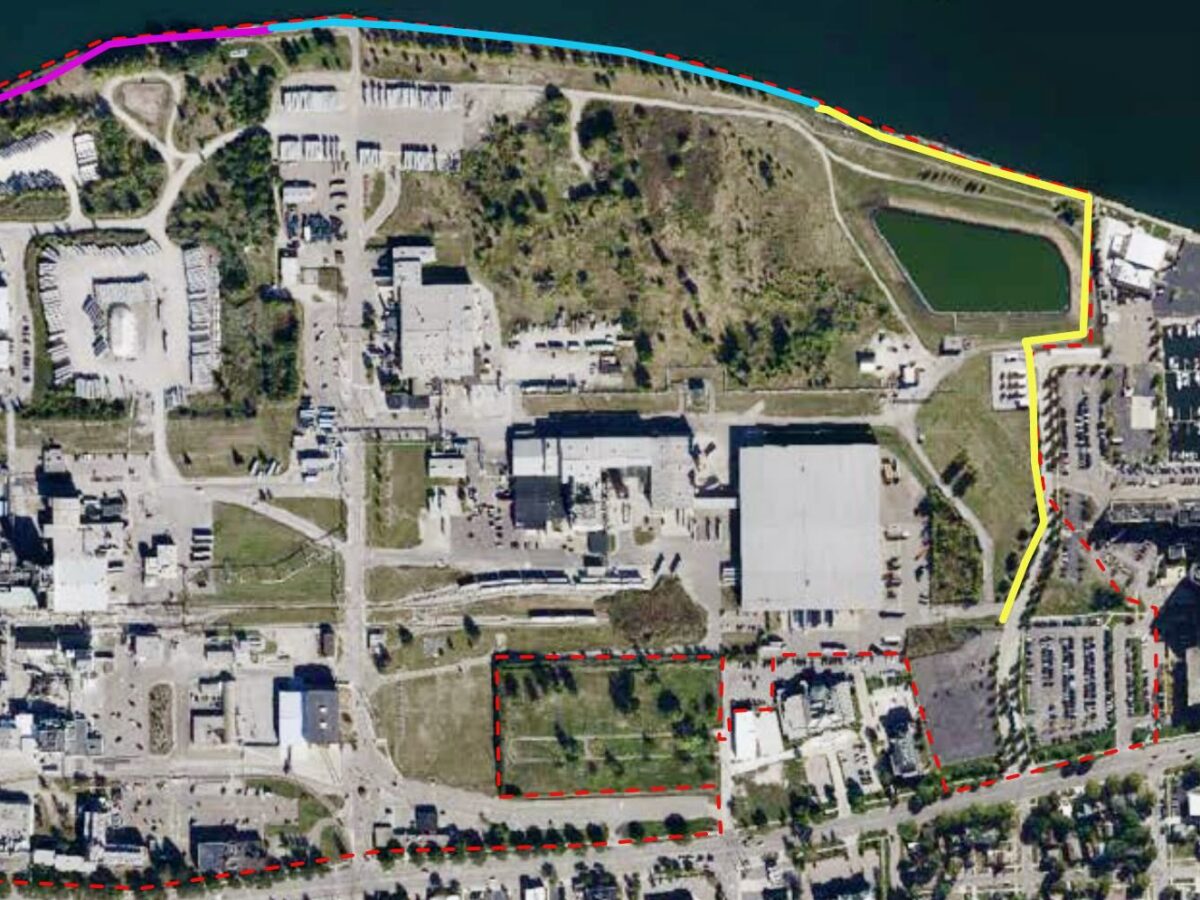
The EPA approves BASF’s plan to address groundwater contamination at its Wyandotte facility, where up to 60 gallons per minute of contaminated groundwater flows into the Detroit River near the city’s drinking water intake.

Detroit River restoration receives $10 million boost from EPA, state
The EPA and state are investing $10 million to clean up toxic sediment in the Detroit River.