

Overview:
- Detroit urban farms have evolved from grassroots projects to essential community infrastructure, with policies like the 2013 Urban Agriculture Ordinance legitimizing farming in the city.
- A proposed Land Value Tax would protect urban farmers from being priced out by shifting taxes from improvements to land itself, holding owners of vacant properties accountable.
- Extreme weather driven by climate change and urban heat islands increasingly threatens crop yields, pushing farmers to adopt innovative stormwater management and soil techniques.
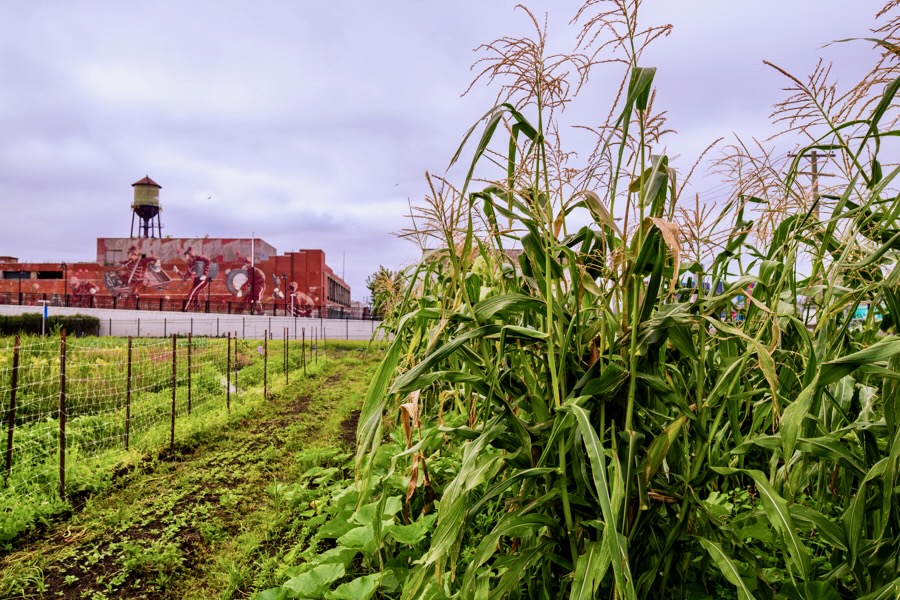
Eight in 10 Americans live in urban areas and rely on their local communities for food access. In Detroit, urban farming has evolved from a grassroots effort into a cornerstone of the city’s infrastructure. It has become a thriving movement, transforming vacant lots into agricultural hubs. These hubs turn abandoned spaces into community oases, making green spaces and food accessible.
Detroit’s urban farms are cultivated by organizations like the Michigan Urban Farming Initiative, a nonprofit engaging Michigan residents in sustainable agriculture, and Keep Growing Detroit, an urban farming collective dedicated to food sovereignty.
The Detroit People’s Food Co-Op brings benefits of its food system directly to local residents. In November 2025, Green Boots Garden stepped up to help the community while the government and SNAP benefits were halted.
The value of urban farming is reflected in Detroit policies such as the Urban Agriculture Ordinance, which gave Michiganders the right to farm in urban areas starting in 2013.
The recently passed Urban Animal Ordinance legalized the ownership of up to eight chickens or ducks and beekeeping in Detroit’s residential zones.
The Land Value Tax Plan (LVT), proposed during former Mayor Mike Duggan’s tenure, has the potential to be one of the most transformative policies in Detroit history. If passed by the state Legislature, the LVT would classify Detroit’s urban farms as community spaces.
If enacted, this policy would shift the tax burden away from “improvements”—such as buildings and greenhouses—and onto the land itself. This would hold owners of underutilized properties, like abandoned buildings, scrapyards, and parking lots, accountable.
Most importantly, passing the LVT would ensure that Detroit’s urban farmers are not priced out of their land, protecting these vital community assets for the future.
Urban farms and changing climate
While we have the power to push policy to improve our agriculture, extreme weather events are increasingly less within our control and increasingly damaging to Detroit’s urban farms.
Urban weather patterns are often impacted by the heat island effect, in which urban infrastructure traps heat, increasing humidity and precipitation. Fluctuations in rainfall and temperature can make or break crop yields for urban farms just as they do as for traditional farms.
Extreme weather is a true “butterfly effect,” where today’s phenomena can create more extreme conditions in the near future.
Detroit has become subject to more frequent Arctic blasts as well as recent stratospheric warming events that pummeled the city. Heavy rains that used to occur every few generations are now happening every few years.
In response, farmers are now pivoting to raised beds, high-compost systems and other types of green stormwater infrastructure to increase water absorption and ease the burden on the city’s aging sewer system – a testament to the community’s resilient spirit. It’s imperative for Detroit policy to support these innovations.
The urban farms of Detroit and the innovative farming practices within serve as a beacon of resilience and improved food access in the face of volatile climate. From water management to climate control technology, Detroit urban farmers are creating and adapting to weather changes within their communities.
It’s essential to further integrate urban farms into Detroit’s policies to ensure the city has a climate resilient future.
Planet Detroit’s Voices column includes opinion pieces from our community of partners and readers. These pieces express the voices of the authors and not necessarily those of the publication.
MORE PLANET DETROIT VOICES
Voices: Michigan’s water systems need cybersecurity coordination after summer attacks
Nine Michigan water systems reported cyber intrusions this summer as part of nationwide attacks on water infrastructure. Brandon Jessup argues the state needs coordinated defenses, not fragmented responses.

Voices: What Detroit’s flooding crisis reveals about building resilient Great Lakes cities
A major federal study is examining Detroit’s flooding crisis. The solutions must prioritize neighborhoods that have borne the brunt of aging infrastructure and climate change, say Tiana Starks and Sara Hughes.


Wildfire smoke may have cleared, but mental health impacts can linger
As wildfire smoke events become more frequent in Michigan, mental health professionals are seeing increased anxiety, grief, and anger among residents—especially young people concerned about their future.