

Overview:
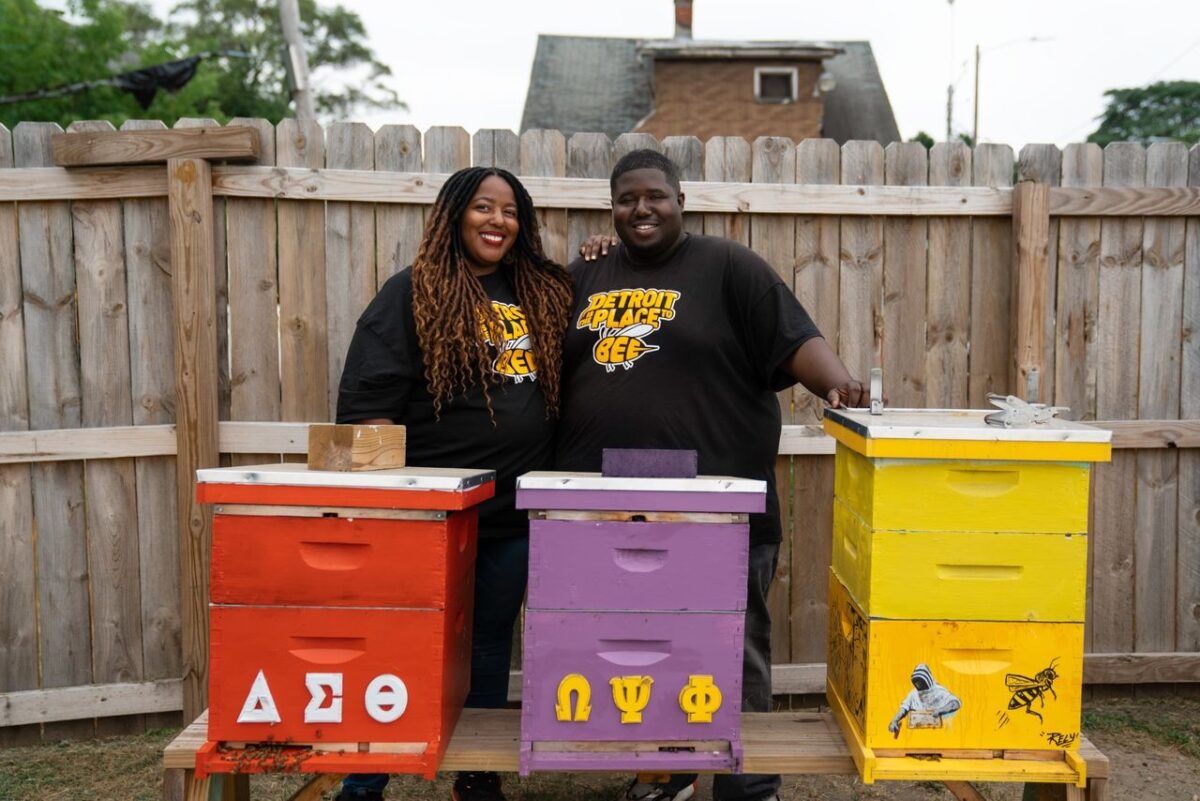
- Detroit Hives began in 2016 when Timothy Jackson and Nicole Lindsey won $1,600 through Detroit Soup to start beekeeping on vacant lots, with no prior experience in apiculture
- The nonprofit now operates 38 locations across Michigan and beyond, helped Detroit become a certified Bee City USA in 2024, and has documented 465 native bee species in the city
- Detroit Hives is developing the East Warren Community Arboretum and Botanical Garden on 11 former vacant lots and plans to expand to more than 60 locations within five years
Rooted in Detroit: Stories from the Soil is a Planet Detroit farmer profile series exploring Detroit’s local urban farming community. Local journalists, farming leaders, and Planet Detroit Neighborhood Reporting Lab Fellows and participants write the farmer profiles, supported by the Kresge Foundation and the Sustainability Institute of Detroit. See the full series here.
Detroit Hives began not with a plan for bees, but with a search for a new story about Detroit.
In early 2016, the City of Detroit issued a call to action: with tens of thousands of vacant lots scattered across the city, officials sought nonprofits and residents willing to buy and reimagine them, some for as little as $100 apiece.
Timothy Jackson and Nicole Lindsey saw an opportunity to do more than fill empty ground — they wanted to change how people talked about their city.
“Sometimes the media and people living outside the city viewed Detroit as a violent place full of crime,” Jackson said. “Nicole and I wanted to change that narrative.”
Their first ideas had nothing to do with honey. The couple considered an urban peacock farm and an outdoor photography studio — a free, rotating installation where residents could take family portraits, mark birthdays, or simply have a place for neighborhood selfies against a new backdrop each year. Then Jackson got sick.
Looking for relief from a persistent cough and cold, he walked into a convenience store in Ferndale, where the owner recommended raw honey. Jackson was skeptical, but three weeks later, his cough was gone.
“I thought, ‘ How is honey going to help me,” he said. “But it did.”
That recovery sent him deeper into researching raw honey’s properties, and it planted an idea in Lindsey’s mind.
“Why don’t we make this hyper-local and make a farm here in Detroit,” she recalled thinking. “We hadn’t seen any examples of this. Had we seen this, we wouldn’t have done it.”
The pair wanted something original, something no one else in the city was doing. Beekeeping on reclaimed vacant land in Detroit fit that description.
Neither had any background in apiculture. What they had was $1,600 — seed money won through Detroit Soup, a community micro-granting dinner where local residents pitch ideas and the audience votes on which one receives that evening’s pooled donations.
It was enough to get Detroit Hives off the ground in 2016.
Ten years later, the 501(c)(3) nonprofit organization operates across 38 locations, primarily in Detroit but increasingly across southeast and south-central Michigan and as far as Kansas City, Missouri.
It runs on three full-time paid staff, roughly 12 regular volunteers, and a five-person board of directors — a lean structure for an operation that now blends land reclamation, environmental science, and public education.
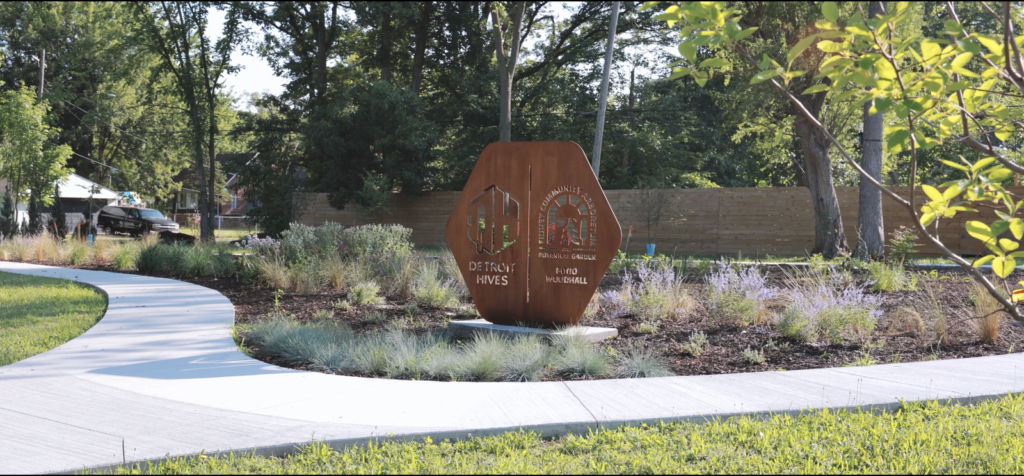
In 2024, Detroit became the 207th certified Bee City USA affiliate, a designation Detroit Hives helped bring about by working with the Detroit City Council and Xerces Society. The city has since documented 465 certified native bee species — a figure Jackson and Lindsey often cite when correcting one of the most persistent misconceptions about their work: that honeybees, introduced to North America by European settlers, compete with native pollinators for space.
“If people are growing more flowers and plants, there’s more work for everyone,” Lindsey said. “The honeybees are not competing.”
She added that a second source of confusion is between bees and yellow jackets. The latter are wasps, not bees, and while they pollinate incidentally, they primarily prey on other insects in a garden.
Education, more than honey, has now become the organization’s core product. Detroit Hives runs tours, hosts school groups, and partners with businesses through its Bee City USA initiative to enhance and restore pollinator habitats, while educating others on pollinator conservation.
Other stories in our ‘Rooted in Detroit’ series





For Lindsey, the most rewarding audience is young girls, who often arrive at a hive site expecting to be afraid and leave with a different relationship to the insect.
“Girls are most likely afraid of bees, and this gives me a chance to highlight that the females are the ones doing the work,” she said. “When you see a female on a nectar, she’s the one doing the work.”
Male bees, called drones, do not forage. Watching that fact land with a group of kids, Lindsey said, is when “you see a spark change in their minds, and they begin to ask more questions.”
Jackson names climate change and public misunderstanding of pesticide use as the organization’s steadiest challenges. Lessons, he said, more than obstacles, are how he views them, each one different from the last. What keeps him going is the same thing that brought him to bees in the first place: curiosity.
“I enjoy most educating others on pollinators,” he said, “and being able to explore their curiosity in nature.”
Looking ahead, the founders describe a version of Detroit Hives that looks much like what it is now, just larger.
Jackson envisions establishing Detroit’s first education and resource center for pollinators and expanding in more than 60 locations within five years, with an expanded educational footprint to match. Lindsey’s vision, she said, is largely the same.
Both are Detroit natives, and both said their ideas about where the organization should go have stayed in sync since the beginning.
In celebration of their 10-year milestone, Detroit Hoves is collaborating with residents, organizations, and businesses to develop the East Warren Community Arboretum and Botanical Garden, formerly 11 vacant lots located in the East Warren / Cadieux Neighborhood, with the goal of creating a shared oasis for pollinators and residents alike.
To get involved, the entry points are simple: volunteer at one of the organization’s more than 38 active sites, donate through detroithives.org, or learn more about their Bee City USA Detroit initiative.
What began as an attempt to change a narrative about a city has become, a decade in, a working case study in what an empty lot can hold — not just bees, but a different way of looking at the ground beneath a city that once had close to 90,000 reasons to be written off.
