

Overview:
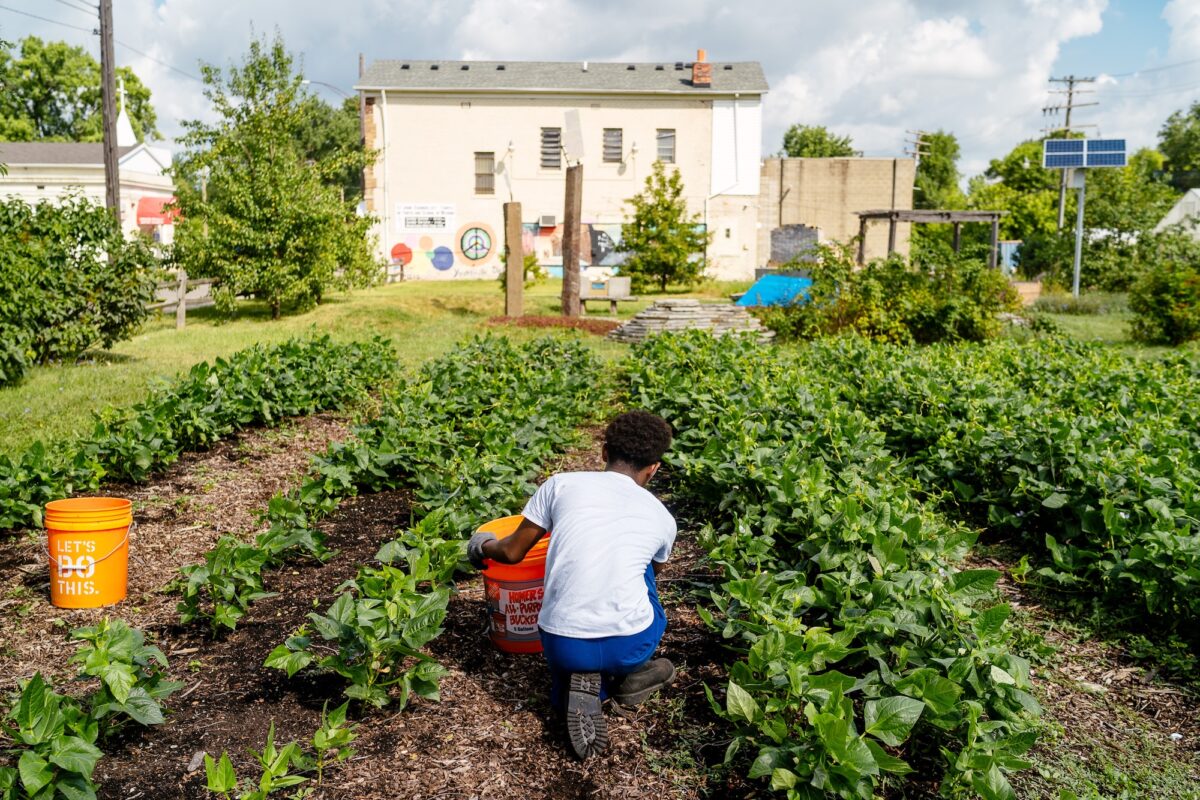
- Detroit now has more than 3,200 farms and gardens, building on centuries of food cultivation by Anishinaabe peoples, Great Migration families and community activists
- Historic programs from Mayor Pingree's 1890s potato patches to Coleman Young's Farm-A-Lot helped Detroiters grow food during economic crises, though city support has been inconsistent
- Today's growers face challenges with land access, funding and climate change, with questions remaining about whether Detroit can achieve true food sovereignty despite its urban farming leadership
Rooted in Detroit: Stories from the Soil is a Planet Detroit farmer profile series exploring Detroit’s local urban farming community. Local journalists, farming leaders, and Planet Detroit Neighborhood Reporting Lab Fellows and participants write the farmer profiles, supported by the Kresge Foundation and the Sustainability Institute of Detroit. See the full series here.
At Brother Nature Produce in Corktown, oranges, kiwis and pomegranates grow encased in a subtropical glass greenhouse.
Near Rouge Park, more than a dozen Detroiters learn how to install solar panels in a free training program at seven-acre D-Town Farm.
On the city’s east side, Sanctuary Farms composts thousands of pounds of food waste annually, creating enough compost to fill 30 commercial dump trucks.
Across the city, new apiaries supported the reintroduction of 12 million honeybees over the last decade, pollinating Detroit and producing thousands of pounds of local honey each year.
As of September, 2026, 3,277 farms and gardens now sprout across Detroit, according to nonprofit gardening group Keep Growing Detroit, or KGD. That number has steadily grown over the last several decades, giving the city national renown as a leader in urban farming.
Farming Detroit’s soil is nothing new. The Anishinaabe grew food here long before the French founded Detroit in 1701 as a fur trading post and military stronghold. Over the centuries, city programs and grassroots groups have repeatedly helped Detroiters grow food to feed themselves in hard times.
Today, as 70% of Detroit households struggle to reliably access healthy food, the city’s growers are carrying that history forward. They’re also facing the same questions that have shadowed every chapter: who gets land, who gets funded and whether a city can grow enough to feed itself.
Before Detroit: The Three Sisters, wild rice and ribbon farms
At KGD’s two-acre farm in Eastern Market, Anishinaabe farmer and KGD co-director Rosebud Bear Schneider plants tall Cherokee White Eagle corn with soup beans and winter squash growing below it. Her plot is one of several at the farm meant to help Detroiters reclaim their ancestral foodways.
Local tribes grew corn, beans and squash together, a planting known as the Three Sisters, and harvested wild rice, or manoomin, along local waterways. The relationship with these foods runs so deep that the plants are called “relatives” in the tradition, she said.
“These foods have been with us forever,” Schneider said.
“It’s a magical space at the farm, the Three Sisters Garden, and from there that inspired our foodways gardens. We have similar ancestral food traditions being practiced from the Puerto Rican community, the Venezuelan community, different African diaspora gardens, Filipino gardens … watching that reconnection inspires others to reconnect.”
The Anishinaabe peoples of this region, including the Ojibwe, Potawatomi and Odawa, migrated here from the East Coast long before European colonizers arrived.
“They were told in a prophecy that they needed to move west until they found food that grew on the water, and so they traveled the St. Lawrence River, and then they came to this area, and that’s where they found wild rice,” Schneider said. “And wild rice grew on every riverbed, all along the Detroit River.”
As colonizers pushed tribes off their land, many Native people were later sent to residential boarding schools or went to work in industry, losing their connection to traditional foodways.
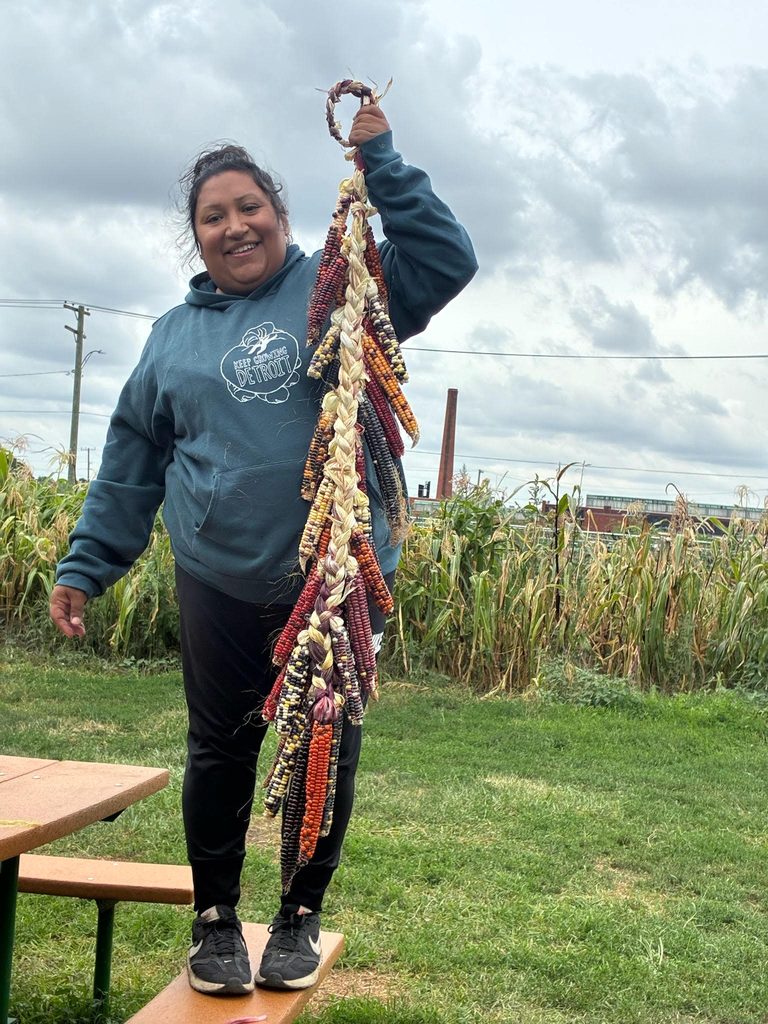
Schneider’s work focuses on restoring that memory through education and the Three Sisters Garden.
“When we talk about Indigenous food sovereignty, it’s really the act of returning to what we knew,” she said. “And the work that I do is to reconnect and reclaim these Indigenous foodways, especially in urban settings like this.”
Early European settlers: Ribbon farms
French colonizers were the first to displace the Anishinaabe. Starting in the 1700s, they laid out long, narrow farms along the Detroit River, each with river access. These “ribbon farms” included land later called Black Bottom for its fertile soil.
After the British took control in 1760, settlers kept working the ribbon farms with the labor of enslaved Native and Black people, growing corn, grains and vegetables, and raising fruit trees and livestock. When the United States took over in 1796, it opened Detroit’s first land grant office, and the first grant went to Elijah Brush’s ribbon farm.
1890s to 1940s: Potato patches, thrift gardens, and victory gardens
Detroit’s best-known early urban farming experiment came during the economic depression that followed the Panic of 1893. Mayor Hazen S. Pingree sold his horse to help fund a program that let residents grow potatoes and vegetables on vacant land. The city secured 430 acres, and up to 1,700 families grew food.
Jason Hawes, a University of Wyoming professor, said the potato patches made Detroit one of the originators of urban agriculture.
“It was certainly one of the first examples of a city incentivizing or facilitating urban [agriculture] through urban policymaking,” he said.
New York, Boston, Denver and cities abroad followed Detroit’s lead.
“It was so evocative that leaders in other cities started something similar, where they would essentially set aside land for poor people to grow food,” said Kami Pothukuchi, a professor of urban studies and planning at Wayne State University. “That came from Detroit.”
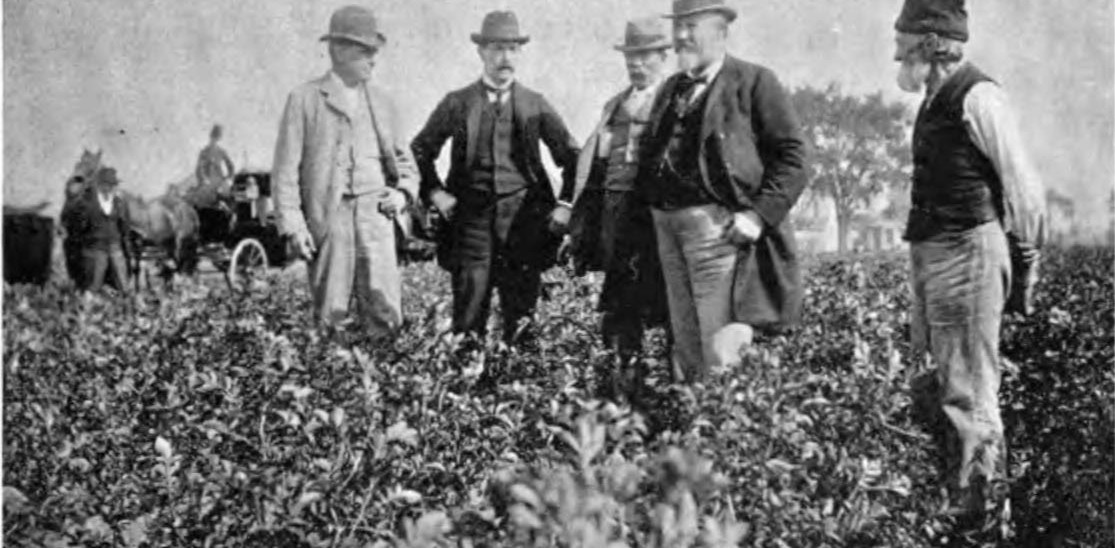
When the economy recovered, the patches faded until the next crisis. During World War I, Detroiters planted “war gardens” in their backyards. During the Great Depression, Mayor Frank Murphy, who took office in 1930, started “thrift gardens” on vacant land. During World War II, war gardens came back as victory gardens.
Other stories in our ‘Rooted in Detroit’ series
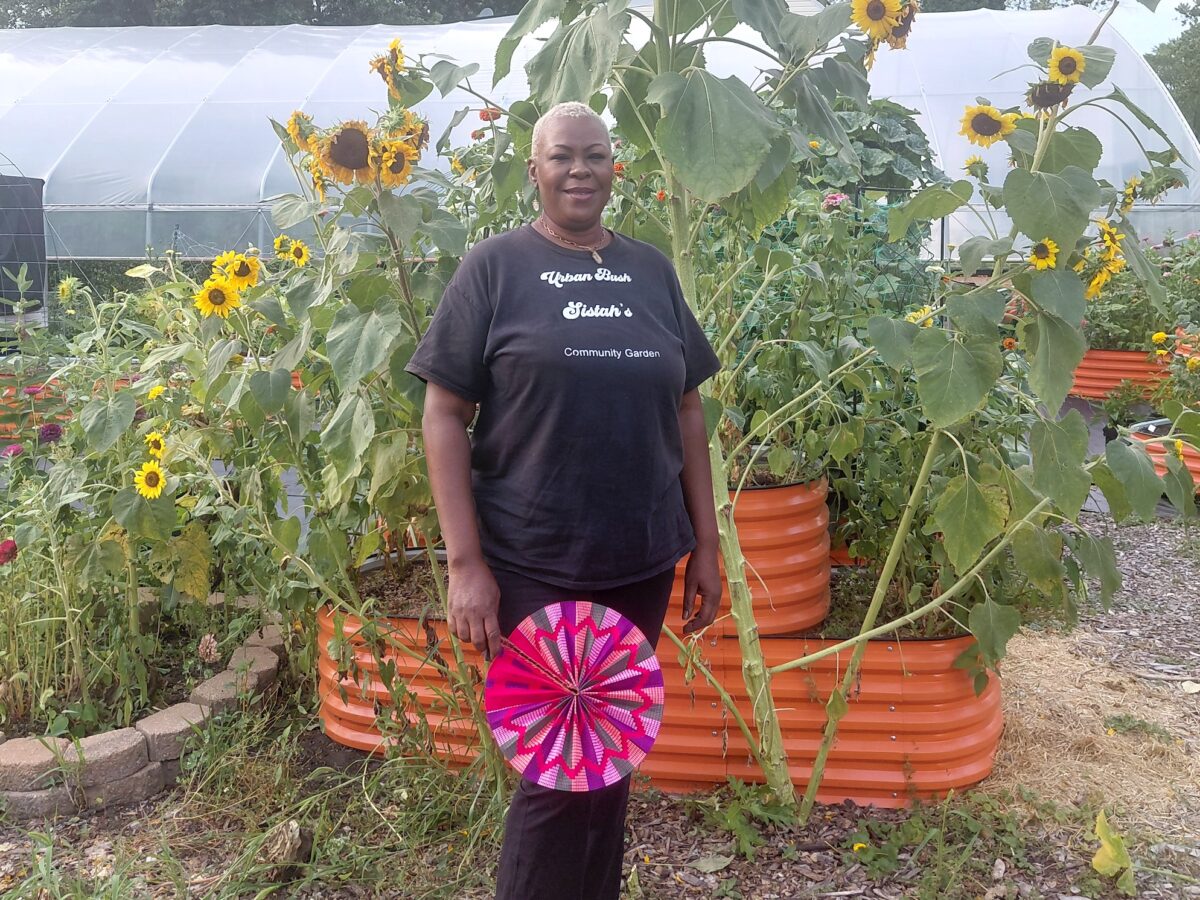





Over these decades, many of the families whose descendants lead Detroit’s farming movement today arrived from Southern farms during the Great Migration. One of them was the family of Detroit Black food sovereignty activist Malik Yakini.
“My grandfather was from Georgia, and came to Detroit about 1921 and had a victory garden during World War II, but also after that, always maintained a backyard garden,” he said.
1950s and 1960s: Backyard orchards and the loss of Black Bottom
Asenath Andrews also descends from Great Migration families. Her grandfather moved to Detroit in the 1920s and farmed on Eight Mile. Growing up in the 1950s and ’60s, she remembers peach, pear, cherry and mulberry trees in yards stretching from Cherrylawn to Meyers.
“Everybody’s yard had fruit trees when I was growing up. Even though everybody had fruit trees, we would still go to the other neighborhoods stealing fruit,” she said. “Such an adventure.”
In the same years, people cleared the fertile ground that gave Black Bottom its name. Starting in the late 1950s, the city razed Black Bottom and neighboring Paradise Valley, the center of Black life in Detroit, for urban renewal and the Chrysler Freeway, displacing thousands of residents.
1970s to 1990s: Farm-A-Lot and ‘Gardening Angels’
By the 1970s, Detroit was in crisis again, with an estimated 140,000 residents out of work.
Mayor Coleman A. Young, who called Pingree his favorite mayor in his autobiography “Hard Stuff,” launched the Farm-A-Lot program in 1975 to turn vacant lots into productive gardens. The city gave residents seeds, technical help, canning supplies and provided workshops.
Around the same time, a group known as the Gardening Angels began to take shape. Gerald Hairston helped steer the group, largely made up of older, Southern-born Black women who used Farm-A-Lot seeds to grow food on vacant land for their families and homeless shelters.
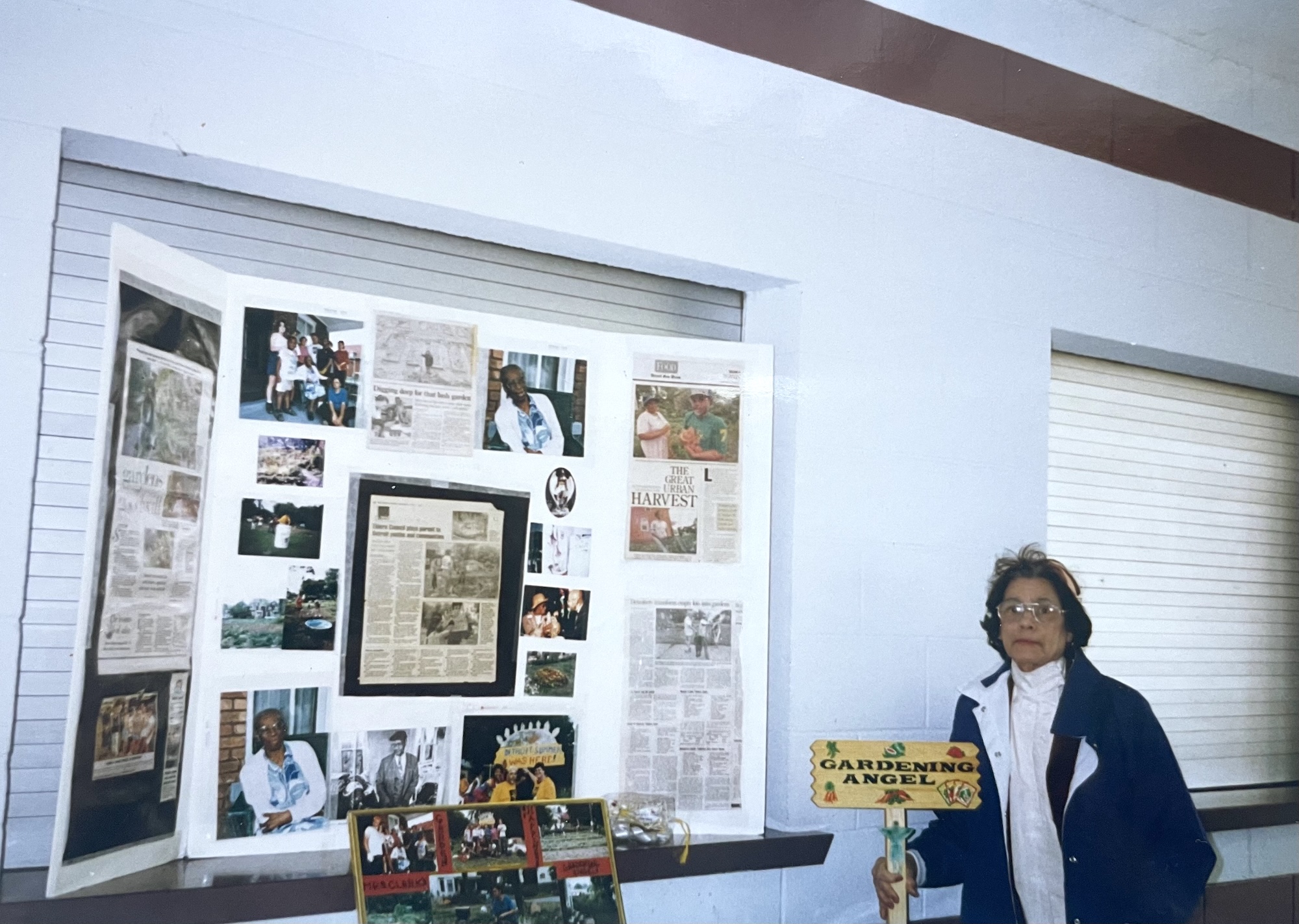
Detroit activist Grace Lee Boggs later credited them with laying the movement’s foundation in The Nation.
“Detroit’s local foods movement has been a catalyst in the [r]evolution that is rebirthing Detroit as a City of Hope,” she wrote. “Our [r]evolution began in the 1980s with African-American elders. Raised in the South, these ‘Gardening Angels’ could see Detroit’s vacant lots not as blight but as opportunities to grow our own food and also help urban youth understand the importance of self-reliance.”
Andrews brought that self-reliance into a classroom. As principal of Catherine Ferguson Academy, a public high school near downtown for pregnant teens and young mothers, she built the school around urban farming. Students learned life skills like growing greens and vegetables, keeping honeybees, milking goats and caring for horses. The school operated from 1986 to 2014 and drew international acclaim.
The Greening of Detroit was founded in 1989 to reforest the city and would later play a major role in the city’s next chapter of urban farming.
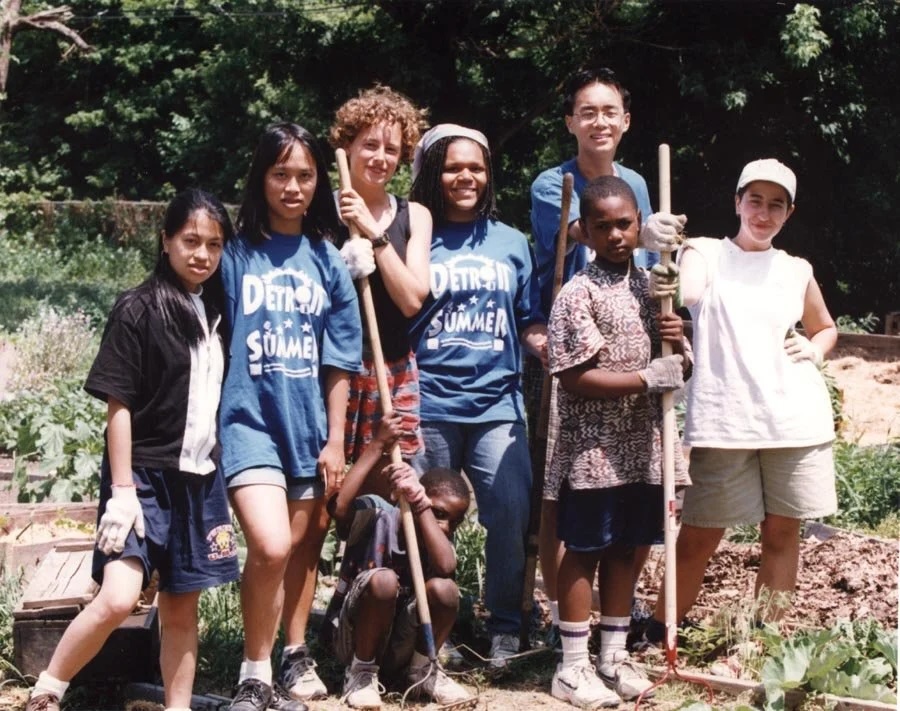
In 1992, Boggs and her husband, James Boggs, founded Detroit Summer, which paired young people with elders to plant gardens, paint murals and run poetry workshops. For hundreds of Detroit teens and young adults, it was a first step into community activism.
As community gardens grew, the city’s Farm-A-Lot program fell apart.
Boggs was part of a network of growers who met at a 4-H center on the east side, which became a hub for Detroit urban agriculture.
The group included city planner Kathryn Underwood, Hairston and Farm-A-Lot manager Susan Stellar, and they strategized to “try and keep Farm-A-Lot alive,” said Ashley Atkinson, co-director of KGD.
By the mid-1990s, with help from the Hunger Action Coalition of Michigan, they had formed the Detroit Agriculture Network, a coalition of nonprofits that supported gardening.
Atkinson remembers one gathering in the late 1990s when a woman she knew as Ms. Clark, then in her 80s, was distraught. She’d never gone a year without a garden, and she couldn’t get anyone at Farm-A-Lot to answer the phone.
Stellar, who managed Farm-A-Lot from 1996 to 2002, said the program had old equipment and no funding by then.
“The city didn’t take it seriously as a program,” she said. “But meanwhile, the gardening movement had really burgeoned around it.”
With Detroit’s revenue shrinking, the program wasn’t a priority.
“The tax base was so eroded that it was really hard to get basic city services done, and then there was this beloved program that nobody, no political person, wanted to do away with,” Atkinson said. “So they divested until the program died.”
“That’s kind of when we were like, we’ve got to do something.”
People were gardening all over the city, but places like Earthworks Urban Farm, started by the Capuchin Soup Kitchen in 1998, and Catherine Ferguson Academy gave the work a new vision.
“There’s starting to be this new kind of thing or new version of a thing: that’s the urban farm,” she said.
Out of Farm-A-Lot’s collapse came the Garden Resource Program, a partnership of the Detroit Agriculture Network, Michigan State University Extension and Earthworks.
It began in 2003 with 80 gardens by The Greening of Detroit, which expanded beyond tree planting to meet demand for gardening support. KGD now runs the program and supports gardens in backyards and on community lots across the city.
2000s to today: The rise of Black food sovereignty
In 2006, Yakini, Boggs, and others traveled 400 miles to Milwaukee to visit Growing Power- an urban farm and nonprofit founded there in 1993- on a trip sponsored by The Greening of Detroit.
Yakini had been gardening for years. In 1989, he co-founded the Nsoroma Institute, an African-centered school in Detroit with a large garden, where every teacher taught a weekly food security lesson.
The trip opened his eyes.
“I didn’t know there was a food movement; I knew we were gardening. I didn’t know there was some movement: people doing this all over the country,” he said.
In the back of the van on the ride home, Yakini sketched out a plan for what became the Detroit Black Community Food Security Network. A month later, 40 people came to its first meeting.
“We’ve been rolling since,” he said.
The group, now called the Detroit Black Community Food Sovereignty Network, or DBCFSN, marks its 20th anniversary this year. Over two decades, it built the seven-acre D-Town Farm, opened the full-service Detroit People’s Food Co-op grocery store in the North End in 2024 and helped lay the groundwork for Detroit’s urban agriculture policies.
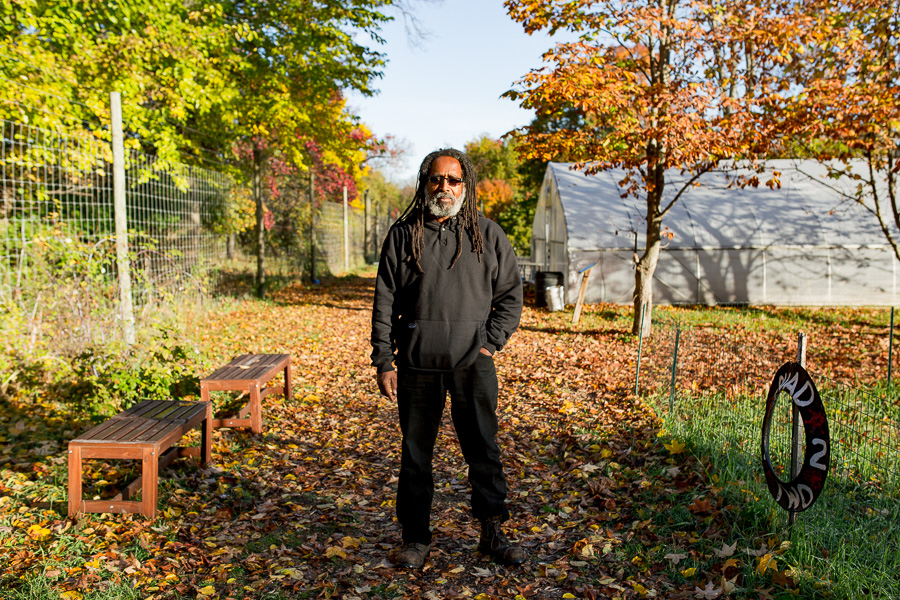
“When we started DBCFSN in 2006, one of our goals was to create a policy that helped enable gardening and food security in the city of Detroit,” said Yakini, who helped create the Detroit Food Policy Council in 2009.
Those were hard years for Detroit. After the subprime housing crisis and the Great Recession, the city overtaxed property owners by $600 million, feeding a wave of tax foreclosures. Much of that land went to the Detroit Land Bank Authority, created in 2008 to return vacant property to productive use.
In late 2012, with the city nearing bankruptcy, Detroit agreed to sell about 1,500 east side lots to wealthy businessman John Hantz for roughly $520,000. Hantz pitched the world’s largest urban farm to remove blight, but settled on a tree farm instead. DBCFSN and many residents opposed the deal. The City Council approved it with special terms that lasted more than a decade.
A few months later, in 2013, the city passed an urban agriculture ordinance that legalized the farms and gardens many residents were already growing on Detroit lots.
Even as the movement grew, its leading organizations didn’t look like the city. Tepfirah Rushdan joined The Greening of Detroit as director of urban agriculture in 2014.
“When I came, I was the only Black person on the staff on both sides [agriculture and forestry],” she said. “We’re in an 85% Black city, so this feels awkward.”
That experience shaped the Detroit Black Farmer Land Fund, which Rushdan and others started in 2020 to help Black farmers get land and technical support.
“The Black Farmer Land Fund comes out of that angst of this urban farming movement in the city that was largely white-led,” Rushdan said.
Yakini said DBCFSN grew out of similar frustration.
“In some ways, DBCFSN was a response to the overwhelming whiteness of the urban [agriculture] scene, and then also we were coming out of Nsoroma Institute with these radical Black politics, and so we wanted to inject that we weren’t just interested in growing food; we were interested in smashing white supremacy and destroying capitalism while we’re growing food,” he said.
The future: Can Detroit feed itself?
City policy has caught up in some ways. In 2023, Detroit appointed Rushdan as its first director of urban agriculture. In 2025, it legalized keeping chickens, ducks, and honeybees. The city also excluded urban farm use from its proposed land value tax.
But growers still face hurdles with land, zoning, money and climate change.
The last comprehensive study of Detroit’s farming potential came out in 2010, when the city had about 60,000 more residents than it does now. Researchers found that with 5,000 acres under cultivation, Detroit could become a “food sovereign city.”
Land alone isn’t enough, said Krystal Marie Whitten, a researcher at Humboldt-Universität zu Berlin’s Agricultural and Food Policy Group who studies Detroit.
“Detroit probably cannot ‘feed itself’ through urban agriculture alone, at least not in the sense of producing enough food to meet the city’s overall needs,” Whitten said.
“A recurring theme was that vacant land is not necessarily usable agricultural land.”
Soil contamination, zoning and the difficulty of securing land permanently all stand in the way, she said.
Land
The land bank now holds fewer than 60,000 vacant lots, and some Detroiters say it’s selling them in ways that aren’t transparent or fair. Of those lots, the city directs the land bank to hold thousands in inventory at its discretion for what leaders see as the land’s highest and best use, such as affordable housing and job-creation projects.
Meanwhile, at the end of last year, Hantz closed out his arrangement with the city by buying 55 more properties from the land bank for $18,308. He has sold roughly 430 of his properties for $48 million, according to the city’s online property data portal.
Shakara Tyler, co-founder of the Detroit Black Farmer Land Fund and co-executive director of DBCFSN, said her groups have always pushed for fair land policies.
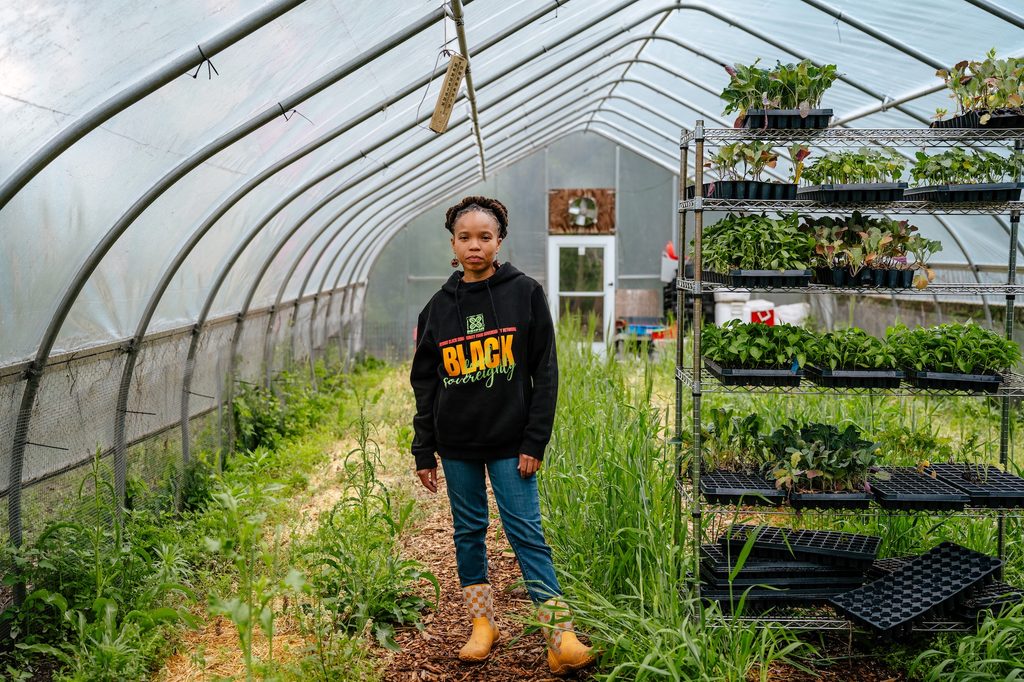
“The Detroit Black Farmer Land Fund has purchased almost 40 acres of city land for and with Black farmers, and that is a huge accomplishment. And we could do so much more if we, as an institution, got the deal that Hantz could get as a white, wealthy man,” she said.
Hantz Farms president Mike Score did not respond to a request for comment. In a 2023 statement, he said that no one wanted the land and that it was seen as a risky investment. He added that they paid to demolish dangerous structures, plant trees, and steward them all these years.
“We began our investment, and we continue to invest in our venture, because we believe people should not have to live in neighborhoods defined by extreme blight,” Score said in the statement.
Even on land they own, growers can run into trouble. Some have received blight tickets for growing food on formerly vacant lots.
Money
The opening of the Detroit People’s Food Co-op was a big moment, a chance for Black Detroiters to own part of their food system. Yet, about two years after it opened, the co-op is struggling, with sales below expectations causing cash-flow problems.
Rising food and fuel prices and Supplemental Nutrition Assistance Program (SNAP) cuts likely mean people are buying fewer groceries, said Alex Hill, project director of Detroit Food Map, who has tracked food access in Detroit since 2011.
“The most important thing is not to overstate the importance of urban agriculture,” Hill said.
“Everyone is like, ‘don’t worry, Detroiters are growing their own food.’ Yes, but some Detroiters are growing some food, and it’s something, but it’s not a substitute for putting meals on their plates.”
Detroit doesn’t have the infrastructure for urban agriculture to feed the city, Hill said.
“Even though we have this amazing number of people participating in urban [agriculture], it’s still 1% to 2% of the population. It’s a very niche community,” he said.
Philanthropic money for Detroit’s food system has also been unpredictable, Hill said. Around 2014, funders poured money into urban agriculture and then pulled back, which made long-term progress hard to sustain.
New public money is arriving. In September, the Michigan Department of Agriculture and Rural Development awarded the Detroit Food Policy Council $494,960 to distribute more than 1 million pounds of food a year through local food hubs, create an educational and assistance guild for the city’s animal-keeping community and build on Detroit’s compost pilots.
“This grant will help Detroit maintain its status as a national leader in urban agriculture while creating new opportunities for growers, increasing families’ access to local foods in underserved areas and improving quality of life for city residents,” MDARD Director Tim Boring said in a press release.
The first food hub, at Oakland Avenue Urban Farm, aims to raise $10 million to turn a vacant former grocery store into a solar-powered food resiliency hub. Because Congress has failed to pass a farm bill, the coalition is seeking to raise funds for the effort instead of relying on expected federal funding.
Farmers are also pushing the city to adopt a composting ordinance that would let them turn food waste into soil amendments while cutting the greenhouse gas emissions that drive climate change.
Climate
Even with steady funding, climate change will make growing harder. More extreme weather brings too much water or not enough, more pests and disease and lower yields.
“The bugs are harder to deal with. The stress on the plants, more time watering, it’s like everything is difficult,” said Greg Willerer, who has made his living as an urban farmer in Corktown for two decades as co-founder of Brother Nature Produce.
jøn kent, founder and executive director of Sacred Spaces and the co-founder of Sanctuary Farms on the east side, believes Detroit can feed itself. The question, he said, is whether it can do so fairly.
“That’s going to be the hard part that we’re going to need folks to help bring that to life. Because it’s not just us, we have to make a collective decision as citizens that this is something that we support,” Kent said.
